[Type the document title]
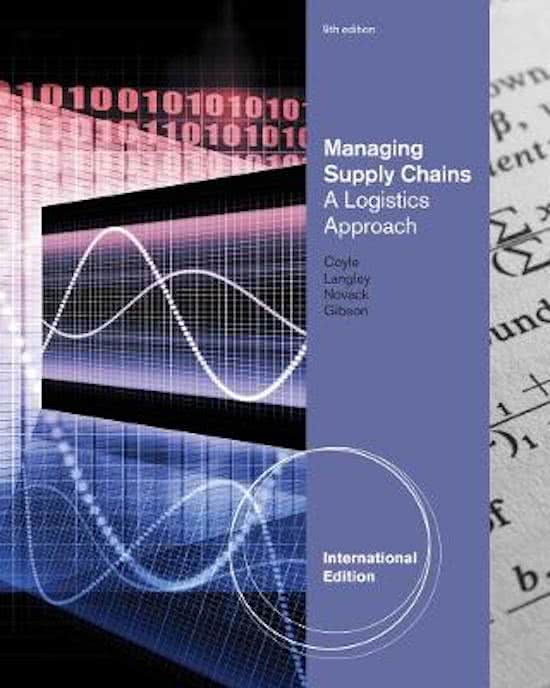
TEST BANK FOR MANAGING SUPPLY
CHAIN A LOGISTIC APPROACH
INTERNATIONAL 9TH EDITION BY
COYLE 2025/2026 A+
1-1
© 2013 Cengage Learning. All Rights Reserved. This edition is intended for use outside of the U.S. only, with content that may be different
from the U.S. Edition. May not be scanned, copied, duplicated, or posted to a publicly accessible website, in whole or in part.
, [Type the document title]
TABLE OF CONTENT
1. Supply chain management: an overview.
2. Role of logistics in supply chain.
3. Global dimensions of supply chains.
4. Supply chain relationships.
5. Supply chain performance measurement and financial analysis.
6. Supply chain technology – managing information flows.
7. Demand management.
8. Order management and customer service.
9. Managing inventory in the supply chain.
10. Transportation – managing the flow of the supply chain.
11. Distribution – managing fulfillment operations.
12. Supply chain network analysis and design.
13. Sourcing materials and services.
14. Operations – producing goods and services.
15. Managing reverse flows in the supply chain.
16. Strategic challenges and change for supply chains.
1-2
© 2013 Cengage Learning. All Rights Reserved. This edition is intended for use outside of the U.S. only, with content that may be different
from the U.S. Edition. May not be scanned, copied, duplicated, or posted to a publicly accessible website, in whole or in part.
, [Type the document title]
CHAPTER 1 TEST QUESTIONS
True-False
1. The Last Decade Of The Twentieth Century Was A Period Of Rapid Change For Organizations,
Especially Businesses.
ANS: True
2. A Key Element In Wal-Mart's Ability To Discount Brand Name Products Was An Understanding Of The
Criticality Of Efficiency In Its Logistics And Supply Chain System.
ANS: True
3. Globalization Has Had Little Effect On Consumers.
ANS: False
4. Supply And Demand Has Become Less Volatile As Managers Become More Adept At Controlling
The Elements.
ANS: False
5. Outsourcing Is A Fairly New Concept.
ANS: False
6. SAB Should Examine Their Off-Shore Purchasing Policy, Even Though The Products Are Sourced From The
U.S.
ANS: True
7. The World Economy Still Favors The United States And European Countries, Even Though China And
India Can Participate In The Global Economy Much More Readily.
ANS: False
8. The U.S. Transportation System Was Deregulated In The 1930s And 1940s In Response To Economic
Conditions And World War 2.
ANS: False
1-3
© 2013 Cengage Learning. All Rights Reserved. This edition is intended for use outside of the U.S. only, with content that may be different
from the U.S. Edition. May not be scanned, copied, duplicated, or posted to a publicly accessible website, in whole or in part.
, [Type the document title]
9. Even Though There Are References To Supply Chain Management In The 1980s, SCM Did Not Capture The
Attention Of Senior-Level Management Until The 1990s.
ANS: True
10. Supply Chain Managers No Longer Need To Worry About Suboptimization In Light Of Today's Technology.
ANS: False
Multiple Choice
11. Most Retailers Are Essentially Supply Chain Companies Since
a. They Dominate The Consumer Market.
b. Own Their Warehouses And Trucks.
c. They Buy Products Produced By Others.
d. Engage In Off-Shore Sourcing.
ANS: C
12. Which Of The Below Is Not One Of The External Forces Driving The Rate Of Change And Shaping
Our Economic And Political Landscape?
a. Government Policy
b. Technology
c. Environmental Concerns
d. Globalization
ANS: C
13. Outsourcing Involves
a. Moving Company Facilities Away From The Home Office.
b. Hiring Foreign Nationals To Manage Parts Of The Business.
1-4
© 2013 Cengage Learning. All Rights Reserved. This edition is intended for use outside of the U.S. only, with content that may be different
from the U.S. Edition. May not be scanned, copied, duplicated, or posted to a publicly accessible website, in whole or in part.
TEST BANK FOR MANAGING SUPPLY
CHAIN A LOGISTIC APPROACH
INTERNATIONAL 9TH EDITION BY
COYLE 2025/2026 A+
1-1
© 2013 Cengage Learning. All Rights Reserved. This edition is intended for use outside of the U.S. only, with content that may be different
from the U.S. Edition. May not be scanned, copied, duplicated, or posted to a publicly accessible website, in whole or in part.
, [Type the document title]
TABLE OF CONTENT
1. Supply chain management: an overview.
2. Role of logistics in supply chain.
3. Global dimensions of supply chains.
4. Supply chain relationships.
5. Supply chain performance measurement and financial analysis.
6. Supply chain technology – managing information flows.
7. Demand management.
8. Order management and customer service.
9. Managing inventory in the supply chain.
10. Transportation – managing the flow of the supply chain.
11. Distribution – managing fulfillment operations.
12. Supply chain network analysis and design.
13. Sourcing materials and services.
14. Operations – producing goods and services.
15. Managing reverse flows in the supply chain.
16. Strategic challenges and change for supply chains.
1-2
© 2013 Cengage Learning. All Rights Reserved. This edition is intended for use outside of the U.S. only, with content that may be different
from the U.S. Edition. May not be scanned, copied, duplicated, or posted to a publicly accessible website, in whole or in part.
, [Type the document title]
CHAPTER 1 TEST QUESTIONS
True-False
1. The Last Decade Of The Twentieth Century Was A Period Of Rapid Change For Organizations,
Especially Businesses.
ANS: True
2. A Key Element In Wal-Mart's Ability To Discount Brand Name Products Was An Understanding Of The
Criticality Of Efficiency In Its Logistics And Supply Chain System.
ANS: True
3. Globalization Has Had Little Effect On Consumers.
ANS: False
4. Supply And Demand Has Become Less Volatile As Managers Become More Adept At Controlling
The Elements.
ANS: False
5. Outsourcing Is A Fairly New Concept.
ANS: False
6. SAB Should Examine Their Off-Shore Purchasing Policy, Even Though The Products Are Sourced From The
U.S.
ANS: True
7. The World Economy Still Favors The United States And European Countries, Even Though China And
India Can Participate In The Global Economy Much More Readily.
ANS: False
8. The U.S. Transportation System Was Deregulated In The 1930s And 1940s In Response To Economic
Conditions And World War 2.
ANS: False
1-3
© 2013 Cengage Learning. All Rights Reserved. This edition is intended for use outside of the U.S. only, with content that may be different
from the U.S. Edition. May not be scanned, copied, duplicated, or posted to a publicly accessible website, in whole or in part.
, [Type the document title]
9. Even Though There Are References To Supply Chain Management In The 1980s, SCM Did Not Capture The
Attention Of Senior-Level Management Until The 1990s.
ANS: True
10. Supply Chain Managers No Longer Need To Worry About Suboptimization In Light Of Today's Technology.
ANS: False
Multiple Choice
11. Most Retailers Are Essentially Supply Chain Companies Since
a. They Dominate The Consumer Market.
b. Own Their Warehouses And Trucks.
c. They Buy Products Produced By Others.
d. Engage In Off-Shore Sourcing.
ANS: C
12. Which Of The Below Is Not One Of The External Forces Driving The Rate Of Change And Shaping
Our Economic And Political Landscape?
a. Government Policy
b. Technology
c. Environmental Concerns
d. Globalization
ANS: C
13. Outsourcing Involves
a. Moving Company Facilities Away From The Home Office.
b. Hiring Foreign Nationals To Manage Parts Of The Business.
1-4
© 2013 Cengage Learning. All Rights Reserved. This edition is intended for use outside of the U.S. only, with content that may be different
from the U.S. Edition. May not be scanned, copied, duplicated, or posted to a publicly accessible website, in whole or in part.