
Ch 2. The Study of Chemistry
Study online at https://quizlet.com/_f5pvgs
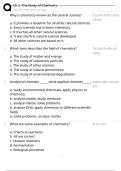
1. Why is chemistry known as the central science? It touches all other natural
sciences.
a. It provides a baseline for all other natural sciences.
b. Every scientist has to learn chemistry.
c. It touches all other natural sciences.
d. It was the first natural science developed
e. All other sciences are based on it.
2. Which best describes the field of chemistry? The study of matter and
energy
a. The study of matter and energy
b. The study of subatomic particles
c. The study of other sciences
d. The study of natural phenomena
e. The study of environmental degradation
3. Analytical chemists _____, while applied chemists _____. analyze matter, solve prob-
lems
a. study environmental chemicals, apply physics to
chemistry
b. analyze matter, study medicine
c. analyze matter, solve problems
d. analyze DNA, apply chemistry to different scientific
fields
e. solve problems, analyze matter
4. What are some examples of chemistry? All are correct
a. Chemical reactions.
b. All are correct
c. Nuclear reactions
d. Fermentation
e. Biological processes
1/8
, Ch 2. The Study of Chemistry
Study online at https://quizlet.com/_f5pvgs
5. The sub-fields of quantum mechanics, thermodynam- Physical chemistry
ics, and kinetics fall under which branch of chemistry?
a. Applied chemistry
b. Physical chemistry
c. Biochemistry
d. Geochemistry
e. Nuclear chemistry
6. Which of the following is a way that science has bene- All are correct
fited society?
a. Space travel
b. All are correct
c. Traveling farther and more easily.
d. Healthier, longer lives
e. More fuel-efficient vehicles
7. Which of the following is NOT a scientific field? All are scientific fields
a. All are scientific fields
b. Psychology
c. Sociology
d. Biology
e. Chemistry
8. How do satellites benefit society? They allow us to monitor
weather and storms
a. None are correct
b. They allow us to monitor weather and storms
c. They reduce pollution
2/8
Study online at https://quizlet.com/_f5pvgs
1. Why is chemistry known as the central science? It touches all other natural
sciences.
a. It provides a baseline for all other natural sciences.
b. Every scientist has to learn chemistry.
c. It touches all other natural sciences.
d. It was the first natural science developed
e. All other sciences are based on it.
2. Which best describes the field of chemistry? The study of matter and
energy
a. The study of matter and energy
b. The study of subatomic particles
c. The study of other sciences
d. The study of natural phenomena
e. The study of environmental degradation
3. Analytical chemists _____, while applied chemists _____. analyze matter, solve prob-
lems
a. study environmental chemicals, apply physics to
chemistry
b. analyze matter, study medicine
c. analyze matter, solve problems
d. analyze DNA, apply chemistry to different scientific
fields
e. solve problems, analyze matter
4. What are some examples of chemistry? All are correct
a. Chemical reactions.
b. All are correct
c. Nuclear reactions
d. Fermentation
e. Biological processes
1/8
, Ch 2. The Study of Chemistry
Study online at https://quizlet.com/_f5pvgs
5. The sub-fields of quantum mechanics, thermodynam- Physical chemistry
ics, and kinetics fall under which branch of chemistry?
a. Applied chemistry
b. Physical chemistry
c. Biochemistry
d. Geochemistry
e. Nuclear chemistry
6. Which of the following is a way that science has bene- All are correct
fited society?
a. Space travel
b. All are correct
c. Traveling farther and more easily.
d. Healthier, longer lives
e. More fuel-efficient vehicles
7. Which of the following is NOT a scientific field? All are scientific fields
a. All are scientific fields
b. Psychology
c. Sociology
d. Biology
e. Chemistry
8. How do satellites benefit society? They allow us to monitor
weather and storms
a. None are correct
b. They allow us to monitor weather and storms
c. They reduce pollution
2/8


