

NSG 3500 Unit 4, 5, & 6 Deep Dive
Unit 4
Stages of Labor
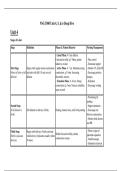
Stage Definition Phases & Patient Behavior Nursing Management
- Latent Phase: 0-3 cm dilation.
Contractions mild, q5–30min, patient - Pain control
talkative, excited. - Emotional support
First Stage Begins with regular uterine contractions - Active Phase: 4–7 cm. Moderate-strong - Monitor VS, fetal HR
(Onset of labor to full and ends with full (10 cm) cervical contractions, q3–5min. Increasing - Encourage position
dilation) dilation. discomfort, anxiety. changes
- Transition Phase: 8–10 cm. Strong - Hydration
contractions q2–3min. Nausea, irritability, - Encourage voiding
urges to push.
- Positioning for
pushing
Second Stage - Support perineum
(Full dilation to Full dilation to delivery of baby Pushing, intense focus, relief with pushing - Encourage rest
birth) between contractions
- Monitor fetal descent
and HR
Third Stage Begins with delivery of baby and ends - Observe signs of
Mother focused on baby, uterine placental separation
(Birth to placenta with delivery of placenta (usually within
contractions resume - Fundal massage
delivery) 30 mins)
- Administer oxytocin
, Stage Definition Phases & Patient Behavior Nursing Management
- Assess for
hemorrhage
- Monitor VS, lochia,
fundus
Fourth Stage - Skin-to-skin &
(Recovery - first 1–2 Initial postpartum recovery Bonding, fatigue, hunger, chills, cramping breastfeeding
hours after placenta) - Pain control
- Watch for
hemorrhage
Fetal Monitoring (EFM) & VEAL CHOP
Monitoring Type Details
Intermittent Auscultation Doppler/ fetoscope q15–30min during active labor, q5–15min during pushing
Continuous EFM External or internal; monitors fetal HR and contractions
Normal Baseline FHR 110–160 bpm
- Tachycardia: >160 bpm (caused by maternal fever, hypoxia)
Deviations
- Bradycardia: <110 bpm (cord compression, maternal hypotension)
VEAL CHOP Mnemonic:
EFM Change Definition Cause Nursing Management
Variable Abrupt ↓ in FHR Cord compression Reposition, amnioinfusion
Unit 4
Stages of Labor
Stage Definition Phases & Patient Behavior Nursing Management
- Latent Phase: 0-3 cm dilation.
Contractions mild, q5–30min, patient - Pain control
talkative, excited. - Emotional support
First Stage Begins with regular uterine contractions - Active Phase: 4–7 cm. Moderate-strong - Monitor VS, fetal HR
(Onset of labor to full and ends with full (10 cm) cervical contractions, q3–5min. Increasing - Encourage position
dilation) dilation. discomfort, anxiety. changes
- Transition Phase: 8–10 cm. Strong - Hydration
contractions q2–3min. Nausea, irritability, - Encourage voiding
urges to push.
- Positioning for
pushing
Second Stage - Support perineum
(Full dilation to Full dilation to delivery of baby Pushing, intense focus, relief with pushing - Encourage rest
birth) between contractions
- Monitor fetal descent
and HR
Third Stage Begins with delivery of baby and ends - Observe signs of
Mother focused on baby, uterine placental separation
(Birth to placenta with delivery of placenta (usually within
contractions resume - Fundal massage
delivery) 30 mins)
- Administer oxytocin
, Stage Definition Phases & Patient Behavior Nursing Management
- Assess for
hemorrhage
- Monitor VS, lochia,
fundus
Fourth Stage - Skin-to-skin &
(Recovery - first 1–2 Initial postpartum recovery Bonding, fatigue, hunger, chills, cramping breastfeeding
hours after placenta) - Pain control
- Watch for
hemorrhage
Fetal Monitoring (EFM) & VEAL CHOP
Monitoring Type Details
Intermittent Auscultation Doppler/ fetoscope q15–30min during active labor, q5–15min during pushing
Continuous EFM External or internal; monitors fetal HR and contractions
Normal Baseline FHR 110–160 bpm
- Tachycardia: >160 bpm (caused by maternal fever, hypoxia)
Deviations
- Bradycardia: <110 bpm (cord compression, maternal hypotension)
VEAL CHOP Mnemonic:
EFM Change Definition Cause Nursing Management
Variable Abrupt ↓ in FHR Cord compression Reposition, amnioinfusion


