Robbins & Cotran 10th Ed. Pathology Test Bank | Chapter-
by-Chapter Questions & Verified Solutions
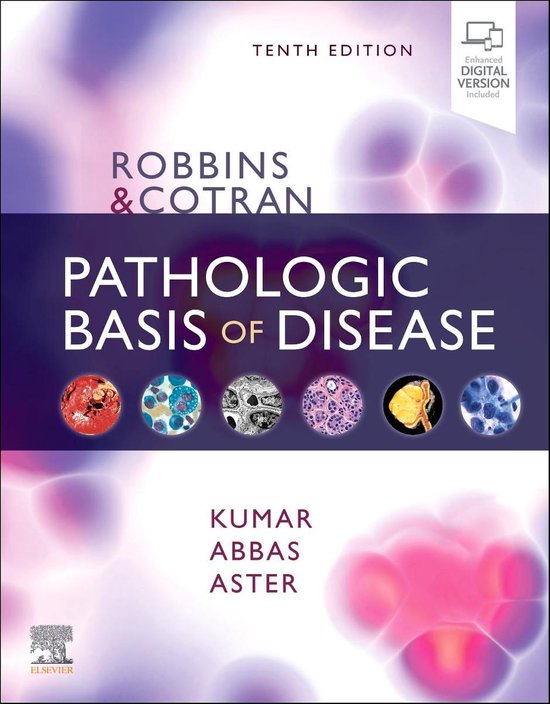
Robbins & Cotran Pathologic Basis of Disease
10th Edition
• Author(s)Vinay Kumar; Abul K. Abbas; Jon C. Aster
Chapter 1 — The Genome
Stem: A 32-year-old patient’s tumor sequencing shows a single-
nucleotide substitution that changes one amino acid in a key
enzyme without altering protein length. Which term best
describes this mutation?
A. Nonsense mutation
B. Missense mutation
C. Frameshift mutation
D. Silent mutation
Correct Answer: B. Missense mutation
Rationale (correct): A missense mutation is a point mutation
that substitutes one amino acid for another, altering protein
function without changing length — a classic description in
Robbins (Chapter 1, The Genome).
,A (wrong): Nonsense mutations introduce a premature stop
codon, shortening the protein; not described here.
C (wrong): Frameshift mutations result from
insertions/deletions shifting the reading frame and typically
alter many downstream amino acids.
D (wrong): Silent mutations change the DNA without altering
the encoded amino acid (no amino acid change), so protein
sequence stays the same.
Teaching Point: Missense mutations change an amino acid,
potentially altering protein function.
Citation: Robbins & Cotran, 10th Ed., Ch. 1 — The Genome.
2. Chapter 1 — The Genome
Stem: A patient has hereditary nonpolyposis colorectal cancer
(HNPCC) due to mismatch repair gene defects. Which cellular
process is primarily defective in these tumors?
A. Base-excision repair
B. Nucleotide-excision repair
C. DNA mismatch repair
D. Homologous recombination
Correct Answer: C. DNA mismatch repair
Rationale (correct): HNPCC (Lynch syndrome) is caused by
germline mutations in mismatch repair genes (e.g., MLH1,
MSH2), leading to microsatellite instability, as described in
Robbins.
,A (wrong): Base-excision repair corrects small base lesions from
oxidation/deamination, not the primary defect in HNPCC.
B (wrong): Nucleotide-excision repair fixes bulky DNA adducts
(e.g., UV-induced thymine dimers).
D (wrong): Homologous recombination repairs double-strand
breaks (e.g., BRCA-related defects), not mismatch repair.
Teaching Point: Mismatch repair defects cause microsatellite
instability in HNPCC.
Citation: Robbins & Cotran, 10th Ed., Ch. 1 — The Genome.
3. Chapter 1 — The Genome
Stem: An oncologist explains that promoter hypermethylation
silences tumor suppressor genes in some cancers. This is an
example of which mechanism?
A. DNA point mutation
B. Epigenetic modification
C. Chromosomal translocation
D. Frameshift insertion
Correct Answer: B. Epigenetic modification
Rationale (correct): Promoter methylation is an epigenetic
change that alters gene expression without changing DNA
sequence; Robbins discusses methylation as epigenetic
regulation relevant to cancer.
A (wrong): Point mutations alter DNA sequence directly;
methylation does not change sequence.
, C (wrong): Chromosomal translocations rearrange
chromosomal segments; different mechanism.
D (wrong): Frameshift insertions change the reading frame by
adding bases; unrelated to methylation.
Teaching Point: Epigenetic changes alter gene expression
without changing DNA sequence.
Citation: Robbins & Cotran, 10th Ed., Ch. 1 — The Genome.
4. Chapter 1 — Cellular Housekeeping
Stem: A patient’s cardiomyocytes accumulate ubiquitinated
misfolded proteins due to proteasome dysfunction. Which
intracellular pathway is primarily impaired?
A. Autophagy-lysosomal pathway
B. Ubiquitin–proteasome system
C. Endoplasmic reticulum-associated degradation via lysosomes
D. Phagocytosis
Correct Answer: B. Ubiquitin–proteasome system
Rationale (correct): The ubiquitin–proteasome system tags
misfolded proteins with ubiquitin for proteasomal degradation;
its failure leads to accumulation of ubiquitinated proteins as
noted in Robbins.
A (wrong): Autophagy handles larger structures and organelles
but ubiquitinated soluble proteins are mainly proteasome
substrates.
C (wrong): ER-associated degradation uses the proteasome (not
by-Chapter Questions & Verified Solutions
Robbins & Cotran Pathologic Basis of Disease
10th Edition
• Author(s)Vinay Kumar; Abul K. Abbas; Jon C. Aster
Chapter 1 — The Genome
Stem: A 32-year-old patient’s tumor sequencing shows a single-
nucleotide substitution that changes one amino acid in a key
enzyme without altering protein length. Which term best
describes this mutation?
A. Nonsense mutation
B. Missense mutation
C. Frameshift mutation
D. Silent mutation
Correct Answer: B. Missense mutation
Rationale (correct): A missense mutation is a point mutation
that substitutes one amino acid for another, altering protein
function without changing length — a classic description in
Robbins (Chapter 1, The Genome).
,A (wrong): Nonsense mutations introduce a premature stop
codon, shortening the protein; not described here.
C (wrong): Frameshift mutations result from
insertions/deletions shifting the reading frame and typically
alter many downstream amino acids.
D (wrong): Silent mutations change the DNA without altering
the encoded amino acid (no amino acid change), so protein
sequence stays the same.
Teaching Point: Missense mutations change an amino acid,
potentially altering protein function.
Citation: Robbins & Cotran, 10th Ed., Ch. 1 — The Genome.
2. Chapter 1 — The Genome
Stem: A patient has hereditary nonpolyposis colorectal cancer
(HNPCC) due to mismatch repair gene defects. Which cellular
process is primarily defective in these tumors?
A. Base-excision repair
B. Nucleotide-excision repair
C. DNA mismatch repair
D. Homologous recombination
Correct Answer: C. DNA mismatch repair
Rationale (correct): HNPCC (Lynch syndrome) is caused by
germline mutations in mismatch repair genes (e.g., MLH1,
MSH2), leading to microsatellite instability, as described in
Robbins.
,A (wrong): Base-excision repair corrects small base lesions from
oxidation/deamination, not the primary defect in HNPCC.
B (wrong): Nucleotide-excision repair fixes bulky DNA adducts
(e.g., UV-induced thymine dimers).
D (wrong): Homologous recombination repairs double-strand
breaks (e.g., BRCA-related defects), not mismatch repair.
Teaching Point: Mismatch repair defects cause microsatellite
instability in HNPCC.
Citation: Robbins & Cotran, 10th Ed., Ch. 1 — The Genome.
3. Chapter 1 — The Genome
Stem: An oncologist explains that promoter hypermethylation
silences tumor suppressor genes in some cancers. This is an
example of which mechanism?
A. DNA point mutation
B. Epigenetic modification
C. Chromosomal translocation
D. Frameshift insertion
Correct Answer: B. Epigenetic modification
Rationale (correct): Promoter methylation is an epigenetic
change that alters gene expression without changing DNA
sequence; Robbins discusses methylation as epigenetic
regulation relevant to cancer.
A (wrong): Point mutations alter DNA sequence directly;
methylation does not change sequence.
, C (wrong): Chromosomal translocations rearrange
chromosomal segments; different mechanism.
D (wrong): Frameshift insertions change the reading frame by
adding bases; unrelated to methylation.
Teaching Point: Epigenetic changes alter gene expression
without changing DNA sequence.
Citation: Robbins & Cotran, 10th Ed., Ch. 1 — The Genome.
4. Chapter 1 — Cellular Housekeeping
Stem: A patient’s cardiomyocytes accumulate ubiquitinated
misfolded proteins due to proteasome dysfunction. Which
intracellular pathway is primarily impaired?
A. Autophagy-lysosomal pathway
B. Ubiquitin–proteasome system
C. Endoplasmic reticulum-associated degradation via lysosomes
D. Phagocytosis
Correct Answer: B. Ubiquitin–proteasome system
Rationale (correct): The ubiquitin–proteasome system tags
misfolded proteins with ubiquitin for proteasomal degradation;
its failure leads to accumulation of ubiquitinated proteins as
noted in Robbins.
A (wrong): Autophagy handles larger structures and organelles
but ubiquitinated soluble proteins are mainly proteasome
substrates.
C (wrong): ER-associated degradation uses the proteasome (not