
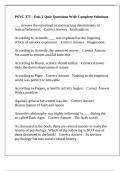
PSYC 375 - Unit 1 Quiz Questions With Complete Solutions
___ stresses the emotional or unconscious determinants of
human behaviour. Correct Answer Irrationalism
According to Aristotle, ___ was explained as the lingering
effects of sensory experience. Correct Answer Imagination
According to Aristotle, the unmoved mover: Correct Answer
Set nature in motion and did little else
According to Bacon, science should utilize: Correct Answer
Only the direct observation of nature
According to Plato: Correct Answer Nothing in the empirical
world was perfect or knowable
According to Popper, scientific activity begins: Correct Answer
With a problem
Aquina's great achievement was the: Correct Answer
Reconciliation of faith and reason
Aristotle's philosophy was highly influential in ___ during the
so-called Dark Ages. Correct Answer The Arab world
As discussed in the book, there are several reasons to study the
history of psychology. Which of the following is NOT one of
those discussed in the book? Correct Answer To see how
psychology fits into social/cultural history
___ stresses the emotional or unconscious determinants of
human behaviour. Correct Answer Irrationalism
According to Aristotle, ___ was explained as the lingering
effects of sensory experience. Correct Answer Imagination
According to Aristotle, the unmoved mover: Correct Answer
Set nature in motion and did little else
According to Bacon, science should utilize: Correct Answer
Only the direct observation of nature
According to Plato: Correct Answer Nothing in the empirical
world was perfect or knowable
According to Popper, scientific activity begins: Correct Answer
With a problem
Aquina's great achievement was the: Correct Answer
Reconciliation of faith and reason
Aristotle's philosophy was highly influential in ___ during the
so-called Dark Ages. Correct Answer The Arab world
As discussed in the book, there are several reasons to study the
history of psychology. Which of the following is NOT one of
those discussed in the book? Correct Answer To see how
psychology fits into social/cultural history


