

Written by students who passed Immediately available after payment Read online or as PDF Wrong document? Swap it for free 4.6 TrustPilot
logo-home
Document preview thumbnail
Preview 2 out of 7 pages
Exam (elaborations)

BIO 169 Final Exam 2025

Document preview thumbnail
Preview 2 out of 7 pages

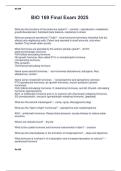
BIO 169 Final Exam 2025 What are the functions of the endocrine system? - -controls - reproduction, metabolism, growth/development, fluid/electrolyte balance, resistance to stress What are paracrine secretions? Traits? - -local hormone that enters interstitial fluid but affects only neighboring cells. Potent and secreted in small amounts, only when needed. They break down quickly. What hormones are secreted by the anterior pituitary gland? - -ACTH adrenocorticotropic hormone. FSH-follicle-stimulating hormone. GH-growth hormone. Also called STH, or somatotrophic hormone. LH-luteinizing hormone. PRL-prolactin. TSH-thyroid-stimulating hormone Name some steroid hormones. - -sex hormones-testosterone, estrogens. Also, aldosterone, cortisol. Name some nonsteroid hormones. - -norepinephrine and epinephrine (amines) PTH (parathyroid hormone), gh (growth hormone), and prl (prolactin) (protein hormones) FHS (follicle stimulating hormone), lh (luteinizing hormone), and tsh (thyroid- stimulating hormone).(glycoproteins) ADH, or antidiuretic hormone and ot, or oxytocin),(trh (thyrotropin-releasing hormone), SS (somastostatin), and gnrh (gonadotropin-releasing hormone). (peptides) What are the second messengers? - -camp, cgmp, diacylglycerol (dag) What are the "fight-or-flight" hormones? - -epinephrine and norephinephrine ADH - -antiduiretic hormone. Raises blood pressure, causes kidneys to reduce water excretion. Where are colloids found? - -thyroid What is the cuddle hormone and hormone instrumental in labor? - -oxytocin What are the intermediaries in the formation of norepinephrine? - -dopa and dopamine What hormone is involved in vit d absorption and increased absorption of calcium? - parathyroid hormone Bio169 Bio169 What hormones determine basal metabolic rate? - -T3 and t4 What hormone is responsible for the biological clock? - -melatonin ADH hormone is released from the ___. - -pituitary gland What is the hormone that causes the kidney to secrete na and excrete k and cause water retention? - -aldosterone What is calcitonin secreted by? - -thyroid gland Type ii diabetes - -maturity onset diabetes. Happens later in life. Non-insulin-dependent diabetes. Loss of insulin receptors. Associated with obesity. Type i diabetes - -an autoimmune disorder where immune system attacks beta cells of pancreas. Insulin cannot be produced. Juvenile diabetes. Diabetes insipidus - -body is not producing or responding to adh. Impairs regulation of water balance. Lots of urine. Dehydration. What is the fight-or-flight gland and what part of nervous system is involved? - -adrenal gland, sympathetic nervous system What hormone lowers blood calcium and phosphate ion levels and stimulates bone formation? - -calcitonin Name characteristics of RBCS. - -life span of about 120 days. Lose nucleus during development, so they cannot make proteins or divide. Produce atp through glycolysis only. RBCS wear out the liver and spleen dispose of them. Platelets - -also called thrombocytes. Large cytoplasm fragments of megakaryocytes that shrink. Diagenesis - -passage of white blood cells through intact capillary walls and into the surrounding tissue Agglutination - -causes chest pain, difficulty breathing Fibrin - -forms meshwork to trap blood cells, platelets to form blood clot. What is associated with intrinsic clotting mechanism only? - -hageman factor What is associated with blood clot dissolution? - -plasminogen RBCC - -red blood cell count. Tests oxygen carrying capacity of blood. Bio169 PTT - -prothrombin time. Tests clotting time Which does not refer to antigens on rbcs? - -o What phagocytizes bacteria? - -neutrophils What is responsible for colloidal osmotic pressure? - -albumins What transports lipids? - -alpha and beta globulins Heparine and histamine are associated with ___. - -basophils What is the most abundant electrolyte in plasma? - -NA Steps in blood clot formation - -vessel spasm. Platelet plug formation. Blood coagulation. Prothrombin converted into thrombin, which converts fibrinogen into fibrin. Fibrin threads form a mesh or clot. S-a node - -the cardiac pacemaker A-v node - -conduction between atrial and ventricular syncytia Mitral valve - -prevents backflow into left atria Tricuspid valve - -prevents backflow of blood into right atria What are the layers of the heart? - -outer epicardium, middle myocardium, inner endocardium What does the right ventricle do? - -pumps deoxygenated blood to lungs Characteristics of veins - -larger lumens, valves, thinner muscular walls. Coronary arteries - -supply blood to heart muscle QRS wave - -depolarization of ventricular fibers that will lead to contraction of ventricles. P wave - -depolarization of atrial fibers that will lead to contraction of atria. T wave - -slow repolarization of ventricular fibers What maintains osmotic pressure in capillaries? - -plasma proteins Chordate tendinae - -prevents valves from swinging into aorta Bio169 Bio169 Bio169 Type o - -universal donor. Has neither antigen a or antigen b. Has both anti-a and anti-b antigens. Ventricular systole - -the contraction of both right and left ventricles. Associated with atrial diastole, bp generation. Not associated with semilunar valve closing. What is the cardiac control center? - -medulla oblongata Minimal arterial bp - -diastolic bp Sympathetic nervous system is involved with ___. - -fight or flight response Parasympathetic nervous system is involved with ___. - -braking action of heart Is the aortic valve 1 of 2 av valves? - -no What are the functions of the lymphatic system? - -moves excess tissue fluid to blood, defends against infectious microbes, lipid absorption What do lymph nodes do? - -immune surveillance What do plasma cells do? - -produce antibodies Iga - -found in exocrine secretions (breast milk, nasal fluids, tears, etc.) Defends against bacteria and viruses. Igd - -activates b cells. On the surfaces of most b cells. Igg - -effective against bacteria, viruses, and toxins. Found in plasma and tissue fluids. Activates complement. Where is the portal vein found? - -liver Second line of defense - -chemical barriers like gastric juice, interferons, defensins, colletins, complement, nk cells, inflammation, phagocytosis, fever. B cells - -originate in red bone marrow. Primary location is lymphatic tissues; 20-30% of circulating lymphocytes in blood. Act indirectly by producing antibodies that destroy antigens or antigen-bearing agents. Lymph flow - -capillaries to vessels to lymph nodes to trunk to collecting ducts to subclavian vein T cells - -originate in red bone marrow but differentiate in thymus. Found in lymphatic tissues; 70-80% of circulating lymphocytes in blood. Act directly to destroy antigens or antigen-bearing agents. Bio169 Bio169 Naturally acquired passive immunity - -short-term immunity for newborns. Antibodies pass to fetus from mother with active immunity or to newborn through breast milk. Artificially acquired passive immunity - -injection of antibodies or antitoxin. The recipient's cells do not produce the antibody. Naturally acquired active immunity - -immunity that develops after a primary immune response. Artificially acquired active immunity - -a vaccine, or preparation that includes an antigen that can stimulate a primary immune response against a particular pathogen but does not produce symptoms of the associated infectious disease. Cytokines - -chemicals released by t helper cells that enhance cellular response to antigens Interferon - -secreted by t cells. Block viral replication, stimulate macrophages, stimulate b cells to produce antibodies, attack cancer cells Interleukin-2 - -casues t cells to proliferate. Complement - -group of proteins in plasma that interact in a cascade as part of immune response. Stimulates inflammation, attracts phagocytes, enhances phagocytosis. What is the structure of an antibody molecule? - -4 chains that form y shape structure Cytotoxic t cell - -t cell that recognizes and combines with nonself antigens that cancerous or virally infected cells display on their surfaces. They release perforin to destroy these cells. Bile and digestive juices empty into what part of intestines? - -duodenum What are the functions of the liver? - -carbohydrate, lipid, and protein metabolism; storage; blood filtering; detoxification; secretion What are the functions of the small intestine? - -receives secretions from pancreas and liver, completes digestion of nutrieints in chyme, absorbs products of digestion, transports remaining residue to large intestine. What converts trypsinogen to trypsin? - -enterokinase What does bile do? - -breaks down fats Gastrin - -hormone produced in the stomach wall that stimulates sustained secretion of gastric juice Bio169 Bio169 Intrinsic factor - -a substance produced by the mucosa of the stomach and intestines that is essential for the absorption of vitamin b12. Peptidase - -breaks down peptides into amino acids Cholecystokinin (CCK) - -hormone in intestinal wall cells secreted in response to proteins and fats in small intestine. Decreases secretory activity of gastric glands and inhibits gastric motility;stimulates pancreas to secrete fluid with a high digestive enzyme concentration; stimulates gallbladder to release bile. Trypsin - -an enzyme from the pancreas that digests proteins in the small intestine. Activates other pancreatic enzymes. What are the intestinal enzymes? - -peptidase, sucrase, maltase, lactase, intestinal lipase, enterokinase Function of large intestines? - -absorbs water and electrolytes remaining in alimentary canal. Resorbs and recycles water and digestive secretions. Stores feces. Tv - -tidal volume. The volume of air that enters or leaves during a respiratory cycle. Irv - -inspiratory reserve volume. A volume of air in addition to the resting tidal volume during a forced maximal inspiration. Erv - -expiratory reserve volume. A volume of air in addition to the resting tidal volume during a forced maximal expiration. Vc - -vital capacity. Inspiratory reserve volume + tidal volume + expiratory reserve volume. Rv - -residual volume. Air remaining in lungs even after the most forceful expiration. Ic - -inspiratory capacity. Tidal volume + inspiratory reserve volume. Tlv - -total lung volume. Total volume of air that the lungs can hold. Vital capacity + residual volume. Minute ventilation - -tidal volume x respiratory rate Physiological dead space - -combination of anatomical dead space and alveoli that do not contribute normally to blood gas exchange Respiratory acidosis - -abnormal condition characterized by increased arterial carbon dioxide concentration, excess carbonic acid, and increased hydrogen ion concentration. 7.35 ph. Drowsiness, disorientation, stupor.

Content preview

Bio169


BIO 169 Final Exam 2025

What are the functions of the endocrine system? - -controls - reproduction, metabolism,
growth/development, fluid/electrolyte balance, resistance to stress

What are paracrine secretions? Traits? - -local hormone that enters interstitial fluid but
affects only neighboring cells. Potent and secreted in small amounts, only when
needed. They break down quickly.

What hormones are secreted by the anterior pituitary gland? - -ACTH-
adrenocorticotropic hormone.
FSH-follicle-stimulating hormone.
GH-growth hormone. Also called STH, or somatotrophic hormone.
LH-luteinizing hormone.
PRL-prolactin.
TSH-thyroid-stimulating hormone

Name some steroid hormones. - -sex hormones-testosterone, estrogens. Also,
aldosterone, cortisol.

Name some nonsteroid hormones. - -norepinephrine and epinephrine (amines)
PTH (parathyroid hormone), gh (growth hormone), and prl (prolactin) (protein
hormones)
FHS (follicle stimulating hormone), lh (luteinizing hormone), and tsh (thyroid- stimulating
hormone).(glycoproteins)
ADH, or antidiuretic hormone and ot, or oxytocin),(trh (thyrotropin-releasing hormone),
SS (somastostatin), and gnrh (gonadotropin-releasing hormone). (peptides)

What are the second messengers? - -camp, cgmp, diacylglycerol (dag)

What are the "fight-or-flight" hormones? - -epinephrine and norephinephrine

ADH - -antiduiretic hormone. Raises blood pressure, causes kidneys to reduce water
excretion.

Where are colloids found? - -thyroid

What is the cuddle hormone and hormone instrumental in labor? - -oxytocin

What are the intermediaries in the formation of norepinephrine? - -dopa and dopamine

What hormone is involved in vit d absorption and increased absorption of calcium? - -
parathyroid hormone


Bio169

, Bio169


What hormones determine basal metabolic rate? - -T3 and t4

What hormone is responsible for the biological clock? - -melatonin

ADH hormone is released from the ___. - -pituitary gland

What is the hormone that causes the kidney to secrete na and excrete k and cause
water retention? - -aldosterone

What is calcitonin secreted by? - -thyroid gland

Type ii diabetes - -maturity onset diabetes. Happens later in life. Non-insulin-dependent
diabetes. Loss of insulin receptors. Associated with obesity.

Type i diabetes - -an autoimmune disorder where immune system attacks beta cells of
pancreas. Insulin cannot be produced. Juvenile diabetes.

Diabetes insipidus - -body is not producing or responding to adh. Impairs regulation of
water balance. Lots of urine. Dehydration.

What is the fight-or-flight gland and what part of nervous system is involved? - -adrenal
gland, sympathetic nervous system

What hormone lowers blood calcium and phosphate ion levels and stimulates bone
formation? - -calcitonin

Name characteristics of RBCS. - -life span of about 120 days. Lose nucleus during
development, so they cannot make proteins or divide. Produce atp through glycolysis
only. RBCS wear out the liver and spleen dispose of them.

Platelets - -also called thrombocytes. Large cytoplasm fragments of megakaryocytes
that shrink.

Diagenesis - -passage of white blood cells through intact capillary walls and into the
surrounding tissue

Agglutination - -causes chest pain, difficulty breathing

Fibrin - -forms meshwork to trap blood cells, platelets to form blood clot.

What is associated with intrinsic clotting mechanism only? - -hageman factor

What is associated with blood clot dissolution? - -plasminogen

RBCC - -red blood cell count. Tests oxygen carrying capacity of blood.


Bio169

Document information

Uploaded on
September 25, 2025
Number of pages
7
Written in
2025/2026
Type
Exam (elaborations)
Contains
Questions & answers
$16.49

Wrong document? Swap it for free Within 14 days of purchase and before downloading, you can choose a different document. You can simply spend the amount again.
Written by students who passed
Immediately available after payment
Read online or as PDF

Seller avatar
Reputation scores are based on the amount of documents a seller has sold for a fee and the reviews they have received for those documents. There are three levels: Bronze, Silver and Gold. The better the reputation, the more your can rely on the quality of the sellers work.
AlexScorer
2.5
(2)
Sold
11
Followers
0
Items
1800
Last sold
2 weeks ago


Why students choose Stuvia

Created by fellow students, verified by reviews

Quality you can trust: written by students who passed their tests and reviewed by others who've used these notes.

Didn't get what you expected? Choose another document

No worries! You can instantly pick a different document that better fits what you're looking for.

Pay as you like, start learning right away

No subscription, no commitments. Pay the way you're used to via credit card and download your PDF document instantly.

Student with book image

“Bought, downloaded, and aced it. It really can be that simple.”

Alisha Student

Working on your references?

Create accurate citations in APA, MLA and Harvard with our free citation generator.

Working on your references?

Frequently asked questions
