

d027
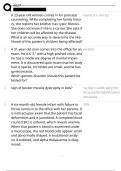
1. A 23-year-old woman comes in for prenatal A genetic or a carrier test
counseling. While completing her family histo-
ry, she reports her brother has cystic fibrosis.
She does not know if she is a carrier. She asks if
her children will be affected by the disease.
What is an accurate way to determine the like-
lihood of this patient's children being affected?
2. A 31-year-old man comes into the office for an kleinfelters
exam. He is 6' 5 " with a high-pitched voice, and
he has a moderate degree of mental impair-
ment. It is discovered upon exam that his body
hair is sparse, his testes are small, and he has
gynecomastia.
Which genetic disorder should this patient be
tested for?
3. sign of becker muscle dystrophy in kids? may begin to waddle, walk on their
toes or push their abdomen forward
when walking
4. A six-month-old female infant with failure to 100%
thrive comes in to the office with her parents. It
is noticed upon exam that the patient has facial
deformities and is jaundiced. A complete blood
count (CBC) is ordered, which reveals anemia.
When that patient's blood is examined under
a microscope, the red blood cells appear small
and abnormally shaped. A mutational analy-
sis is ordered, and alpha thalassemia is diag-
nosed.
, d027
What is the likelihood of incidence of these par-
ent's future children having alpha thalassemia?
5. A 64-year-old male truck driver comes in com- Doppler U/S
plaining of pain in his lower left calf. He states
he drives eight to ten hours per day. Upon
exam, swelling and mottled coloring are noted
in the patient's calf. A D-dimer test is ordered
and comes back positive.
Which additional test should be ordered to con-
firm a diagnosis in this patient?
6. A 54-year-old man comes into a clinic for a rou- Completing an ambulatory blood
tine visit. His initial BP is 148/92. After a recheck pressure assessment
15 minutes later, his BP is 140/90. He states
he suffers from "white coat hypertension." He
states he has no history of high blood pressure
and no family history of high blood pressure.
Which nursing intervention would assist this
patient in receiving a clinical diagnosis of hyper-
tension?
7. A 58-year-old woman comes in complaining Lupus
of retrosternal chest pain, worsening with re-
cumbent position. She states she has had a
low-grade fever for two days. Upon exam, the
patient has a friction rub. An EKG reveals sinus
tachycardia with inflammatory changes. An ul-
trasound is performed, and she is diagnosed
with an acute pericarditis.
Which condition would make pericarditis more
likely in this patient?
, d027
8. A 54-year-old Caucasian man comes in for a lab Lipitor 20 mg
review. His lipids reveal an LDL of 180, an HDL of
52, and triglycerides of 326. He has no history of
atherosclerotic cardiovascular disease (ASCVD)
or diabetes. His blood pressure is 118/64. He
has a pulse rate of 64, and he weighs 320 lb. He
smokes one pack of cigarettes per day, and his
ASCVD risk score is 12.8.
Which medication should this patient be start-
ed on?
9. A 73-year-old man with Systolic congestive Stop angiotensin receptor blockers
heart failure (CHF) with reduced ejection frac- (ARB) and add sacubitril/valsartan
tion (HFrEF) comes to a clinic complaining of (Entresto), if BNP high replace ARB
shortness of breath. He is currently taking 6.25 w/ ACE or ARNI
mg carvedilol (Coreg) twice a day and 50 mg
losartan (Cozaar) and 20 mg furosemide (Lasix)
daily. His oxygen saturation is 95%, and he has
a pulse of 64. His BP is 138/82, and his BNP is
1150.
Using the 2017 heart failure guidelines, which
medication change should be recommended
for this patient?
10. A 78-year-old man comes in with stable angina. BBs, BB contraindicated in pts w/
He reports he has been having more angina re- COPD/ asthma
cently. He is currently taking the following med-
ications: lisinopril (Zestril), atorvastatin (Lipi-
tor), aspirin, and nitrostat PRN for chest pain.
He has a history of COPD with bronchospasm.
His blood pressure is 145/88, and he has a pulse
, d027
of 74.
Which class of medications should be avoided
for this patient?
11. A 45-year-old Muslim woman presents to a clin- Start metformin XR (Glucophage XR)
ic for an intervention for her type 2 diabetes. 250 mg once a day and reevaluate
She is prescribed metformin (Glucophage) 500 after Ramadan
mg BID. During a follow-up phone call a week
later, it is discovered she has not been taking
the metformin. A second visit is scheduled. Dur-
ing this visit, she states that she cannot take
the medication as prescribed because it is Ra-
madan, a month-long period of religious obser-
vances. Due to her religious beliefs, she fasts
from dawn to sunset. When the pharmacist told
her to take metformin with breakfast and din-
ner, she decided not to start the medication due
to her fasting.
Which nursing intervention should be made for
this patient?
12. A 45-year-old Jewish man is visiting a clinic While insulin did have porcine
for an adjustment of his diabetes medications. sources in the past, it is now synthet-
Though the patient is taking oral medications, ically made.
his blood sugar levels continue to increase, and
a decision is made to start him on insulin. Al-
though the patient is comfortable with the con-
cept of starting insulin, he is concerned with
the formulation of the insulin saying, "I heard
insulin was made from pigs. If that is the case,
I cannot take it due to my faith."
Which response should be given to this patient?
1. A 23-year-old woman comes in for prenatal A genetic or a carrier test
counseling. While completing her family histo-
ry, she reports her brother has cystic fibrosis.
She does not know if she is a carrier. She asks if
her children will be affected by the disease.
What is an accurate way to determine the like-
lihood of this patient's children being affected?
2. A 31-year-old man comes into the office for an kleinfelters
exam. He is 6' 5 " with a high-pitched voice, and
he has a moderate degree of mental impair-
ment. It is discovered upon exam that his body
hair is sparse, his testes are small, and he has
gynecomastia.
Which genetic disorder should this patient be
tested for?
3. sign of becker muscle dystrophy in kids? may begin to waddle, walk on their
toes or push their abdomen forward
when walking
4. A six-month-old female infant with failure to 100%
thrive comes in to the office with her parents. It
is noticed upon exam that the patient has facial
deformities and is jaundiced. A complete blood
count (CBC) is ordered, which reveals anemia.
When that patient's blood is examined under
a microscope, the red blood cells appear small
and abnormally shaped. A mutational analy-
sis is ordered, and alpha thalassemia is diag-
nosed.
, d027
What is the likelihood of incidence of these par-
ent's future children having alpha thalassemia?
5. A 64-year-old male truck driver comes in com- Doppler U/S
plaining of pain in his lower left calf. He states
he drives eight to ten hours per day. Upon
exam, swelling and mottled coloring are noted
in the patient's calf. A D-dimer test is ordered
and comes back positive.
Which additional test should be ordered to con-
firm a diagnosis in this patient?
6. A 54-year-old man comes into a clinic for a rou- Completing an ambulatory blood
tine visit. His initial BP is 148/92. After a recheck pressure assessment
15 minutes later, his BP is 140/90. He states
he suffers from "white coat hypertension." He
states he has no history of high blood pressure
and no family history of high blood pressure.
Which nursing intervention would assist this
patient in receiving a clinical diagnosis of hyper-
tension?
7. A 58-year-old woman comes in complaining Lupus
of retrosternal chest pain, worsening with re-
cumbent position. She states she has had a
low-grade fever for two days. Upon exam, the
patient has a friction rub. An EKG reveals sinus
tachycardia with inflammatory changes. An ul-
trasound is performed, and she is diagnosed
with an acute pericarditis.
Which condition would make pericarditis more
likely in this patient?
, d027
8. A 54-year-old Caucasian man comes in for a lab Lipitor 20 mg
review. His lipids reveal an LDL of 180, an HDL of
52, and triglycerides of 326. He has no history of
atherosclerotic cardiovascular disease (ASCVD)
or diabetes. His blood pressure is 118/64. He
has a pulse rate of 64, and he weighs 320 lb. He
smokes one pack of cigarettes per day, and his
ASCVD risk score is 12.8.
Which medication should this patient be start-
ed on?
9. A 73-year-old man with Systolic congestive Stop angiotensin receptor blockers
heart failure (CHF) with reduced ejection frac- (ARB) and add sacubitril/valsartan
tion (HFrEF) comes to a clinic complaining of (Entresto), if BNP high replace ARB
shortness of breath. He is currently taking 6.25 w/ ACE or ARNI
mg carvedilol (Coreg) twice a day and 50 mg
losartan (Cozaar) and 20 mg furosemide (Lasix)
daily. His oxygen saturation is 95%, and he has
a pulse of 64. His BP is 138/82, and his BNP is
1150.
Using the 2017 heart failure guidelines, which
medication change should be recommended
for this patient?
10. A 78-year-old man comes in with stable angina. BBs, BB contraindicated in pts w/
He reports he has been having more angina re- COPD/ asthma
cently. He is currently taking the following med-
ications: lisinopril (Zestril), atorvastatin (Lipi-
tor), aspirin, and nitrostat PRN for chest pain.
He has a history of COPD with bronchospasm.
His blood pressure is 145/88, and he has a pulse
, d027
of 74.
Which class of medications should be avoided
for this patient?
11. A 45-year-old Muslim woman presents to a clin- Start metformin XR (Glucophage XR)
ic for an intervention for her type 2 diabetes. 250 mg once a day and reevaluate
She is prescribed metformin (Glucophage) 500 after Ramadan
mg BID. During a follow-up phone call a week
later, it is discovered she has not been taking
the metformin. A second visit is scheduled. Dur-
ing this visit, she states that she cannot take
the medication as prescribed because it is Ra-
madan, a month-long period of religious obser-
vances. Due to her religious beliefs, she fasts
from dawn to sunset. When the pharmacist told
her to take metformin with breakfast and din-
ner, she decided not to start the medication due
to her fasting.
Which nursing intervention should be made for
this patient?
12. A 45-year-old Jewish man is visiting a clinic While insulin did have porcine
for an adjustment of his diabetes medications. sources in the past, it is now synthet-
Though the patient is taking oral medications, ically made.
his blood sugar levels continue to increase, and
a decision is made to start him on insulin. Al-
though the patient is comfortable with the con-
cept of starting insulin, he is concerned with
the formulation of the insulin saying, "I heard
insulin was made from pigs. If that is the case,
I cannot take it due to my faith."
Which response should be given to this patient?


