GNRS 555: Respiratory - Questions With Correct
Solutions
Save
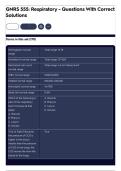
Terms in this set (170)
Hemoglobin normal Total range: 12-18
range
Hematocrit normal range Total range: 37-52%
Red blood cell count Total range: 4.2-6.1 million/mm3
normal range
WBC normal range 5,000-10,000
Platelet normal range 150,000-400,000
Neutrophil normal range 46-78%
Band cell normal range 0-6%
Which of the following is A. Bronchi
part of the respiratory B. Pharynx
tract? Choose all that C. Larynx
apply D. Sinuses
A. Bronchi
B. Pharynx
C. Larynx
D. Sinuses
True or False? Because True
the pressure of CO2 is
higher in the blood
vessels than the pressure
of CO2 in the lungs, the
CO2 moves the from the
blood to the lungs.
,Which of the following B. Too much carbon dioxide in the blood stream
would cause the medulla
oblongata to increase the
respiratory rate?
A. Too much oxygen in
the blood stream
B. Too much carbon
dioxide in the blood
stream
C. Decrease in metabolic
needs
The functional unit of the The alveolus (alveoli)
respiratory system is____?
,A patient with acute D. Perform a respiratory system assessment and ask
shortness of breath is specific questions about this episode of respiratory
admitted to the hospital. distress
Which action should the
nurse take during the
initial assessment of the
patient?
A. Complete a full
physical examination to
determine the systemic
effect of the respiratory
distress
B. Obtain a
comprehensive health
history to determine the
extent of any prior
respiratory problems
C. Delay the physical
assessment and ask
family members about
any history of respiratory
problems
D. Perform a respiratory
system assessment and
ask specific questions
about this episode of
respiratory distress
, On auscultation of a B. Expiratory wheezes in both lungs
patient's lungs, you hear
short, high-pitched
sounds during exhalation
in the lower 1/3 of both
lungs. You should record
this finding as:
A. Expiratory crackles at
the bases
B. Expiratory wheezes in
both lungs
C. Abnormal lung sounds
in the bases of both
lungs
D. Pleural friction rub in
the right and left lower
lobes
What do each of the -Wheezes: high-pitched
abnormal lung sounds -Crackles: low-pitched "bubbling" sounds
sound like? -Pleural friction rub: grating sounds
-Wheezes -Stridor: loud low-pitched sound during inspiration,
-Crackles seal-like
-Pleural friction rub
-Stridor
You palpate the posterior C. Absent tactile fremitus
chest while the patient
says "99" and note that
no vibration is felt. How
should this be charted?
A. Diminished expansion
B. Dullness to percussion
C. Absent tactile fremitus
D. Decreased breath
sounds
Solutions
Save
Terms in this set (170)
Hemoglobin normal Total range: 12-18
range
Hematocrit normal range Total range: 37-52%
Red blood cell count Total range: 4.2-6.1 million/mm3
normal range
WBC normal range 5,000-10,000
Platelet normal range 150,000-400,000
Neutrophil normal range 46-78%
Band cell normal range 0-6%
Which of the following is A. Bronchi
part of the respiratory B. Pharynx
tract? Choose all that C. Larynx
apply D. Sinuses
A. Bronchi
B. Pharynx
C. Larynx
D. Sinuses
True or False? Because True
the pressure of CO2 is
higher in the blood
vessels than the pressure
of CO2 in the lungs, the
CO2 moves the from the
blood to the lungs.
,Which of the following B. Too much carbon dioxide in the blood stream
would cause the medulla
oblongata to increase the
respiratory rate?
A. Too much oxygen in
the blood stream
B. Too much carbon
dioxide in the blood
stream
C. Decrease in metabolic
needs
The functional unit of the The alveolus (alveoli)
respiratory system is____?
,A patient with acute D. Perform a respiratory system assessment and ask
shortness of breath is specific questions about this episode of respiratory
admitted to the hospital. distress
Which action should the
nurse take during the
initial assessment of the
patient?
A. Complete a full
physical examination to
determine the systemic
effect of the respiratory
distress
B. Obtain a
comprehensive health
history to determine the
extent of any prior
respiratory problems
C. Delay the physical
assessment and ask
family members about
any history of respiratory
problems
D. Perform a respiratory
system assessment and
ask specific questions
about this episode of
respiratory distress
, On auscultation of a B. Expiratory wheezes in both lungs
patient's lungs, you hear
short, high-pitched
sounds during exhalation
in the lower 1/3 of both
lungs. You should record
this finding as:
A. Expiratory crackles at
the bases
B. Expiratory wheezes in
both lungs
C. Abnormal lung sounds
in the bases of both
lungs
D. Pleural friction rub in
the right and left lower
lobes
What do each of the -Wheezes: high-pitched
abnormal lung sounds -Crackles: low-pitched "bubbling" sounds
sound like? -Pleural friction rub: grating sounds
-Wheezes -Stridor: loud low-pitched sound during inspiration,
-Crackles seal-like
-Pleural friction rub
-Stridor
You palpate the posterior C. Absent tactile fremitus
chest while the patient
says "99" and note that
no vibration is felt. How
should this be charted?
A. Diminished expansion
B. Dullness to percussion
C. Absent tactile fremitus
D. Decreased breath
sounds