TCOLE BPOC: Victims of Crime Training
Guide.
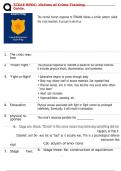
The normal human response to TRAUMA follows a similar pattern called
the crisis reaction. It occurs in all of us.
1. The crisis reac-
tion
2. "frozen fright." The physical response to TRAUMA is based on our animal instincts.
It includes physical shock, disorientation, and numbness:
3. "Fight-or-flight" • Adrenaline begins to pump through body
• Body may relieve itself of excess materials, like ingested food
• Physical senses, one or more, may become very acute while others
"shut down"
• Heart rate increases
• Hyperventilation, sweating, etc.
4. Exhaustion Physical arousal associated with fight or flight cannot be prolonged
indefinitely. Eventually, it will result in exhaustion.
5. physical re-
sponse The mind's response parallels the .
6. Stage one: Shock, "Denial" in this sense means truly believing something did not
happen, or that it
Disbelief, and De- was not as "bad" as it actually was. This is a psychological defense
mechanism that
nial Cat- aclysm of emo- tions
7. Stage two: 8. Stage three: Re- construction of equilibrium
1/
12
, TCOLE BPOC: Victims of Crime Training
Guide.
9. The Range of kicks in to protect a person from the full impact of what has happened.
the Crisis
Reaction:
Anger/RAGE, fear/TERROR, grief/SORROW, confusion/
FRUSTRATION, guilt/SELF-BLAME, and
violation/VULNERABILITY
Emotional roller coaster that eventually becomes balanced
• Shock
• Depression and loneliness
• Panic
2/
12
Guide.
The normal human response to TRAUMA follows a similar pattern called
the crisis reaction. It occurs in all of us.
1. The crisis reac-
tion
2. "frozen fright." The physical response to TRAUMA is based on our animal instincts.
It includes physical shock, disorientation, and numbness:
3. "Fight-or-flight" • Adrenaline begins to pump through body
• Body may relieve itself of excess materials, like ingested food
• Physical senses, one or more, may become very acute while others
"shut down"
• Heart rate increases
• Hyperventilation, sweating, etc.
4. Exhaustion Physical arousal associated with fight or flight cannot be prolonged
indefinitely. Eventually, it will result in exhaustion.
5. physical re-
sponse The mind's response parallels the .
6. Stage one: Shock, "Denial" in this sense means truly believing something did not
happen, or that it
Disbelief, and De- was not as "bad" as it actually was. This is a psychological defense
mechanism that
nial Cat- aclysm of emo- tions
7. Stage two: 8. Stage three: Re- construction of equilibrium
1/
12
, TCOLE BPOC: Victims of Crime Training
Guide.
9. The Range of kicks in to protect a person from the full impact of what has happened.
the Crisis
Reaction:
Anger/RAGE, fear/TERROR, grief/SORROW, confusion/
FRUSTRATION, guilt/SELF-BLAME, and
violation/VULNERABILITY
Emotional roller coaster that eventually becomes balanced
• Shock
• Depression and loneliness
• Panic
2/
12