TCOLE BPOC Criminal Investigations Study Guide.
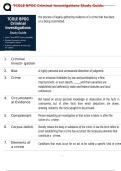
the process of legally gathering evidence of a crime that has been
or is being committed.
1. Criminal
Investi- gation
2. Bias A highly personal and unreasoned distortion of judgment.
3. Crime act or omission forbidden by law and punishable by a fine,
imprisonment, or even death. and their penalties are
established and defined by state and federal statutes and local
ordinances.
4. Circumstanti Not based on actual personal knowledge or observation of the facts in
al Evidence controversy, but of other facts from which deductions are drawn,
showing indirectly the facts sought to be proved.
5. Complainant Person requesting an investigation or that action is taken. Is often the
victim of a crime.
6. Corpus delicti literally means the body or substance of the crime. In law the term refers to
proof establishing that a crime has occurred; the necessary elements that
constitute a crime.
7. Elements of Conditions that must occur for an act to be called a specific kind of crime
a crime
, TCOLE BPOC Criminal Investigations Study Guide.
8. Evidence Anything to be ottered in court to prove the truth or falsity of a fact in
issue.
9. Fence One who receives and disposes of stolen property on a regular basis.
10. Field On-the-scene identification of a suspect by the victim of or witness to a
Identifica- crime, conducted within minutes of the commission of a crime.
tion
11. Prejudice An opinion or leaning adverse to anything without just grounds or
before obtain- ing suflcient knowledge.
12. A criminal's characteristic method of operation.
, TCOLE BPOC Criminal Investigations Study Guide.
Modus Operandi
(MO)
13. Rapport a felling of ease and harmony in a contact or relationship between people
14. Reasonabl The level of certainty a juror must have to find a defendant guilty of a
e Doubt crime.
15. Statement A legal narrative description of events related to a crime.
A broad term meaning simply oral or written declaration or assertion
16. Suspect A person considered to be directly or indirectly connected with a crime,
either by overt act or by planning and/or directing it.
17. Criminal • Information
Investi- gation • Instrumentation or forensic science
Tools
• Interviewing
• Laws of arrest, search and seizure
18. Information the knowledge a criminal investigator gathers from other persons (victims,
wit-
nesses, suspects) and other legitimate sources (records, reports, etc).
19. Interview the questioning of a person who has no personal reason to withhold
information and therefore may be expected to cooperate with the
investigator.
20. Interrogation the questioning of a suspect or other person who may normally be
expected to
be reluctant to divulge information concerning the ottense under investigation.
21. Goals of To determine if a crime has been committed;
Criminal To legally obtain information and evidence to identify the person(s)
Investigation
responsible for committing the crime.
To legally arrest the
, TCOLE BPOC Criminal Investigations Study Guide.
s operty; and
u To present the best case possible for prosecution.
s
p
e
c
t
(
s
)
;
T
o
r
e
c
o
v
e
r
s
t
o
l
e
n
p
r
the process of legally gathering evidence of a crime that has been
or is being committed.
1. Criminal
Investi- gation
2. Bias A highly personal and unreasoned distortion of judgment.
3. Crime act or omission forbidden by law and punishable by a fine,
imprisonment, or even death. and their penalties are
established and defined by state and federal statutes and local
ordinances.
4. Circumstanti Not based on actual personal knowledge or observation of the facts in
al Evidence controversy, but of other facts from which deductions are drawn,
showing indirectly the facts sought to be proved.
5. Complainant Person requesting an investigation or that action is taken. Is often the
victim of a crime.
6. Corpus delicti literally means the body or substance of the crime. In law the term refers to
proof establishing that a crime has occurred; the necessary elements that
constitute a crime.
7. Elements of Conditions that must occur for an act to be called a specific kind of crime
a crime
, TCOLE BPOC Criminal Investigations Study Guide.
8. Evidence Anything to be ottered in court to prove the truth or falsity of a fact in
issue.
9. Fence One who receives and disposes of stolen property on a regular basis.
10. Field On-the-scene identification of a suspect by the victim of or witness to a
Identifica- crime, conducted within minutes of the commission of a crime.
tion
11. Prejudice An opinion or leaning adverse to anything without just grounds or
before obtain- ing suflcient knowledge.
12. A criminal's characteristic method of operation.
, TCOLE BPOC Criminal Investigations Study Guide.
Modus Operandi
(MO)
13. Rapport a felling of ease and harmony in a contact or relationship between people
14. Reasonabl The level of certainty a juror must have to find a defendant guilty of a
e Doubt crime.
15. Statement A legal narrative description of events related to a crime.
A broad term meaning simply oral or written declaration or assertion
16. Suspect A person considered to be directly or indirectly connected with a crime,
either by overt act or by planning and/or directing it.
17. Criminal • Information
Investi- gation • Instrumentation or forensic science
Tools
• Interviewing
• Laws of arrest, search and seizure
18. Information the knowledge a criminal investigator gathers from other persons (victims,
wit-
nesses, suspects) and other legitimate sources (records, reports, etc).
19. Interview the questioning of a person who has no personal reason to withhold
information and therefore may be expected to cooperate with the
investigator.
20. Interrogation the questioning of a suspect or other person who may normally be
expected to
be reluctant to divulge information concerning the ottense under investigation.
21. Goals of To determine if a crime has been committed;
Criminal To legally obtain information and evidence to identify the person(s)
Investigation
responsible for committing the crime.
To legally arrest the
, TCOLE BPOC Criminal Investigations Study Guide.
s operty; and
u To present the best case possible for prosecution.
s
p
e
c
t
(
s
)
;
T
o
r
e
c
o
v
e
r
s
t
o
l
e
n
p
r