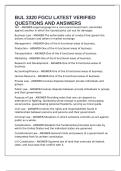
BUL 3320 FGCU LATEST VERIFIED
QUESTIONS AND ANSWERS
Tort - ANSWER-Legal language for a civil (noncriminal) harm committed
against another in which the injured party can sue for damages.
Business Law - ANSWER-The enforceable rules of conduct that govern the
actions of buyers and sellers in market exchange.
Management - ANSWER-One of the 6 functional areas of business.
Production - ANSWER-One of the 6 functional areas of business.
Transportation - ANSWER-One of the 6 functional areas of business.
Marketing - ANSWER-One of the 6 functional areas of business.
Research and Development - ANSWER-One of the 6 functional areas of
business.
Accounting/Finance - ANSWER-One of the 6 functional areas of business.
Human Resource - ANSWER-One of the 6 functional areas of business.
Private Law - ANSWER-Involves disputes between private individuals and
groups.
Public Law - ANSWER-Involves disputes between private individuals or groups
and their government.
Purpose of Law - ANSWER-Providing order that one can depend on,
alternative to fighting, facilitating sense change is possible, encouraging
social justice, guaranteeing personal freedoms, serving as moral guide.
Civil Law - ANSWER-Involves the rights and responsibilities found in
relationships between persons and persons and their government.
Criminal Law - ANSWER-Situations in which someone commits an act against
public as a whole.
Constitutions - ANSWER-Establish the fundamental principles and rules by
which the United States and the individual states are governed.
Constitutional Law - ANSWER-General limits and powers of a government as
interpreted from its written constitution.
U.S Constitution - ANSWER-Supreme law of land that overrules all federal,
state, and local laws that conflict with it.
,Statutes - ANSWER-Legislative actions/U.S Codes.
Statutory Law - ANSWER-Assortment of rules and regulations put forth by
legislatures.
Case Law/Common Law - ANSWER-Collective of legal interpretations made by
judges.
Precedent - ANSWER-Use of past decisions to guide future decisions.
Stare Decisis - ANSWER-Following stare decisis creates greater predictability
for both businesses and individuals.
Restatements of Law - ANSWER-Summaries of common law rules in a
particular area of the law.
Administrative Law - ANSWER-Collection of rules and decisions made by all
these administrative agencies.
Treaties - ANSWER-Binding agreement between two states that must be
approved by ⅔ of senate to be binding.
Originalism - ANSWER-Theory of interpretation of legal texts that believes
these texts should be interpreted according to their original meanings.
Legal Realism - ANSWER-Judges need to consider more than just the law
when ruling on a case.
Fundamentalism - ANSWER-Principle based approach that emphasizes
following the rules.
Utilitarianism - ANSWER-Maximize return on investment, does not keep in
count of others.
SUPREMACY CLAUSE - ANSWER-CONSTITUTION, FED, STATE, COUNTY, CITY
CIVIL LAW - ANSWER-Has 2 meanings: France is civil law; if it's not criminal
then it's civil.
CRIMINAL VS GOV - ANSWER-GOV VS INDIVIDUAL
CIVIL - ANSWER-Person to person.
Business ethics - ANSWER-Require a thought process that weighs the
benefits of a decision compared to its harm.
Ethics - ANSWER-A more complicated set of expectations because it refers to
reflection about what morals should be.
, Values - ANSWER-Positive abstractions that capture our sense of what is good
and desirable.
Freedom - ANSWER-1. To act without restriction from rules imposed by
others; 2. To possess capacity or resources to act as one wishes; 3. To escape
the cares and demands of this world entirely.
Security - ANSWER-1. To possess a large enough supply of goods and
services to meet needs; 2. To be safe from those interfering with property
rights; 3. To achieve psychological condition of self confidence.
Efficiency - ANSWER-1. To maximize amount of wealth in society; 2. Get most
from output; 3. Maximize costs.
WH Framework - ANSWER-A useful set of ethical guidelines requiring
recognition that managerial decisions must meet criteria affecting particular
groups of stakeholders.
WH PROCESS - ANSWER-W → WHO (Stakeholders); H → HOW (Public
Disclosure, Universalization, Golden Rule).
Golden Rule - ANSWER-We should interact with people in a manner that is
consistent with the way you would like them to interact with us.
Public Disclosure Test - ANSWER-Requires us to imagine that our actions are
being broadcasted.
Universalization Test - ANSWER-Urges us to consider before we act what the
world would be like if everyone acted this way.
Jurisdiction - ANSWER-Courts power to render a decision affecting.
Subject Matter Jurisdiction - ANSWER-Diversity → Citizens of different states
+ damage more than $75,000.
Personal Jurisdiction - ANSWER-The judge has Nexus 'Connection' with the
court.
Juries - ANSWER-Finders of fact tasked with evaluating evidence, determining
credibility factors, and resolving factual disputes in a case.
Judges - ANSWER-Finders of law responsible for interpreting and applying
legal principles.
Venue - ANSWER-Specific geographic location where a legal case is heard.