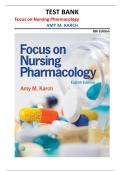
TEST BANK
Focus on Nursing Pharmacology
AMY M. KARCH
8th Edition
, 1
1
3
Table of Content
20
37
Table of Contents
54
Chapter 01 - Introduction to Drugs Chapter
71
02 - Drugs and the Body Chapter 03 - Toxic
86
Effects of Drugs
103
Chapter 04 - The Nursing Process in Drug Therapy and Patient Safety Chapter 05 - Dosage
120
Calculations
138
Chapter 06 - Challenges to Effective Drug Therapy Chapter 07 -
155
Introduction to Cell Physiology Chapter 08 - Antiinfective Agents
172
Chapter 09 - Antibiotics Chapter 10
188
- Antiviral Agents Chapter 11 - Antifungal
Agents 204
Chapter 12 - Antiprotozoal Agents Chapter 13 220
- Anthelmintic Agents Chapter 14 - 237
Antineoplastic Agents 254
Chapter 15 - Introduction to the Immune Response and Inflammation Chapter 16 - 270
Antiinflammatory, Antiarthritis, and Related Agents Chapter 17 - Immune Modulators 287
Chapter 18 - Vaccines and Sera 304
Chapter 19 - Introduction to Nerves and the Nervous System Chapter 20 - 320
Anxiolytic and Hypnotic Agents 337
Chapter 21 - Antidepressant Agents Chapter 22 - 354
Psychotherapeutic Agents Chapter 23 - Antiseizure 371
Agents Chapter 24 - Antiparkinsonism Agents 388
Chapter 25 - Muscle Relaxants 404
Chapter 26 - Narcotics, Narcotic Antagonists, and Antimigraine Agents Chapter 27 - General 420
and Local Anesthetic Agents 436
Chapter 28 - Neuromuscular Junction Blocking Agents Chapter 29 - Introduction 453
to the Autonomic Nervous System Chapter 30 - Adrenergic Agonists 470
Chapter 31 - Adrenergic Antagonists Chapter 32 - 487
Cholinergic Agonists Chapter 33 - Anticholinergic 503
Agents 520
Chapter 34 - Introduction to the Endocrine System Chapter 35 -
536
Hypothalamic and Pituitary Agents Chapter 36 - Adrenocortical
553
Agents
569
Chapter 37 - Thyroid and Parathyroid Agents Chapter 38 - Agents to
585
Control Blood Glucose Levels Chapter 39 - Introduction to the
602
Reproductive System
619
Chapter 40 - Drugs Affecting the Female Reproductive System Chapter 41 -
636
Drugs Affecting the Male Reproductive System Chapter 42 - Introduction to the
653
Cardiovascular System Chapter 43 - Drugs Affecting Blood Pressure
669
Chapter 44 - Agents for Treating Heart Failure Chapter 45
- Antiarrhythmic Agents 685
Chapter 46 - Antianginal Agents Chapter 47 - 702
Lipid-Lowering Agents 719
Chapter 48 - Drugs Affecting Blood Coagulation Chapter 49 - 735
Drugs Used to Treat Anemias Chapter 50 - Introduction to the 752
Renal System 768
785
801
817
,Chapter 01- Introduction to Drugs
A nurse working in radiology administers iodine to a patient who is having a computed
tomography(CT) scan. The nurse working on the oncology unit administers chemotherapy to
patients who have cancer. At the Public Health Department, a nurse administers a measles-mumps-
rubella (MMR) vaccine to a 14-month-old child as a routine immunization. Which branch of
pharmacology best describes the actions of all three nurses?
Pharmacoeconomics
Pharmacotherapeutics
Pharmacodynamics
Pharmacokinetics
Ans:
B
Feedback:
Pharmacology is the study of the biologic effects of chemicals. Nurses are involved with clinical
pharmacology or pharmacotherapeutics, which is a branch of pharmacology that deals with the uses of
drugs to treat, prevent, and diagnose disease. The radiology nurse is administering a drug to help
diagnose a disease. The oncology nurse is administering a drug to help treat a disease.
Pharmacoeconomics includes any costs involved in drug therapy. Pharmacodynamics involves how a drug
affects the body and pharmacokinetics is how the body acts on the body.
A physician has ordered intramuscular (IM) injections of morphine, a narcotic, every 4 hours as
neededfor pain in a motor vehicle accident victim. The nurse is aware this drug has a high abuse
potential. Under what category would morphine be classified?
Schedule I
Schedule II
Schedule III
Schedule IV
Ans: B
Feedback:
Narcotics with a high abuse potential are classified as Schedule II drugs because of severe dependence liability.
Schedule I drugs have high abuse potential and no accepted medical use. Schedule III drugs have a lesser abuse
potential than II and an accepted medical use. Schedule IV drugs have low abuse potential and limited
dependence liability.
When involved in phase III drug evaluation studies, what responsibilities would the nurse
have?
Working with animals who are given experimental drugs
Choosing appropriate patients to be involved in the drug study
Monitoring and observing patients closely for adverse effects
Conducting research to determine effectiveness of the drug
Ans: C
Feedback:
Phase III studies involve use of a drug in a vast clinical population in which patients are asked to record
any symptoms they experience while taking the drugs. Nurses may be responsible for helping collect and
analyze the information to be shared with the Food and Drug Administration (FDA) but would not conduct
research independently because nurses do not prescribe medications. Use of animals in drug testing is
done in the preclinical trials. Select patients who are involved in phase II studies to participate in studies
where the participants have the disease the drug is intended to treat. These patients are monitored
, closely for drug action and adverse effects. Phase I studies involve healthy human volunteers who are
usually paid for their participation. Nurses may observe for adverse effects and toxicity.
What concept is considered when generic drugs are substituted for brand name drugs?
Bioavailability
Critical concentration
Distribution
Half-life
Ans: A
Feedback:
Bioavailability is the portion of a dose of a drug that reaches the systemic circulation and is available to
act on body cells. Binders used in a generic drug may not be the same as those used in the brand name
drug. Therefore, the way the body breaks down and uses the drug may differ, which may eliminate a
generic drug substitution.
Critical concentration is the amount of a drug that is needed to cause a therapeutic effect and should not
differ between generic and brand name medications. Distribution is the phase of pharmacokinetics, which
involves the movement of a drug to the body’s tissues and is the same in generic and brand name drugs.
A drug’s half-life is the time it takes for the amount of drug to decrease to half the peak level, which
should not change when substituting a generic medication.
A nurse is assessing the patient’s home medication use. After listening to the patient list current
medications, the nurse asks what priority question?
Do you take any generic medications?
Are any of these medications orphan drugs?
Are these medications safe to take during
pregnancy?
Do you take any over-the-counter medications?
Ans: D
Feedback:
It is important for the nurse to specifically question use of over-the-counter medications because patients
may not consider them important. The patient is unlikely to know the meaning of orphan drugs unless
they too are health care providers. Safety during pregnancy, use of a generic medication, or
classification of orphan drugs are things the patient would be unable to answer but could be found in
reference books if the nurse wishes to research them.
After completing a course on pharmacology for nurses, what will the nurse know?
Everything necessary for safe and effective medication administration
Current pharmacologic therapy; the nurse will not require ongoing education for 5
years.
General drug information; the nurse can consult a drug guide for specific drug
information.
The drug actions that are associated with each classification of medication
Ans:C
Feedback:
After completing a pharmacology course nurses will have general drug information needed for safe and
effective medication administration but will need to consult a drug guide for specific drug information
before administering any medication. Pharmacology is constantly changing, with new drugs entering
the market and new uses for existing drugs identified. Continuing education in pharmacology is
essential to safe practice.
Nurses tend to become familiar with the medications they administer most often, but there will always
be a need to research new drugs and also those the nurse is not familiar with because no nurse knows
all medications.
A nurse is instructing a pregnant patient concerning the potential risk to her fetus from a Pregnancy Category
B drug. What would the nurse inform the patient?
Focus on Nursing Pharmacology
AMY M. KARCH
8th Edition
, 1
1
3
Table of Content
20
37
Table of Contents
54
Chapter 01 - Introduction to Drugs Chapter
71
02 - Drugs and the Body Chapter 03 - Toxic
86
Effects of Drugs
103
Chapter 04 - The Nursing Process in Drug Therapy and Patient Safety Chapter 05 - Dosage
120
Calculations
138
Chapter 06 - Challenges to Effective Drug Therapy Chapter 07 -
155
Introduction to Cell Physiology Chapter 08 - Antiinfective Agents
172
Chapter 09 - Antibiotics Chapter 10
188
- Antiviral Agents Chapter 11 - Antifungal
Agents 204
Chapter 12 - Antiprotozoal Agents Chapter 13 220
- Anthelmintic Agents Chapter 14 - 237
Antineoplastic Agents 254
Chapter 15 - Introduction to the Immune Response and Inflammation Chapter 16 - 270
Antiinflammatory, Antiarthritis, and Related Agents Chapter 17 - Immune Modulators 287
Chapter 18 - Vaccines and Sera 304
Chapter 19 - Introduction to Nerves and the Nervous System Chapter 20 - 320
Anxiolytic and Hypnotic Agents 337
Chapter 21 - Antidepressant Agents Chapter 22 - 354
Psychotherapeutic Agents Chapter 23 - Antiseizure 371
Agents Chapter 24 - Antiparkinsonism Agents 388
Chapter 25 - Muscle Relaxants 404
Chapter 26 - Narcotics, Narcotic Antagonists, and Antimigraine Agents Chapter 27 - General 420
and Local Anesthetic Agents 436
Chapter 28 - Neuromuscular Junction Blocking Agents Chapter 29 - Introduction 453
to the Autonomic Nervous System Chapter 30 - Adrenergic Agonists 470
Chapter 31 - Adrenergic Antagonists Chapter 32 - 487
Cholinergic Agonists Chapter 33 - Anticholinergic 503
Agents 520
Chapter 34 - Introduction to the Endocrine System Chapter 35 -
536
Hypothalamic and Pituitary Agents Chapter 36 - Adrenocortical
553
Agents
569
Chapter 37 - Thyroid and Parathyroid Agents Chapter 38 - Agents to
585
Control Blood Glucose Levels Chapter 39 - Introduction to the
602
Reproductive System
619
Chapter 40 - Drugs Affecting the Female Reproductive System Chapter 41 -
636
Drugs Affecting the Male Reproductive System Chapter 42 - Introduction to the
653
Cardiovascular System Chapter 43 - Drugs Affecting Blood Pressure
669
Chapter 44 - Agents for Treating Heart Failure Chapter 45
- Antiarrhythmic Agents 685
Chapter 46 - Antianginal Agents Chapter 47 - 702
Lipid-Lowering Agents 719
Chapter 48 - Drugs Affecting Blood Coagulation Chapter 49 - 735
Drugs Used to Treat Anemias Chapter 50 - Introduction to the 752
Renal System 768
785
801
817
,Chapter 01- Introduction to Drugs
A nurse working in radiology administers iodine to a patient who is having a computed
tomography(CT) scan. The nurse working on the oncology unit administers chemotherapy to
patients who have cancer. At the Public Health Department, a nurse administers a measles-mumps-
rubella (MMR) vaccine to a 14-month-old child as a routine immunization. Which branch of
pharmacology best describes the actions of all three nurses?
Pharmacoeconomics
Pharmacotherapeutics
Pharmacodynamics
Pharmacokinetics
Ans:
B
Feedback:
Pharmacology is the study of the biologic effects of chemicals. Nurses are involved with clinical
pharmacology or pharmacotherapeutics, which is a branch of pharmacology that deals with the uses of
drugs to treat, prevent, and diagnose disease. The radiology nurse is administering a drug to help
diagnose a disease. The oncology nurse is administering a drug to help treat a disease.
Pharmacoeconomics includes any costs involved in drug therapy. Pharmacodynamics involves how a drug
affects the body and pharmacokinetics is how the body acts on the body.
A physician has ordered intramuscular (IM) injections of morphine, a narcotic, every 4 hours as
neededfor pain in a motor vehicle accident victim. The nurse is aware this drug has a high abuse
potential. Under what category would morphine be classified?
Schedule I
Schedule II
Schedule III
Schedule IV
Ans: B
Feedback:
Narcotics with a high abuse potential are classified as Schedule II drugs because of severe dependence liability.
Schedule I drugs have high abuse potential and no accepted medical use. Schedule III drugs have a lesser abuse
potential than II and an accepted medical use. Schedule IV drugs have low abuse potential and limited
dependence liability.
When involved in phase III drug evaluation studies, what responsibilities would the nurse
have?
Working with animals who are given experimental drugs
Choosing appropriate patients to be involved in the drug study
Monitoring and observing patients closely for adverse effects
Conducting research to determine effectiveness of the drug
Ans: C
Feedback:
Phase III studies involve use of a drug in a vast clinical population in which patients are asked to record
any symptoms they experience while taking the drugs. Nurses may be responsible for helping collect and
analyze the information to be shared with the Food and Drug Administration (FDA) but would not conduct
research independently because nurses do not prescribe medications. Use of animals in drug testing is
done in the preclinical trials. Select patients who are involved in phase II studies to participate in studies
where the participants have the disease the drug is intended to treat. These patients are monitored
, closely for drug action and adverse effects. Phase I studies involve healthy human volunteers who are
usually paid for their participation. Nurses may observe for adverse effects and toxicity.
What concept is considered when generic drugs are substituted for brand name drugs?
Bioavailability
Critical concentration
Distribution
Half-life
Ans: A
Feedback:
Bioavailability is the portion of a dose of a drug that reaches the systemic circulation and is available to
act on body cells. Binders used in a generic drug may not be the same as those used in the brand name
drug. Therefore, the way the body breaks down and uses the drug may differ, which may eliminate a
generic drug substitution.
Critical concentration is the amount of a drug that is needed to cause a therapeutic effect and should not
differ between generic and brand name medications. Distribution is the phase of pharmacokinetics, which
involves the movement of a drug to the body’s tissues and is the same in generic and brand name drugs.
A drug’s half-life is the time it takes for the amount of drug to decrease to half the peak level, which
should not change when substituting a generic medication.
A nurse is assessing the patient’s home medication use. After listening to the patient list current
medications, the nurse asks what priority question?
Do you take any generic medications?
Are any of these medications orphan drugs?
Are these medications safe to take during
pregnancy?
Do you take any over-the-counter medications?
Ans: D
Feedback:
It is important for the nurse to specifically question use of over-the-counter medications because patients
may not consider them important. The patient is unlikely to know the meaning of orphan drugs unless
they too are health care providers. Safety during pregnancy, use of a generic medication, or
classification of orphan drugs are things the patient would be unable to answer but could be found in
reference books if the nurse wishes to research them.
After completing a course on pharmacology for nurses, what will the nurse know?
Everything necessary for safe and effective medication administration
Current pharmacologic therapy; the nurse will not require ongoing education for 5
years.
General drug information; the nurse can consult a drug guide for specific drug
information.
The drug actions that are associated with each classification of medication
Ans:C
Feedback:
After completing a pharmacology course nurses will have general drug information needed for safe and
effective medication administration but will need to consult a drug guide for specific drug information
before administering any medication. Pharmacology is constantly changing, with new drugs entering
the market and new uses for existing drugs identified. Continuing education in pharmacology is
essential to safe practice.
Nurses tend to become familiar with the medications they administer most often, but there will always
be a need to research new drugs and also those the nurse is not familiar with because no nurse knows
all medications.
A nurse is instructing a pregnant patient concerning the potential risk to her fetus from a Pregnancy Category
B drug. What would the nurse inform the patient?