
NDAEB2 UPDATED ACTUAL Questions and CORRECT
Answers
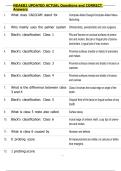
1. What does CAD/CAM stand for Computer-Aided Design/Computer-Aided Manu-
facturing
2. Who mainly uses the palmer system Orthodontists, periodontists and oral surgeons
3. Black's classification: Class 1 Pits and fissures on occlusal surfaces of premo-
lars and molars. Buccal or lingual pits of premo-
lars/molars. Lingual pits of max incisors.
4. Black's classification: Class 2 Proximal surfaces (medial or distal) of premolars
and molars
5. Black's classification: Class 3 Proximal surfaces (mesial and distal) of incisors or
canines
6. Black's classification: Class 4 Proximal surfaces (mesial and distal) of incisors
and canines
7. What is the difference between class Class 4 involves the incisal edge or angle of the
3 and 4 tooth
8. Black's classification: Class 5 Gingival third of the facial or lingual surface of any
tooth
9. What is class 5 resto also called Surface decay
10. Black's classification: Class 6 Incisal edge of anterior teeth, cusp tips of premo-
lars and molars
11. What is class 6 caused by Abrasion and defects
12. 0 probing score All measurements are visible, no calculus or defec-
tive margins
13. 1 probing score
, NDAEB2 UPDATED ACTUAL Questions and CORRECT
Answers
All measurements visible. No calculus or defective
margins visible. Bleeding occurs
14. 2 probing score All measurements visible. Calculus and defective
margins visible
15. 3 probing score Some of the probe is visible in the deepest part of
sulcus
16. 4 probing score Most of the probe disappears, meaning greater
than 5.5mm
17. Class 1 furcation Beginning involvement. Can be detected with an
explorer or probe, but cannot be entered
18. Clas 2 furcation Can enter furcation but cannot go through to other
side
19. Class 3 furcation Involvement with both sides, but covered with soft
tissue
20. Class 4 furcation Involvement with both sides, not covered with soft
tissue
21. Class 1 mobility Tooth can be moved up to 1mm in any direction
22. Class 2 mobility Tooth can be moved more than 1mm in any direc-
tion, but is not depressible in the socket
23. Class 3 mobility Tooth can be moved in a buccolingual direction
and is depressible in the socket
24. Treatment plan: Level 1 Emergency care: Relieves immediate discomfort
and provides relief for the pt.
Answers
1. What does CAD/CAM stand for Computer-Aided Design/Computer-Aided Manu-
facturing
2. Who mainly uses the palmer system Orthodontists, periodontists and oral surgeons
3. Black's classification: Class 1 Pits and fissures on occlusal surfaces of premo-
lars and molars. Buccal or lingual pits of premo-
lars/molars. Lingual pits of max incisors.
4. Black's classification: Class 2 Proximal surfaces (medial or distal) of premolars
and molars
5. Black's classification: Class 3 Proximal surfaces (mesial and distal) of incisors or
canines
6. Black's classification: Class 4 Proximal surfaces (mesial and distal) of incisors
and canines
7. What is the difference between class Class 4 involves the incisal edge or angle of the
3 and 4 tooth
8. Black's classification: Class 5 Gingival third of the facial or lingual surface of any
tooth
9. What is class 5 resto also called Surface decay
10. Black's classification: Class 6 Incisal edge of anterior teeth, cusp tips of premo-
lars and molars
11. What is class 6 caused by Abrasion and defects
12. 0 probing score All measurements are visible, no calculus or defec-
tive margins
13. 1 probing score
, NDAEB2 UPDATED ACTUAL Questions and CORRECT
Answers
All measurements visible. No calculus or defective
margins visible. Bleeding occurs
14. 2 probing score All measurements visible. Calculus and defective
margins visible
15. 3 probing score Some of the probe is visible in the deepest part of
sulcus
16. 4 probing score Most of the probe disappears, meaning greater
than 5.5mm
17. Class 1 furcation Beginning involvement. Can be detected with an
explorer or probe, but cannot be entered
18. Clas 2 furcation Can enter furcation but cannot go through to other
side
19. Class 3 furcation Involvement with both sides, but covered with soft
tissue
20. Class 4 furcation Involvement with both sides, not covered with soft
tissue
21. Class 1 mobility Tooth can be moved up to 1mm in any direction
22. Class 2 mobility Tooth can be moved more than 1mm in any direc-
tion, but is not depressible in the socket
23. Class 3 mobility Tooth can be moved in a buccolingual direction
and is depressible in the socket
24. Treatment plan: Level 1 Emergency care: Relieves immediate discomfort
and provides relief for the pt.


