

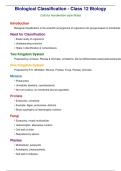
Biological Classification - Class 12 Biology
Colorful Handwritten-style Notes
Introduction
Biological classification is the scientific arrangement of organisms into groups based on similarities
Need for Classification
• Easier study of organisms
• Understanding evolution
• Helps in identification & nomenclature.
Two Kingdom System
Proposed by Linnaeus: Plantae & Animalia. Limitations: Did not differentiate prokaryotes/eukaryotes
Five Kingdom System
Proposed by R.H. Whittaker: Monera, Protista, Fungi, Plantae, Animalia.
Monera
• Prokaryotes
• Unicellular (bacteria, cyanobacteria)
• No true nucleus, no membrane-bound organelles.
Protista
• Eukaryotic, unicellular
• Example: Algae, protozoans, diatoms
• Show autotrophic & heterotrophic nutrition.
Fungi
• Eukaryotic, mostly multicellular
• Heterotrophic, absorptive nutrition
• Cell wall of chitin
• Reproduce by spores.
Plantae
• Multicellular, eukaryotic
• Autotrophic, photosynthetic
• Cell wall of cellulose.
Colorful Handwritten-style Notes
Introduction
Biological classification is the scientific arrangement of organisms into groups based on similarities
Need for Classification
• Easier study of organisms
• Understanding evolution
• Helps in identification & nomenclature.
Two Kingdom System
Proposed by Linnaeus: Plantae & Animalia. Limitations: Did not differentiate prokaryotes/eukaryotes
Five Kingdom System
Proposed by R.H. Whittaker: Monera, Protista, Fungi, Plantae, Animalia.
Monera
• Prokaryotes
• Unicellular (bacteria, cyanobacteria)
• No true nucleus, no membrane-bound organelles.
Protista
• Eukaryotic, unicellular
• Example: Algae, protozoans, diatoms
• Show autotrophic & heterotrophic nutrition.
Fungi
• Eukaryotic, mostly multicellular
• Heterotrophic, absorptive nutrition
• Cell wall of chitin
• Reproduce by spores.
Plantae
• Multicellular, eukaryotic
• Autotrophic, photosynthetic
• Cell wall of cellulose.


