
Neuroscience: Synapses, Neurotransmitters, And Drug Effects Questions With Correct Verified Answers | 100%
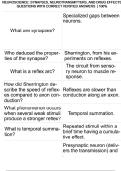
NEUROSCIENCE: SYNAPSES, NEUROTRANSMITTERS, AND DRUG EFFECTS QUESTIONS WITH CORRECT VERIFIED ANSWERS | 100% Specialized gaps between neurons. Who deduced the properties of the synapse? Sherrington, from his experiments on reflexes. What is a reflex arc? The circuit from sensory neuron to muscle response. How did Sherrington describe the speed of reflexes compared to axon conduction? Reflexes are slower than conduction along an axon. What phenomenon occurs when several weak stimuli produce a stronger reflex? Temporal summation. What is temporal summation? Repeated stimuli within a brief time having a cumulative effect. Presynaptic neuron (delivers the transmission) and 1 / 18 Neuroscience: Synapses, Neurotransmitters, and Drug Effects What are the two types of neurons involved in synaptic transmission? postsynaptic neuron (receives the message). What are graded potentials? Changes in the postsynaptic neuron's potential, which can be either depolarization (excitatory) or hyperpolarization (inhibitory). What is an excitatory postsynaptic potential (EPSP)? A graded depolarization that occurs when Na+ ions enter the postsynaptic neuron. How does the magnitude of an EPSP change as it moves along the membrane? The magnitude decreases as it moves along the membrane. What is an inhibitory postsynaptic potential (IPSP)? A temporary hyperpolarization of a postsynaptic cell. What causes an IPSP? It occurs when K+ leaves the cell or Cl- enters the cell after stimulation. 2 / 18 Neuroscience: Synapses, Neurotransmitters, and Drug Effects What determines the probability of an action potential in a neuron? The ratio of EPSPs to IPSPs at a given moment. What is spontaneous firing rate? The ability to produce action potentials without synaptic input. What role do neurotransmitters play in synaptic transmission? They are chemicals released by one neuron that affect another neuron. What are the major events at a synapse? Synthesis of neurotransmitters, transport to axon terminal, action potentials causing calcium entry, release into the synaptic cleft, attachment to receptors, and recycling. What happens to neurotransmitters after they attach to receptors? They alter the activity of the postsynaptic neuron. 3 / 18 Neuroscience: Synapses, Neurotransmitters, and Drug Effects What are the types of neurotransmitters? Amino acids, peptides, acetylcholine, and monoamines. What are amino acids in the context of neurotransmitters? Acids containing an amine group (NH2). What are peptides? Chains of amino acids; a long chain is called a polypeptide. What is acetylcholine? A chemical similar to an amino acid, with the NH‚ group replaced by an N(CH3)3 group. What are monoamines? Neurotransmitters containing an amine group (NH2) formed by a metabolic change of an amino acid. What are purines in the context of neurotransmitters? Adenosine and several of its derivatives. Catecholamines are closely related compounds containing
Document information
- Uploaded on
- September 19, 2025
- Number of pages
- 18
- Written in
- 2025/2026
- Type
- Exam (elaborations)
- Contains
- Questions & answers


