

Written by students who passed Immediately available after payment Read online or as PDF Wrong document? Swap it for free 4.6 TrustPilot
logo-home
Document preview thumbnail
Preview 2 out of 8 pages
Exam (elaborations)

BIO 141 DETAILED UPDATED EXAM 3 2025

Document preview thumbnail
Preview 2 out of 8 pages

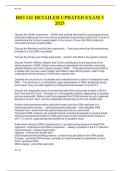
BIO 141 DETAILED UPDATED EXAM 3 2025 Discuss the Griffith experiment - -Griffith was working with bacteria causing pneumonia, chemicals substances from one cell are genetically transforming another cell. R strain is transforming the S strain causing death in the mouse. Proves that DNA transforms information through transformation. Discuss the Macleod and McCarty experiment - -They discovered that the transforming principle is in fact DNA, not protein. Discuss the Hersey and Chase experiment - -Confirm that DNA is the genetic material Discuss Franklin, Wilkins, Watson and Crick's contributions to the discovery of the helical structure of DNA. Explain how evidence collected by the scientific community allowed Watson and Crick to build a model of DNA. - -They discovered that the DNA is a double helix, but they used Franklin and Wilkins' data without proper credit to fully understand that the structure of DNA was a double helix. Describe the structure of a nucleotide and understand how a chain of nucleotides make DNA - -The structure of a nucleotide is sugar (deoxyribose in DNA), phosphate group, and a base. They are held together by hydrogen bonds between C-G and A-T. Discuss the antiparallel nature of double stranded DNA and be able to label a DNA at the 5' end and the 3' end - -Strands run in the opposite direction (depending on polarity) and are antiparallel. Watson and Crick proposed that 2 DNA strands line up in opposite directions to each other, and the antiparallel strands twist to form the double helix. Explain what semiconservative replication means and how DNA replicates in a semiconservative manner. - -semiconservative replication - each daughter DNA molecule has 1 strand from the partial molecules and one new strand. The parent DNA molecule, the parental strands unwind and separate at several points, each parental strand provides for DNA polymerase to bind complementary bases (A and T, C and G), sugar-phosphate backbones of daughter close. Know which direction DNA is synthesized in, and discuss key players involved DNA replication. Understand how DNA is replicated. - -Always synthesis in the 5'-3' direction. Topoisomerase - relaxes supercoiling Helicase - unwinds the double helix SSB (single-stranded binding proteins) - proteins that get added to the DNA strand. Primase - synthesis RNA primers, provides an initial template for replication to occur. Pol 3- syntheses DNA DNA is ligase - joins DNA segments. Bio 141 Bio 141 Know base pairing rules and be able to replicate DNA and determine the new strand sequence in the directions of synthesis - -Always in the 5'-3' direction. Adenine and Thymine Guanine with cytosine Nucleotides are always synthesis in the 5' - 3' direction meaning that nucleotides are added only to the 3' end of the growing strand. Understand what mutations are and know the difference between somatic and germline mutations. - -Somatic mutation is a mutation only in the somatic cells (body cells), gremlin mutations are mutations in the germline cells, such as sperm, egg Explain how mutations may affect fitness (lethal, harmful, beneficial, neutral) - -Survival + reproduction = fitness Lethal - mutations that cause embryos or juveniles to be non-viable harmful - non-lethal; but lower survival rate silence/neutral - no effect beneficial - useful, typically in a new environment Know and be able to explain the different types of mutations and the different effects the mutations may have on the protein. Be able to predict the effect of the mutation on the protein function - -Silent mutations - base pair change that creates that does not alter the resulting amino acid due to redundancy in the genetic code. Missence mutation - base-pair change that creates a stop codon in place of codon specifying an amino acid. Frameshift mutation - intersection or selection that causes the reading frame to shift Discuss how spontaneous mutations occur and the different types of mutations - -A spontaneous mutation occurs when a base pairs with a non-complentary base (A with G). If this happens during replication, a mutation will persist in one copy of the DNA. Duplicated copies of genes cause misalignment of genes during crossing over. Describe trinucleotide repeat expansion disorders and discuss why mutation is more likely to occur in reparative sequences - -When strand slippage mutations cause some hereditary disorders in humans, wild-type alleles of a gene in question normally have a variable number DNA trinucleotide repeats, increasing the number of repeats beyond a certain threshold causes the disorder. Ex: Fragile X, Huntington Disease, Jacobsen syndrome. Explain how multiple mutations can cause the same genetic disorder - -Premature stop, missense, and frameshift - can all tell the protein to make the same amino acid due to the replications in the code. Discuss how chemicals/radiation/ infectious agents can induce mutations - -Agents that cause DNA damage leading to mutations are called mutagens, which interact with DNA in specific ways to cause particular mutations. Bio 141 Bio 141 Explain the consequences of accumulating DNA damage and how cells deal with it. - DNA repair mechanisms either directly repair DNA damage, or allow the organism to avoid the problems cause by unprepared damage (cell cycle delay/ arrest in G0 or cell death). All organisms possess highly conserved DNA repair systems to detect and repair DNA damage, unreported DNA damage can have harmful effects such as cancer. Discuss how cells avoid passing on unreported DNA damage and the consequences of these avoidance mechanism s - -Damage avoidance mechanisms promote aging. Cells turn senescent (fully metabolic but stuck in the G0 of the cycle) or undergo cell death to avoid passing on damaged DNA -- leads to aging since more and more cells are not being used as a result Know the roles of the different types of RNA - -mRNA - messenger RNA; encodes amino acid sequence rRNA - ribosomal RNA; associated with proteins to form ribosomes, which structurally support and catalyze protein synthesis tRNA - transfer RNA, transports specific amino acids to the ribosome for protein synthesis Explain and identify how RNA compares to DNA - -RNA: usually single-stranded Uracil (U) as a base Ribose as the sugar Carries protein- ending information and controls how information is used Can function as an enzyme Transient DNA: Usually double-stranded Thymine (T) as a base Deoxyribose as the sugar Maintains protein-encoding information Cannot function as an enzyme Persists Explain the 4 step process of bacterial transcription in detail starting with promoter recognition and ending with termination - -Promoter recognition: Promoter is a double stranded DNA sequence that is the RNA polymerase binding site; promoters also bind other transcription factors proteins. RNA polymerase is attracted to promoters by the presence of consensus sequences ( 10, -35 in the TATA Box) RNA polymerase binds to the -10 and -35 sequences and occupies the space between and around them. Transcription initiation: Bio 141 Bio 141 The RNA polymerase core enzyme and sigma subunit bind the -10 and -35 promoter consensus sequences DNA unwinds near the transcription start site due to DNA methylation to form the open promoter complex Chain elongation: RNA polymerase holoenzyme initiations transcription and begins RNA synthesis. The sigma subunit dissociates shortly after transcription ignition, and the core enzyme continues transcription. The core enzyme synthesis until it encounters the termination sequence. As RNA synthesis progresses, the DNA duplex unwinds to allow the template strand to direct RNA assembly. The duplex closes following synthesis. Chain termination: When transcription of the gene is coupled, the RNA trails off the polymerase enzyme the polymerase enzyme dissociates from the DNA Shortly after one round of transcription is imitation, a second round begins. Explain the post transcriptional processes of 5' capping, polyadenylation, and intron splicing - -5' cap acts as a protection of the mRNA from rapid degradation, facilitating, transport of mRNA out of the nucleus, facilitating subsequent intron splicing, enhancing translation efficiency by orienting the ribosome on the mRNA. Polyadenylation (Poly-A tail) facilitates transports of mature mRNA across the nuclear membrane to the cytoplasm, protecting the mRNA from degradation, enhancing transplanting by enabling the ribosomal recognition of mRNA, and transcription termination. Intron splicing (pre-mRNA) - exons become part of the mature mRNA and encode protein segments while introns are intervening segments that are removed from pre mRNA, introns are common in eukaryotic genes, rare in bacterial genes and occasionally found in genes. Explain how Eukaryotic transcription differs from bacteria - -Eukaryotes promoter consensus sequences are more diverse, eukaryotes have 3 different types of RNAs, and the molecular machinery that assembles to imitate and elongate transcription is more complex in eukaryotes than in bacteria. Know how to use the amino acid codon table to translate mRNA into protein - -tRNA bins to the complementary mRNA codon and adds the amino acid to the growing protein chain Predict how mutations will affect transcription rates - -If there is a decrease in transcription rate, there is a decrease in protein synthesis Explain how mutations in the DNA may cause a different phenotype - -If there is a mutation, it changes how the amino acid is read Explain how the mRNA sequence dictates the amino acid sequence - -mRNA slides down the "assembly line" 3 more bases (aka 1 codon), the AUG shifts over to the P site Bio 141 Bio 141 where the amino acid holds onto the tRNA to which the polypeptide is attached, where it is then exposed to the A site where a new tRNA molecule containing an amino acid to be added to the growing polypeptide chain, then it goes to the E site that allows the tRNA to exist after its amino acid has been added to the chain. When a stop codon shows up that programs a release factor protein that stops the amino sequence from continuing. Starting with a DNA sequences, be able to transcribe, process, and translate the code - -Subitistion mutation that caused a premature based on the codon chart, slight change it is harmful since it was right before the actual stop codon. Given the DNA sequence, determine the expected length of a primary transcript vs a mature transcript after processing, and the expected number of amino acid in a translated polypeptide. - -Primary transcript (pre-mRNA) is what happens before RNA processing and is synthesizes from a DNA template during transcription, which its length consists of introns and exons. The primary transcript is typically longer that the mature transcript due to the including on introns. Mature transcript is the final RNA molecule after processing, which only includes exons, and polyadenylation (Poly-A tail). The mature transcript is usually shorter because it doesn't have introns. The number of amino acids in the final transcripted polypeptide is determined by the codon sequences in the mRNA, which each represent an amino acid. The number is calculated by dividing the length of the mature RNA sequences by 3. Discuss ribosome structure and explain the function of each active site. - -PAL (leave = exit) P site holds the tRNA where the polypeptide is attached A site binds a new tRNA molecule containing an amino acid to be added to the growing polypeptide chain L (E) site provides an exist for the tRNA after its amino acid has been added to the chain Explain in detail the process of translating starting with initiation and ending with termination - -Imitation: begins when mature mRNA transcription reaches part of the ribosome, the second amino acid joins the initiation complex. Elongation: first peptide bond forms as a new amino acid arrives, the amino acid chain extends. Prokaryotic translation initiation begins when the small ribosomal subunit binds near the 5' end of the mRNA and identifies the start codon and reaches part of the ribosome. Mature transcript -- cytoplasm -- small subunit -- complementary base paid to be part of the ribosome assembly line -- ribosome (holds rRNA) complementary base pairing and is looking for the ribosomes and also for the start codon (AUG) -- large subunit attached Compare transcription, RNA processing and translation in Bacteria and Eukaryotes - Bacteria: Bio 141 Bio 141 One RNA polymerase Promoter structure contains a -35 and a -10 box Sigma proteins that associate with a promote, different versions of sigma bind to the different promoters. RNA processing is rare since having a 5' cap and a Poly A tail is used for leaving the nucleus and bacteria don't have a nucleus. Initiation and termination less complex, but elongation similar to Eukaryotic. Eukaryotes: 3 RNA polymerase Complicated promoter structure many general transcription factors for proteins that associate with the promoter RNA processing extensive since serval processing stops occur in the nucleus before RNA is exported to the cytoplasm - Enzyme-catalyzed addition to the 5' cap on mRNAs -Splicing to remove introns - Enzyme-catalyzed addition of a 3' PolyA tail on mature mRNAs Imitation and termination more complex, but elongation similar to bacteria. Explain why gene regulation is important in Eukaryotic organisms - -So things like alcohol dehydrogenase, which breaks down alcohol in the liver, get turned on in liver cells, but don't get turned on in neuron cells Discuss the different levels of control that regulate gene expression in Eukaryotes and know the key players involved in each - -Transcriptional: Chromatin remodeling and regulatory DNA sequences DNA is packed tightly together and the RNA polymerase can't access it, so the chromatin must change so that the RNA polymerase can access it. Chromatin structure is structure in active genes and has to be decondensed to expose

Content preview

Bio 141


BIO 141 DETAILED UPDATED EXAM 3
2025

Discuss the Griffith experiment - -Griffith was working with bacteria causing pneumonia,
chemicals substances from one cell are genetically transforming another cell. R strain is
transforming the S strain causing death in the mouse. Proves that DNA transforms
information through transformation.

Discuss the Macleod and McCarty experiment - -They discovered that the transforming
principle is in fact DNA, not protein.

Discuss the Hersey and Chase experiment - -Confirm that DNA is the genetic material

Discuss Franklin, Wilkins, Watson and Crick's contributions to the discovery of the
helical structure of DNA. Explain how evidence collected by the scientific community
allowed Watson and Crick to build a model of DNA. - -They discovered that the DNA is
a double helix, but they used Franklin and Wilkins' data without proper credit to fully
understand that the structure of DNA was a double helix.

Describe the structure of a nucleotide and understand how a chain of nucleotides make
DNA - -The structure of a nucleotide is sugar (deoxyribose in DNA), phosphate group,
and a base. They are held together by hydrogen bonds between C-G and A-T.

Discuss the antiparallel nature of double stranded DNA and be able to label a DNA at
the 5' end and the 3' end - -Strands run in the opposite direction (depending on polarity)
and are antiparallel. Watson and Crick proposed that 2 DNA strands line up in opposite
directions to each other, and the antiparallel strands twist to form the double helix.

Explain what semiconservative replication means and how DNA replicates in a
semiconservative manner. - -semiconservative replication - each daughter DNA
molecule has 1 strand from the partial molecules and one new strand.
The parent DNA molecule, the parental strands unwind and separate at several points,
each parental strand provides for DNA polymerase to bind complementary bases (A
and T, C and G), sugar-phosphate backbones of daughter close.

Know which direction DNA is synthesized in, and discuss key players involved DNA
replication. Understand how DNA is replicated. - -Always synthesis in the 5'-3' direction.
Topoisomerase - relaxes supercoiling
Helicase - unwinds the double helix
SSB (single-stranded binding proteins) - proteins that get added to the DNA strand.
Primase - synthesis RNA primers, provides an initial template for replication to occur.
Pol 3- syntheses DNA
DNA is ligase - joins DNA segments.

Bio 141

, Bio 141


Know base pairing rules and be able to replicate DNA and determine the new strand
sequence in the directions of synthesis - -Always in the 5'-3' direction.
Adenine and Thymine
Guanine with cytosine
Nucleotides are always synthesis in the 5' - 3' direction meaning that nucleotides are
added only to the 3' end of the growing strand.

Understand what mutations are and know the difference between somatic and germline
mutations. - -Somatic mutation is a mutation only in the somatic cells (body cells),
gremlin mutations are mutations in the germline cells, such as sperm, egg

Explain how mutations may affect fitness (lethal, harmful, beneficial, neutral) - -Survival
+ reproduction = fitness
Lethal - mutations that cause embryos or juveniles to be non-viable
harmful - non-lethal; but lower survival rate
silence/neutral - no effect
beneficial - useful, typically in a new environment

Know and be able to explain the different types of mutations and the different effects the
mutations may have on the protein. Be able to predict the effect of the mutation on the
protein function - -Silent mutations - base pair change that creates that does not alter
the resulting amino acid due to redundancy in the genetic code.
Missence mutation - base-pair change that creates a stop codon in place of codon
specifying an amino acid.
Frameshift mutation - intersection or selection that causes the reading frame to shift

Discuss how spontaneous mutations occur and the different types of mutations - -A
spontaneous mutation occurs when a base pairs with a non-complentary base (A with
G). If this happens during replication, a mutation will persist in one copy of the DNA.
Duplicated copies of genes cause misalignment of genes during crossing over.

Describe trinucleotide repeat expansion disorders and discuss why mutation is more
likely to occur in reparative sequences - -When strand slippage mutations cause some
hereditary disorders in humans, wild-type alleles of a gene in question normally have a
variable number DNA trinucleotide repeats, increasing the number of repeats beyond a
certain threshold causes the disorder. Ex: Fragile X, Huntington Disease, Jacobsen
syndrome.

Explain how multiple mutations can cause the same genetic disorder - -Premature stop,
missense, and frameshift - can all tell the protein to make the same amino acid due to
the replications in the code.

Discuss how chemicals/radiation/ infectious agents can induce mutations - -Agents that
cause DNA damage leading to mutations are called mutagens, which interact with DNA
in specific ways to cause particular mutations.


Bio 141

Document information

Uploaded on
September 17, 2025
Number of pages
8
Written in
2025/2026
Type
Exam (elaborations)
Contains
Questions & answers
$11.99

Wrong document? Swap it for free Within 14 days of purchase and before downloading, you can choose a different document. You can simply spend the amount again.
Written by students who passed
Immediately available after payment
Read online or as PDF

Seller avatar
Reputation scores are based on the amount of documents a seller has sold for a fee and the reviews they have received for those documents. There are three levels: Bronze, Silver and Gold. The better the reputation, the more your can rely on the quality of the sellers work.
AlexScorer
2.5
(2)
Sold
11
Followers
0
Items
1800
Last sold
2 weeks ago


Why students choose Stuvia

Created by fellow students, verified by reviews

Quality you can trust: written by students who passed their tests and reviewed by others who've used these notes.

Didn't get what you expected? Choose another document

No worries! You can instantly pick a different document that better fits what you're looking for.

Pay as you like, start learning right away

No subscription, no commitments. Pay the way you're used to via credit card and download your PDF document instantly.

Student with book image

“Bought, downloaded, and aced it. It really can be that simple.”

Alisha Student

Working on your references?

Create accurate citations in APA, MLA and Harvard with our free citation generator.

Working on your references?

Frequently asked questions
