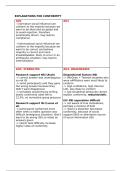
EXPLANATIONS FOR CONFORMITY
AO1 AO1
- (normative social influence) we
conform to the majority because we
want to be liked and accepted and
to avoid rejection, therefore
emotionally driven, may lead to
compliance
- (informational social influence) we
conform to the majority because we
want to be correct and believe
majority is correct and more
knowledgeable, likely to occur in an
ambiguous situation, may lead to
internalisation
AO3- STRENGTHS AO3- WEAKNESSES
Research support NSI (Asch) Dispositional factors NSI
-> correct answer was unambiguous -> (McGhee + Teevan) students who
so not ISI were nAffiliators were most likely to
-> some participants said they gave conform
the wrong answer because they -> high confidence, high internal
didn’t want disapproval LOC, less likely to conform
-> (privately answering by writing -> just situational pressures cannot
down) conformity rates fell to explain conformity, reductionistic
12.5%, no normative group pressure
ISI/ NSI separation difficult
Research support ISI (Lucas et -> not aware of true motivations,
al) perhaps a mixture of both
-> participants conformed more -> (Asch) a dissenter decreases
often when a maths question was conformity, because of social
difficult (ambiguous situation), didn’t support (NSI) or alternative source
want to be wrong (ISI) so relied on of social information (ISI)
answers given
-> (Asch) task difficulty increase,
higher rates of conformity
, ASCH’S RESEARCH
AO1 AO1- variations
- (sample) 8-10 male college - (group size) 1 confederate= 3%
students, 1 participant, rest conformity, 3 confederates= 33%
confederates (participant unaware conformity, 16 confederates 31%
of confederates) conformity, beyond a certain point
group size doesn’t increase pressure
- (procedure) unambiguous line
judgement experiment, 1 standard - (unanimity) 1 confederate broke
line, 3 comparison lines, publicly group unanimity (gave correct
identify which line matched, answer), conformity rate= 5.5%,
participant seated so answers near presence of a dissenter gives social
to the end only, 6 control trials support
(correct answers), 12 critical trials
(incorrect answers)
- (task difficulty) smaller differences
between line lengths increase
- (findings) 75% conformed at least ambiguity, higher rate of conformity,
once, 5% conformed every time, ISI + NSI
overall conformity rate 32%
AO3- STRENGTHS AO3- WEAKNESSES
Methodology- high internal Temporal validity (Perrin +
validity Spencer)
-> controlled and standardised (all -> 1950s cold war America, different
participants experience the same), cultural conditions
lab experiment, replicable, scientific -> (1980s) British students, 1
so can find cause (NSI, ISI, task conformity out of 396 trials, can be
difficulty, unanimity, group size) and explained by modern cultural
effect (conformity) conditions having more
individualistic values
Cultural bias (Bond)
-> higher rates of conformity in
collectivist cultures than
individualistic cultures, not universal
AO1 AO1
- (normative social influence) we
conform to the majority because we
want to be liked and accepted and
to avoid rejection, therefore
emotionally driven, may lead to
compliance
- (informational social influence) we
conform to the majority because we
want to be correct and believe
majority is correct and more
knowledgeable, likely to occur in an
ambiguous situation, may lead to
internalisation
AO3- STRENGTHS AO3- WEAKNESSES
Research support NSI (Asch) Dispositional factors NSI
-> correct answer was unambiguous -> (McGhee + Teevan) students who
so not ISI were nAffiliators were most likely to
-> some participants said they gave conform
the wrong answer because they -> high confidence, high internal
didn’t want disapproval LOC, less likely to conform
-> (privately answering by writing -> just situational pressures cannot
down) conformity rates fell to explain conformity, reductionistic
12.5%, no normative group pressure
ISI/ NSI separation difficult
Research support ISI (Lucas et -> not aware of true motivations,
al) perhaps a mixture of both
-> participants conformed more -> (Asch) a dissenter decreases
often when a maths question was conformity, because of social
difficult (ambiguous situation), didn’t support (NSI) or alternative source
want to be wrong (ISI) so relied on of social information (ISI)
answers given
-> (Asch) task difficulty increase,
higher rates of conformity
, ASCH’S RESEARCH
AO1 AO1- variations
- (sample) 8-10 male college - (group size) 1 confederate= 3%
students, 1 participant, rest conformity, 3 confederates= 33%
confederates (participant unaware conformity, 16 confederates 31%
of confederates) conformity, beyond a certain point
group size doesn’t increase pressure
- (procedure) unambiguous line
judgement experiment, 1 standard - (unanimity) 1 confederate broke
line, 3 comparison lines, publicly group unanimity (gave correct
identify which line matched, answer), conformity rate= 5.5%,
participant seated so answers near presence of a dissenter gives social
to the end only, 6 control trials support
(correct answers), 12 critical trials
(incorrect answers)
- (task difficulty) smaller differences
between line lengths increase
- (findings) 75% conformed at least ambiguity, higher rate of conformity,
once, 5% conformed every time, ISI + NSI
overall conformity rate 32%
AO3- STRENGTHS AO3- WEAKNESSES
Methodology- high internal Temporal validity (Perrin +
validity Spencer)
-> controlled and standardised (all -> 1950s cold war America, different
participants experience the same), cultural conditions
lab experiment, replicable, scientific -> (1980s) British students, 1
so can find cause (NSI, ISI, task conformity out of 396 trials, can be
difficulty, unanimity, group size) and explained by modern cultural
effect (conformity) conditions having more
individualistic values
Cultural bias (Bond)
-> higher rates of conformity in
collectivist cultures than
individualistic cultures, not universal