

EMT-CPR Exam Graded A
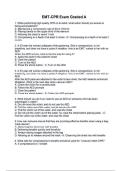
1. While performing high-quality CPR on an adult, what action should you ensure is being accomplished? A: Maintaining a compression rate of 90 to 120/min B: Placing hands on the upper third of the sternum C: Allowing the chest to recoil 1 inch D: Compressing to a depth of at least 2 inches - D: Compressing to a depth of at least 2 inches 2. A 53-year-old woman collapses while gardening. She is unresponsive, is not breathing, and does not have a pulse A neighbor, who is an EMT, rushes to her with an AED. When the AED arrives, what is the first step for using it? A: Apply the pads to the patient's chest B: Clear the patient C: Turn on the AED D: Press the shock button - C: Turn on the AED 3. A 53-year-old woman collapses while gardening. She is unresponsive, is not breathing, and does not have a pulse A neighbor, who is an EMT, rushes to her with an AED. After the AED pads are attached to the victim's bare chest, the AED detects ventricular fibrillation. What is the next step when using an AED? A: Check the victim for a carotid pulse B: Follow the AED prompts C: Clear the patient D: Press the shock button - B: Follow the AED prompts 4. What should you do if you need to use an AED on someone who has been submerged in water? A: Do not move the victim, and do not use the AED B: Pull the victim out of the water, but do not use the AED C: Pull the victim out of the water, and wipe the chest D: Do not pull the victim out of the water, but wipe the chest before placing pads. - C: Pull the victim out of the water, and wipe the chest 5: How can rescuers ensure that they are providing effective breaths when using a bag- mask device? A: Observing the chest rise with breaths B: Delivering breaths quickly and forcefully C: Always having oxygen attached to the bag D: Allowing air to release around the mask - A: Observing the chest rise with breaths 6. What ratio for compressions to breaths should be used for 1-rescuer infant CPR? A: 5 compressions to 1 breath B: 20 compressions to 2 breaths C: 15 compressions to 2 breaths D: 30 compressions to 2 breaths - D: 30 compressions to 2 breaths 7. What is a consideration when you are using an AED? A: You should never remove a transdermal medication patch before applying AED pads B: On a hairy chest, the pads may not stick and may fail to deliver a shock C: AEDs can be used while a victim is submerged in water D: You should not use an AED on someone with an implanted pacemaker - B. On a hairy chest, the pads may not stick and may fail to deliver a shock. 8. A 9-year-old child has suddenly collapsed. After confirming that the scene is safe, a single rescuer determines that the child is in cardiac arrest, shouts for nearby help, and activates the emergency response system. He immediately begins performing high- quality CPR. Two additional rescuers arrive to assist in the resuscitation attempt. A: 2 rescuers alternate using the AED and giving breaths B: 1 rescuer gives CPR while the other 2 wait for advanced life support to arrive C: 2 rescuers alternate giving high-quality chest compressions D: 2 rescuers operate the AED while the third rescuer gives breaths. - C: 2 rescuers alternate giving high-quality chest compressions 9. A 9-year-old child has suddenly collapsed. After confirming that the scene is safe, a single rescuer determines that the child is in cardiac arrest, shouts for nearby help, and activates the emergency response system. He immediately begins performing high- quality CPR. Two additional rescuers arrive to assist in the resuscitation attempt. Two rescuers begin high-quality CPR while the third rescuer leaves to get the AED. What action supports 2-rescuer CPR? A: Alternating the AED role every 2 minutes B: Alternating the compressor role every 2 minutes C: Alternating giving rescue breaths every 3 cycles D: Alternating giving shocks every 3 cycles. - B: Alternating the compressor role every 2 minutes 10. "Members of the team know their boundaries and ask for help before the resuscitation attempt worsens". Match this statement with the most appropriate element of team dynamics listed. A: Knowledge sharing B: Summarizing and reevaluation C: Constructive intervention D: Knowing your limitations - D: Knowing your limitations 11. A victim with a foreign-body airway obstruction becomes unresponsive. What is your first course of action? A: Start CPR, beginning with chest compressions B: Roll the victim over and perform back blows C: Perform abdominal thrusts D: Perform blind finger sweeps - A: Start CPR, beginning with the chest compressions 12. Why is defibrillation importnat? A: It prevents rearrest from occurring B: It is not important for cardiac arrest C: There is a 100% success rate in regaining a normal cardiac rhythm D: It can restore a regular cardiac rhythm - D: It can restore a regular cardiac rhythm 13. You witness someone suddenly collapse. The person is unresponsive, you hear gasping sounds, and there is no pulse. What should you do next? A: Begin CPR; the gasps are not normal breathing B: Give rescue breaths only; the gasps are not normal breathing C: Monitor the patient; the gasps are considered normal breathing D: Begin CPR, even though gasping is normal breathing. - A: Begin CPR; the gasps are not normal breathing 14. A middle-aged man collapses. You and a second rescuer go to the victim and find that he is unresponsive, is not breathing, and does not have a pulse. Which action is most likely to positively impact this victim's survival? A: Performing high-quality CPR B: Ensuring scene safety C: Providing rescue breaths D: Checking the pulse frequently - A: Performing high-quality CPR 15. You and another rescuer begin CPR. After a few cycles, you notice the chest compression rate is slowing. What should you say to offer constructive feedback? A: Compress at a rate of 80 to 120/ minute B: Compress at a rate of at least 120/minute C: Compress at rate of 100 to 120/minute D: Compress at rate of at least 100/minute - C: Compress at rate of 100 to 120/minute 16. How do you perform chest compressions when providing high-quality CPR to a child victim? A: Compressing chest at least 1/3 depth of chest, 2 inches B: Compressing chest at least 1/4 depth of chest, 1.5 inches C: Compressing chest at least 2/3 depth of chest, 4 inches D: Compressing chest at least 1/2 depth of chest, 3 inches - A: Compressing chest at least 1/3 depth of chest, 2 inches 17. When performing CPR on an unresponsive choking victim, what modification should you incorporate? A: There are no modifications to CPR for an unresponsive choking victim B: You don not give breaths to an unresponsive choking victim C: Each time you open the airway, look for the obstructing object. D: Attempt a jaw thrust instead of a head tilt-chin lift - C: Each time you open the airway, look for the obstructing object.
Document information
- Uploaded on
- September 16, 2025
- Number of pages
- 5
- Written in
- 2025/2026
- Type
- Exam (elaborations)
- Contains
- Questions & answers


