Robbins & Cotran 10th Ed. Pathology Test Bank | Chapter-
by-Chapter Questions & Verified Solutions
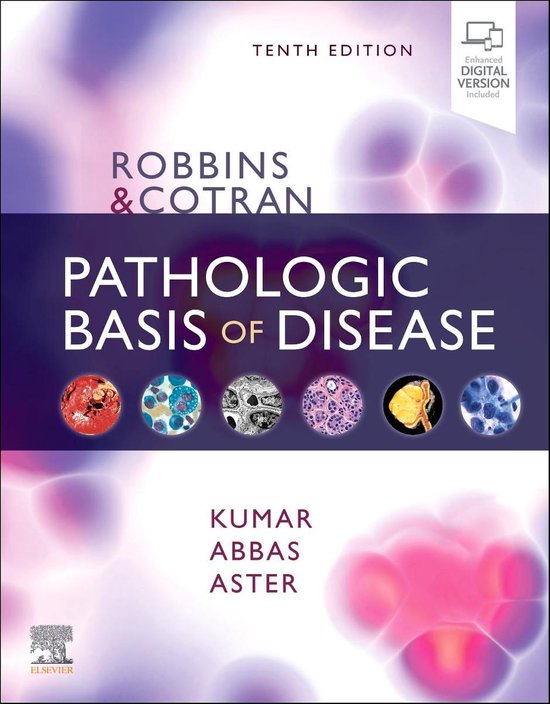
Robbins & Cotran Pathologic Basis of Disease
10th Edition
• Author(s)Vinay Kumar; Abul K. Abbas; Jon C. Aster
1. Chapter Reference – Chapter 1: The Cell as a Unit of
Health and Disease — The Genome
Stem: A 35-year-old woman has recurrent breast and ovarian
cancer in her family. Genetic testing reveals a truncating
mutation in BRCA1 causing loss of function. Which cellular
consequence best explains the increased cancer risk?
A. Enhanced telomerase activity preventing senescence
B. Defective homologous recombination repair of double-strand
DNA breaks
C. Increased mismatch repair leading to microsatellite instability
D. Upregulation of base excision repair producing oncogenic
mutations
Correct Answer: B
,Rationale (correct): BRCA1 is essential for homologous
recombination repair of DNA double-strand breaks; loss impairs
error-free repair, increasing chromosomal instability and cancer
risk.
Rationale (A): Telomerase activation promotes immortality but
is not the primary effect of BRCA1 loss.
Rationale (C): Mismatch repair defects cause microsatellite
instability (e.g., Lynch syndrome), not BRCA1-related cancers.
Rationale (D): Base excision repair fixes small base lesions; its
upregulation is not a mechanism by which BRCA1 loss causes
cancer.
Teaching Point: BRCA1 loss impairs homologous recombination,
increasing genomic instability and cancer risk.
2. Chapter Reference – Chapter 1: The Cell as a Unit of
Health and Disease — The Genome
Stem: A tumor displays kataegis — localized hypermutation
clusters — on sequencing. Which DNA process defect most
likely produces clustered somatic mutations in cancer cells?
A. APOBEC cytidine deaminase activity causing C→T mutations
B. Failure of nucleotide excision repair after UV exposure
C. Loss of DNA polymerase proofreading causing random base
substitutions genome-wide
D. Defective nonhomologous end joining producing deletions
Correct Answer: A
,Rationale (correct): APOBEC enzymes deaminate cytosine to
uracil, producing localized C→T (and C→G) mutations that can
cluster (kataegis) in certain cancers.
Rationale (B): Nucleotide excision repair defects produce UV
signature mutations but typically not tightly clustered kataegis.
Rationale (C): Polymerase proofreading errors tend to be
dispersed rather than highly localized clusters.
Rationale (D): Nonhomologous end joining causes structural
rearrangements/deletions rather than clustered point
mutations.
Teaching Point: APOBEC-mediated cytidine deamination can
generate localized hypermutation (kataegis) in cancers.
3. Chapter Reference – Chapter 1: The Cell as a Unit of
Health and Disease — Cellular Housekeeping
Stem: A hepatocyte sample shows accumulation of Mallory
bodies (cytokeratin aggregates) after chronic alcohol injury.
Which cellular pathway is most directly responsible for clearing
such aggregated proteins under normal conditions?
A. Autophagy–lysosomal degradation
B. Extracellular protease secretion
C. Mitochondrial mitophagy only
D. Proteasomal ubiquitin-dependent degradation is ineffective
for aggregates
Correct Answer: A
, Rationale (correct): Large protein aggregates and damaged
organelles are typically removed by macroautophagy
(autophagy) with lysosomal degradation; Mallory bodies are
often handled this way.
Rationale (B): Extracellular proteases do not clear intracellular
protein aggregates.
Rationale (C): Mitophagy specifically targets mitochondria, not
general cytoskeletal/protein aggregates.
Rationale (D): While the ubiquitin-proteasome system degrades
soluble misfolded proteins, large insoluble aggregates are
mainly removed by autophagy.
Teaching Point: Autophagy clears large intracellular protein
aggregates and damaged organelles.
4. Chapter Reference – Chapter 1: The Cell as a Unit of
Health and Disease — Cellular Metabolism and
Mitochondrial Function
Stem: A patient with ischemic myocardial injury develops
reperfusion arrhythmias. Which mitochondrial event during
reperfusion best explains sudden cardiomyocyte death and
arrhythmogenicity?
A. Activation of mitochondrial ATP synthase increasing ATP
production
B. Opening of the mitochondrial permeability transition pore
(MPTP) with loss of membrane potential
by-Chapter Questions & Verified Solutions
Robbins & Cotran Pathologic Basis of Disease
10th Edition
• Author(s)Vinay Kumar; Abul K. Abbas; Jon C. Aster
1. Chapter Reference – Chapter 1: The Cell as a Unit of
Health and Disease — The Genome
Stem: A 35-year-old woman has recurrent breast and ovarian
cancer in her family. Genetic testing reveals a truncating
mutation in BRCA1 causing loss of function. Which cellular
consequence best explains the increased cancer risk?
A. Enhanced telomerase activity preventing senescence
B. Defective homologous recombination repair of double-strand
DNA breaks
C. Increased mismatch repair leading to microsatellite instability
D. Upregulation of base excision repair producing oncogenic
mutations
Correct Answer: B
,Rationale (correct): BRCA1 is essential for homologous
recombination repair of DNA double-strand breaks; loss impairs
error-free repair, increasing chromosomal instability and cancer
risk.
Rationale (A): Telomerase activation promotes immortality but
is not the primary effect of BRCA1 loss.
Rationale (C): Mismatch repair defects cause microsatellite
instability (e.g., Lynch syndrome), not BRCA1-related cancers.
Rationale (D): Base excision repair fixes small base lesions; its
upregulation is not a mechanism by which BRCA1 loss causes
cancer.
Teaching Point: BRCA1 loss impairs homologous recombination,
increasing genomic instability and cancer risk.
2. Chapter Reference – Chapter 1: The Cell as a Unit of
Health and Disease — The Genome
Stem: A tumor displays kataegis — localized hypermutation
clusters — on sequencing. Which DNA process defect most
likely produces clustered somatic mutations in cancer cells?
A. APOBEC cytidine deaminase activity causing C→T mutations
B. Failure of nucleotide excision repair after UV exposure
C. Loss of DNA polymerase proofreading causing random base
substitutions genome-wide
D. Defective nonhomologous end joining producing deletions
Correct Answer: A
,Rationale (correct): APOBEC enzymes deaminate cytosine to
uracil, producing localized C→T (and C→G) mutations that can
cluster (kataegis) in certain cancers.
Rationale (B): Nucleotide excision repair defects produce UV
signature mutations but typically not tightly clustered kataegis.
Rationale (C): Polymerase proofreading errors tend to be
dispersed rather than highly localized clusters.
Rationale (D): Nonhomologous end joining causes structural
rearrangements/deletions rather than clustered point
mutations.
Teaching Point: APOBEC-mediated cytidine deamination can
generate localized hypermutation (kataegis) in cancers.
3. Chapter Reference – Chapter 1: The Cell as a Unit of
Health and Disease — Cellular Housekeeping
Stem: A hepatocyte sample shows accumulation of Mallory
bodies (cytokeratin aggregates) after chronic alcohol injury.
Which cellular pathway is most directly responsible for clearing
such aggregated proteins under normal conditions?
A. Autophagy–lysosomal degradation
B. Extracellular protease secretion
C. Mitochondrial mitophagy only
D. Proteasomal ubiquitin-dependent degradation is ineffective
for aggregates
Correct Answer: A
, Rationale (correct): Large protein aggregates and damaged
organelles are typically removed by macroautophagy
(autophagy) with lysosomal degradation; Mallory bodies are
often handled this way.
Rationale (B): Extracellular proteases do not clear intracellular
protein aggregates.
Rationale (C): Mitophagy specifically targets mitochondria, not
general cytoskeletal/protein aggregates.
Rationale (D): While the ubiquitin-proteasome system degrades
soluble misfolded proteins, large insoluble aggregates are
mainly removed by autophagy.
Teaching Point: Autophagy clears large intracellular protein
aggregates and damaged organelles.
4. Chapter Reference – Chapter 1: The Cell as a Unit of
Health and Disease — Cellular Metabolism and
Mitochondrial Function
Stem: A patient with ischemic myocardial injury develops
reperfusion arrhythmias. Which mitochondrial event during
reperfusion best explains sudden cardiomyocyte death and
arrhythmogenicity?
A. Activation of mitochondrial ATP synthase increasing ATP
production
B. Opening of the mitochondrial permeability transition pore
(MPTP) with loss of membrane potential