

Written by students who passed Immediately available after payment Read online or as PDF Wrong document? Swap it for free 4.6 TrustPilot
logo-home
Document preview thumbnail
Preview 2 out of 12 pages
Exam (elaborations)

NUR 514 Test 3 (Ch 15-20) Questions with 100% Correct Answers

Document preview thumbnail
Preview 2 out of 12 pages

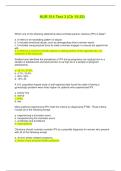
NUR 514 Test 3 (Ch 15-20) Questions with 100% Correct Answers Which one of the following statements about intimate partner violence (IPV) is false? a. It refers to an escalating pattern of abuse. b. It includes emotional abuse, such as disregarding what a woman wants. c. It includes using physical force to make a woman engage in a sexual act against her will. d. It refers to a current or former spouse or dating partner of the opposite sex, not someone of the same sex Studies have identified the prevalence of IPV during pregnancy as ranging from in a sample of adolescents and adult women to as high as in a sample of pregnant adolescents. a. 18.1%; 37.6% b. 4.7%; 10.6% c. 40%; 50% d. 14%; 23 A U.S. population-based study of self-reported data found the odds of having a gynecologic problem were times higher for patients who experienced IPV. a. twenty-five b. twelve c. three d. two Many patients experiencing IPV meet the criteria for diagnosing PTSD. Those criteria include all of the following except a. experiencing a traumatic event. b. reexperiencing the traumatic event. c. numbness and avoidance. d. hypovigilance Clinicians should routinely consider IPV as a possible diagnosis for women who present with all of the following except a. chronic stress-related symptoms. b. denial of any physical health problems. c. central nervous system (CNS) symptoms. d. gynecologic problems, especially multiple ones A theory that includes four categories to describe factors that contribute to a violent relationship—personal history, microsystem, exosystem, and macrosystem—is called the a. Heise's (1998) framework of violence b. Walker's (1979) three-part cycle of violence. c. National Violence Against Women Survey (1998) study. d. International Association of Forensic Nurses (IAFN) Annual Scientific Assembly (2004) report The is probably the most widely used IPV screen a. three-question AAS (McFarlane et al., 1992) b. Campbell's Danger Assessment (2003) c. Sheridan's HARASS Instrument d. Helton's nine-question AAS The most effective means of obtaining the history of abuse is to use a communication model that a. avoids having the patient's children present during the discussion b. signals someone is interested and that the woman is not alone c. emphasizes the belief that violence is not acceptable, no matter what the batterer might have said to the patient. d. allows the patient to talk without interruption and with time to relate, emphasize, and repeat her full story The physical examination of any woman suspected of being abused or battered includes all of the following except a. a thorough inspection for signs of injury, past and present b. a physical assessment just like that of any other adult female c. a focus on the patient's physical appearance, not her behavior d. the use of body maps and diagrams to accurately portray the patient's physical condition The words are among the most commonly misused medical forensic terms a. laceration, ecchymosis, and hematoma b. distal, proximal, and lateral c. rape, assault, and battery d. states, says, and reports The P in the mnemonic EMPOWER is meant to help the clinician remember to a. document findings properly. b. encourage planning for safety and support c. provide information about domestic violence. d. refer to program services such as IPV hotlines and shelters Which one of the following statements about IPV during pregnancy is false? a. affects women more than the most serious antepartum complications. b. Complications are more the result of trauma than psychological abuse. c. IPV is associated with low-birth-weight infants. d. Pregnancy can be a time of escalating violence Plichta (1996) reported that rates of depression, eating disorders, and drug, alcohol, and tobacco use were in girls who reported physical or sexual dating violence as compared to girls who had not been abused. a. about the same b. more than twice as high c. four times as high d. more than ten times as high IPV affects women of all ages, but in elderly women a. the physical and mental sequelae of IPV is much more apparent. b. mistreatment in elder care facilities is the cause, not domestic violence. c. even so-called "low-severity violence" can cause serious injury or death. d. cognitive impairment prevents clinicians from conducting the necessary assessments There is no one legal definition of rape, which means a. clinicians must learn their own state's definitions and statutes. b. it is easier to monitor the incidence of sexual violence in the nation. c. it may be considered a social problem, not a public health problem d. measuring risk and identifying protective measures is a simple task According to Basile & Saltzman (2002) an example of "noncontact sexual abuse," which involves either nonconsent or the inability to give consent, is an a. attempted but not completed sex act b. intentional exposure of an individual to exhibitionism. c. contact between the penis and anus involving penetration. d. intentional touching of the genitalia through clothing The U.S Department of Justice estimates that forcible rapes occurred in the United States in 2008. a. 1,200 b. 24,000 c. 89,000 d. 303,000 The National Violence Against Women (NVAW) national survey conducted between 1995 and 1996 showed that in the United States a. men experience significantly more IPV than women b. 5% of women have survived a completed or attempted rape. c. violence against women is primarily perpetrated by strangers. d. over 20% of female rape survivors were younger than 12 when first raped Data from the NVAW study reveal that women are men to be physically injured during a rape a. less likely than b. just as likely as c. twice as likely as d. 20% more likely than Which one of the following statements about genital trauma associated with rape is false? a. No method currently available can differentiate genital trauma caused by rape from tampon use. b. There is a clear need for studies to determine specific patterns of genital injury. c. Few victims sustain significant genital trauma as a result of a sexual assault. d. The absence of genital trauma proves consent Which one of the following statements about the consequences of rape is true? a. Rates of successful suicide after rape are low. b. Sexual dysfunction is an unlikely or rare result. c. STIs are a result of an active sex life, not of rape. d. A victim's alcohol and drug use usually decreases If a patient has not reported a sexual assault to law enforcement, all of the following clinician actions are important except a. asking if reporting is something she wants to consider. b. discussing any fears or concerns that she may have about reporting. c. explaining that only some forced sexual contacts are reportable crimes. d. telling her that women who report do better psychologically than those who do not In respect to an evidentiary examination a. the patient may not withhold consent if the clinician is a mandated reporter. b. the clinician is required to strictly follow local agency protocols, no others. c. the time frame within which it must take place depends on local standards. d. maintaining the chain of custody of all evidence collected is recommended, not required The clinician's role in the care of an adult sexual assault victim should a. encompass all aspects of the biopsychosocial needs of the patient. b. include testing for all sexually transmitted infections (STIs). c. avoid discussion of vulnerability to future abuse. d. only focus on the related physical trauma Both very young and elderly sexual assault victims a. are addressed in most state mandatory reporting laws b. may have difficulty describing the incident and related symptoms. c. require the same equipment for proper examination that others do. d. have fewer injuries than victims of other age groups. Which one of the following statements about sexual and gender minorities is false? a. Gays and lesbians are more frequently assaulted by heterosexual males. b. Similar to heterosexuals, many LGBT individuals do not report sexual assault. c. The needs of LGBT people who have been sexually assaulted are represented well in research. d. Crimes against them are likely to be more violent than crimes motivated by race, ethnicity, or religion Cyclic mastalgia a. more likely causes unilateral, localized pain that is sharp or burning in nature. b. has an increased risk of occurrence in women whose diets are low in fat. c. occurs most frequently in women who are 18 to 30 years old d. is caused by hormonal changes associated with menstruation The possibility of cancer is associated with mastalgia when the pain a. occurs in perimenopausal women who are receiving HT b. is accompanied by skin changes or palpable abnormality. c. is felt in both breasts equally and is related to a cyclic pattern d. is reproducible with palpation of the chest wall. Effective for 85% of women who have mild or moderate symptoms of mastalgia, the first line of treatment is a. reassurance. b. reduction mammoplasty. c. isoflavones, or naturally occurring phytoestrogens. d. 2% lidocaine injection and 40 mg of methyl prednisone Mammary duct ectasia a. is one of the most common causes of milky nipple discharge b. like intraductal papilloma, is typically unilateral and uniductal c. usually occurs in women 20 to 35 years of age. d. discharge may be green, brown, or black in color. If a woman is complaining of bilateral, milky nipple discharge, the clinician is to first a. perform a pregnancy test b. perform a mammogram and an ultrasound of the breasts c. assess the sella turcica with magnetic resonance imaging (MRI) d. obtain a serum prolactin level and a thyroid-stimulating The most common benign breast masses are a. galactoceles. b. hamartomas c. fibroadenomas and cysts d. lipomas and phyllodestumors Which breast tissue sampling procedure is best to use when density or calcification is seen on a mammogram in a location that cannot be effectively assessed with a core biopsy? a. Fine-needle aspiration b. MRI-guided needle biopsy c. Needle-localized breast biopsy d. Excisional breast biopsy Among women aged 55 years and older a. macromastia is the most common cause of breast masses b. breast masses are presumed malignant until proven otherwise

Content preview

NUR 514 Test 3 (Ch 15-20)


Which one of the following statements about intimate partner violence (IPV) is false?

a. It refers to an escalating pattern of abuse.
b. It includes emotional abuse, such as disregarding what a woman wants.
c. It includes using physical force to make a woman engage in a sexual act against her
will.
d. It refers to a current or former spouse or dating partner of the opposite sex, not
someone of the same sex

Studies have identified the prevalence of IPV during pregnancy as ranging from in a
sample of adolescents and adult women to as high as in a sample of pregnant
adolescents.

a. 18.1%; 37.6%
b. 4.7%; 10.6%
c. 40%; 50%
d. 14%; 23

A U.S. population-based study of self-reported data found the odds of having a
gynecologic problem were times higher for patients who experienced IPV.

a. twenty-five
b. twelve
c. three
d. two

Many patients experiencing IPV meet the criteria for diagnosing PTSD. Those criteria
include all of the following except

a. experiencing a traumatic event.
b. reexperiencing the traumatic event.
c. numbness and avoidance.
d. hypovigilance

Clinicians should routinely consider IPV as a possible diagnosis for women who present
with all of the following except

a. chronic stress-related symptoms.
b. denial of any physical health problems.

, c. central nervous system (CNS) symptoms.
d. gynecologic problems, especially multiple ones

A theory that includes four categories to describe factors that contribute to a violent
relationship—personal history, microsystem, exosystem, and macrosystem—is called
the

a. Heise's (1998) framework of violence
b. Walker's (1979) three-part cycle of violence.
c. National Violence Against Women Survey (1998) study.
d. International Association of Forensic Nurses (IAFN) Annual Scientific Assembly
(2004) report

The is probably the most widely used IPV screen

a. three-question AAS (McFarlane et al., 1992)
b. Campbell's Danger Assessment (2003)
c. Sheridan's HARASS Instrument
d. Helton's nine-question AAS

The most effective means of obtaining the history of abuse is to use a communication
model that

a. avoids having the patient's children present during the discussion
b. signals someone is interested and that the woman is not alone
c. emphasizes the belief that violence is not acceptable, no matter what the batterer
might have said to the patient.
d. allows the patient to talk without interruption and with time to relate, emphasize, and
repeat her full story

The physical examination of any woman suspected of being abused or battered
includes all of the following except

a. a thorough inspection for signs of injury, past and present
b. a physical assessment just like that of any other adult female
c. a focus on the patient's physical appearance, not her behavior
d. the use of body maps and diagrams to accurately portray the patient's physical
condition

The words are among the most commonly misused medical forensic terms

a. laceration, ecchymosis, and hematoma
b. distal, proximal, and lateral
c. rape, assault, and battery
d. states, says, and reports

Document information

Uploaded on
September 15, 2025
Number of pages
12
Written in
2025/2026
Type
Exam (elaborations)
Contains
Questions & answers
$16.99

Wrong document? Swap it for free Within 14 days of purchase and before downloading, you can choose a different document. You can simply spend the amount again.
Written by students who passed
Immediately available after payment
Read online or as PDF

Seller avatar
Reputation scores are based on the amount of documents a seller has sold for a fee and the reviews they have received for those documents. There are three levels: Bronze, Silver and Gold. The better the reputation, the more your can rely on the quality of the sellers work.
NurseHenny
4.4
(31)
Sold
171
Followers
75
Items
2064
Last sold
19 hours ago


Why students choose Stuvia

Created by fellow students, verified by reviews

Quality you can trust: written by students who passed their tests and reviewed by others who've used these notes.

Didn't get what you expected? Choose another document

No worries! You can instantly pick a different document that better fits what you're looking for.

Pay as you like, start learning right away

No subscription, no commitments. Pay the way you're used to via credit card and download your PDF document instantly.

Student with book image

“Bought, downloaded, and aced it. It really can be that simple.”

Alisha Student

Working on your references?

Create accurate citations in APA, MLA and Harvard with our free citation generator.

Working on your references?

Frequently asked questions
