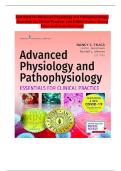
Test Bank for Advanced Physiology and Pathophysiology:
Essentials for Clinical Practice: 2nd Edition Author:Nancy
Tkacs and Linda Herrmann
,Test Bank for Advanced Physiology and Pathophysiology
TEST BANK
CHAPTER 1. THE FOUNDATIONAL CONCEPTS OF CLINICAL PRACTICE
ANSWER KEY AT THE END OF EACH CHAPTER
1. The characteristic, localized cardinal signs of acute inflammation include:
A) fever.
B) fatigue.
C) redness.
D) granuloma.
2. The vascular, hemodynamic stage of acute inflammation is initiated by momentary
vasoconstriction followed by vasodilation that causes localized:
A) bleeding.
B) congestion.
C) pale skin.
D) coolness.
3. The cellular stage of acute inflammation is marked by the movement of leukocytes into
the area. Which of the following cells arrives early in great numbers?
A) Basophils
B) Lymphocytes
C) Neutrophils
2
,Test Bank for Advanced Physiology and Pathophysiology
D) Platelets
4. The phagocytosis process involves three distinct steps. What is the initial step in the
process?
A) Engulfment
B) Intracellular killing
C) Antigen margination
D) Recognition and adherence
5. Which of the following mediators of inflammation causes increased capillary
permeability and pain?
A) Serotonin
B) Histamine
C) Bradykinin
D) Nitric oxide
6. Inflammatory exudates are a combination of several types. Which of the following
exudates is composed of enmeshed necrotic cells?
A) Serous
B) Fibrinous
C) Suppurative
D) Membranous
3
, Test Bank for Advanced Physiology and Pathophysiology
7. The acute-phase systemic response usually begins within hours of the onset of
inflammation and includes:
A) fever and lethargy.
B) decreased C-reactive protein.
C) positive nitrogen balance.
D) low erythrocyte sedimentation rate.
8. In contrast to acute inflammation, chronic inflammation is characterized by which of the
following phenomena?
A) Profuse fibrinous exudation
B) A shift to the left of granulocytes
C) Metabolic and respiratory alkalosis
D) Lymphocytosis and activated macrophages
9. Exogenous pyrogens (interleukin-1) and the presence of bacteria in the blood lead to the
release of endogenous pyrogens that:
A) stabilize thermal control in the brain.
B) produce leukocytosis and anorexia.
C) block viral replication in cells.
D) inhibit prostaglandin release.
4