
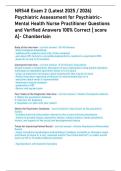
NR548 Exam 2 (Latest )
Psychiatric Assessment for Psychiatric-
Mental Health Nurse Practitioner Questions
and Verified Answers 100% Correct [ score
A]- Chamberlain
Body of the Interview - correct answer -30-40 minutes
-Chief Complaint Established
• additional Q's asked to elicit info r/t the complaint
-ask about HPI, family hx, social/developmental hx, medical hx, psychiatric ROS
-basis for dx and tx formulation
Closing the Interview - correct answer -5-10 minutes, final phase
Should include 2 components: discussion of your assessment using patient education
techniques & negotiated agreement about tx or f/u plans
-wrap-up statement and inquiry about missing info that may be of value
-Patient education regarding working dx & recommended plan of tx
• education about meds if recommended
-Homework may be assigned
• especially in CBT
-Return visit agreed upon
Four Tasks of the Diagnostic Interview - correct answer 1. Build a therapeutic alliance
2. Obtain the psychiatric database
3. Interview for diagnosis
4. Negotiate a tx plan with your patient
Obtain the Psychiatric Database - correct answer Also known as the psychiatric
history
-includes historical information relevant to the current clinical presentation
• history of present illness, psychiatric history, medical history, family psychiatric
history, and aspects of the social and developmental history
Tricks for Improving Patient Recall - correct answer -Anchor Questions to Memorable
Events
• major transitions (graduations and birthdays), holidays, accidents or illnesses, major
purchases (a house or a car), seasonal events ("hurricane Katrina"), or public events
(such as 9/11 or President Obama's election)
-Tag Questions with Specific Examples
,NR548 Exam 2 (Latest )
Psychiatric Assessment for Psychiatric-
Mental Health Nurse Practitioner Questions
and Verified Answers 100% Correct [ score
A]- Chamberlain
• similar to posing multiple-choice questions, specifically for areas in which your
patient is having trouble with recall
-Define Technical Terms
• patient's vague recall may be a lack of understanding of terms
How to Change Topics with Style - correct answer -Smooth Transition
• cue off something the patient just said to introduce a new topic
-Referred Transition
• refer to something the patient said earlier in the interview to move to a new topic
-Introduced Transition
• introduce the next topic or series of topics before actually launching into it
Techniques for the Reluctant Patient - correct answer -Open-Ended Questions and
Commands
• increase the flow of information
-Continuation Techniques, keep the flow coming:
• Go on.
• Uh huh.
• Continue with what you were saying about...
• Really?
• Wow
-Neutral Ground
• changing the subject to something nonpsychiatric, with the intention of sidling back
into your territory once you've gained the patient's trust.
-Second Interview
• When all else fails
*must feel comfortable that the patient is not at imminent risk of suicide or other
dangerous behaviors
, NR548 Exam 2 (Latest )
Psychiatric Assessment for Psychiatric-
Mental Health Nurse Practitioner Questions
and Verified Answers 100% Correct [ score
A]- Chamberlain
Techniques for the Overly Talkative Patient - correct answer -Closed-ended and
multiple-choice questions
-Redirecting questions to another topic
• The Art of the Gentle Interruption
• redirecting statement
• empathic interruption, you add an empathic statement to soften the blow
• educating interruption incorporates a structuring statement in which you educate the
patient about the sorts of questions you have yet to ask and the time constraints you're
both working under
-Structuring statements regarding information required and/or clinical procedures
-brisk, highly controlling style
therapeutic or nontherapeutic communication & communication technique it
represents: Why are you so anxious? - correct answer Nontherapeutic
communication technique: Asking for Explanations
therapeutic or nontherapeutic communication & communication technique it
represents: Why don't you and John get married? - correct answer Nontherapeutic
communication technique: Asking Personal Questions
therapeutic or nontherapeutic communication & communication technique it
represents: What would you like to talk about today? - correct answer Therapeutic
communication technique: Broad Openings
therapeutic or nontherapeutic communication & communication technique it
represents: What do you think you should do about it? - correct answer Therapeutic
communication technique: Reflecting
therapeutic or nontherapeutic communication: Older adults are always confused. -
correct answer Nontherapeutic
Psychiatric Assessment for Psychiatric-
Mental Health Nurse Practitioner Questions
and Verified Answers 100% Correct [ score
A]- Chamberlain
Body of the Interview - correct answer -30-40 minutes
-Chief Complaint Established
• additional Q's asked to elicit info r/t the complaint
-ask about HPI, family hx, social/developmental hx, medical hx, psychiatric ROS
-basis for dx and tx formulation
Closing the Interview - correct answer -5-10 minutes, final phase
Should include 2 components: discussion of your assessment using patient education
techniques & negotiated agreement about tx or f/u plans
-wrap-up statement and inquiry about missing info that may be of value
-Patient education regarding working dx & recommended plan of tx
• education about meds if recommended
-Homework may be assigned
• especially in CBT
-Return visit agreed upon
Four Tasks of the Diagnostic Interview - correct answer 1. Build a therapeutic alliance
2. Obtain the psychiatric database
3. Interview for diagnosis
4. Negotiate a tx plan with your patient
Obtain the Psychiatric Database - correct answer Also known as the psychiatric
history
-includes historical information relevant to the current clinical presentation
• history of present illness, psychiatric history, medical history, family psychiatric
history, and aspects of the social and developmental history
Tricks for Improving Patient Recall - correct answer -Anchor Questions to Memorable
Events
• major transitions (graduations and birthdays), holidays, accidents or illnesses, major
purchases (a house or a car), seasonal events ("hurricane Katrina"), or public events
(such as 9/11 or President Obama's election)
-Tag Questions with Specific Examples
,NR548 Exam 2 (Latest )
Psychiatric Assessment for Psychiatric-
Mental Health Nurse Practitioner Questions
and Verified Answers 100% Correct [ score
A]- Chamberlain
• similar to posing multiple-choice questions, specifically for areas in which your
patient is having trouble with recall
-Define Technical Terms
• patient's vague recall may be a lack of understanding of terms
How to Change Topics with Style - correct answer -Smooth Transition
• cue off something the patient just said to introduce a new topic
-Referred Transition
• refer to something the patient said earlier in the interview to move to a new topic
-Introduced Transition
• introduce the next topic or series of topics before actually launching into it
Techniques for the Reluctant Patient - correct answer -Open-Ended Questions and
Commands
• increase the flow of information
-Continuation Techniques, keep the flow coming:
• Go on.
• Uh huh.
• Continue with what you were saying about...
• Really?
• Wow
-Neutral Ground
• changing the subject to something nonpsychiatric, with the intention of sidling back
into your territory once you've gained the patient's trust.
-Second Interview
• When all else fails
*must feel comfortable that the patient is not at imminent risk of suicide or other
dangerous behaviors
, NR548 Exam 2 (Latest )
Psychiatric Assessment for Psychiatric-
Mental Health Nurse Practitioner Questions
and Verified Answers 100% Correct [ score
A]- Chamberlain
Techniques for the Overly Talkative Patient - correct answer -Closed-ended and
multiple-choice questions
-Redirecting questions to another topic
• The Art of the Gentle Interruption
• redirecting statement
• empathic interruption, you add an empathic statement to soften the blow
• educating interruption incorporates a structuring statement in which you educate the
patient about the sorts of questions you have yet to ask and the time constraints you're
both working under
-Structuring statements regarding information required and/or clinical procedures
-brisk, highly controlling style
therapeutic or nontherapeutic communication & communication technique it
represents: Why are you so anxious? - correct answer Nontherapeutic
communication technique: Asking for Explanations
therapeutic or nontherapeutic communication & communication technique it
represents: Why don't you and John get married? - correct answer Nontherapeutic
communication technique: Asking Personal Questions
therapeutic or nontherapeutic communication & communication technique it
represents: What would you like to talk about today? - correct answer Therapeutic
communication technique: Broad Openings
therapeutic or nontherapeutic communication & communication technique it
represents: What do you think you should do about it? - correct answer Therapeutic
communication technique: Reflecting
therapeutic or nontherapeutic communication: Older adults are always confused. -
correct answer Nontherapeutic


