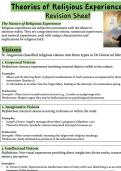
Theories of Religious
Experience
Revision Sheet
The Nature of Religious Experience
Religious experiences are subjective encounters with the
divine or ultimate reality. They are categorised into visions,
numinous experiences, and mystical experiences, each with
unique characteristics and implications for religious faith.
Visions
St. Augustine classified religious visions into three types in De G
ad litteram:
1. Corporeal Visions
Definition: Sensory experiences involving external objects visible to the
subject.
Examples:
• Moses and the Burning Bush: A physical manifestation of God's presence accom
by divine instructions (Exodus 3).
• St. Bernadette at Lourdes: Saw the Virgin Mary, leading to the discovery of a m
spring.
Evaluation:
Strengths: Often lead to transformative actions (e.g., Lourdes as a pilgrimage site)
Weaknesses: Skeptics argue they may be hallucinations or psychological phenomen
2. Imaginative Visions
Definition: Internal visions occurring in dreams or within the mind.
Examples:
• Joseph’s Dream: Angelic message about Mary’s pregnancy (Matthew 1:20).
• Pharaoh’s Dreams: Symbolic visions interpreted by Joseph (Genesis 41).
Evaluation:
Strengths: Often contain symbolic meaning that aligns with religious teachings.
Weaknesses: Easily dismissed as products of the subconscious mind.
. Intellectual Visions
3
Definition: Non-visual experiences providing direct insight into divine tr
transcending sensory perception.
Examples:
• St. Teresa of Avila: Experienced an intellectual vision of unity with God, describ
Experience
Revision Sheet
The Nature of Religious Experience
Religious experiences are subjective encounters with the
divine or ultimate reality. They are categorised into visions,
numinous experiences, and mystical experiences, each with
unique characteristics and implications for religious faith.
Visions
St. Augustine classified religious visions into three types in De G
ad litteram:
1. Corporeal Visions
Definition: Sensory experiences involving external objects visible to the
subject.
Examples:
• Moses and the Burning Bush: A physical manifestation of God's presence accom
by divine instructions (Exodus 3).
• St. Bernadette at Lourdes: Saw the Virgin Mary, leading to the discovery of a m
spring.
Evaluation:
Strengths: Often lead to transformative actions (e.g., Lourdes as a pilgrimage site)
Weaknesses: Skeptics argue they may be hallucinations or psychological phenomen
2. Imaginative Visions
Definition: Internal visions occurring in dreams or within the mind.
Examples:
• Joseph’s Dream: Angelic message about Mary’s pregnancy (Matthew 1:20).
• Pharaoh’s Dreams: Symbolic visions interpreted by Joseph (Genesis 41).
Evaluation:
Strengths: Often contain symbolic meaning that aligns with religious teachings.
Weaknesses: Easily dismissed as products of the subconscious mind.
. Intellectual Visions
3
Definition: Non-visual experiences providing direct insight into divine tr
transcending sensory perception.
Examples:
• St. Teresa of Avila: Experienced an intellectual vision of unity with God, describ