

Written by students who passed Immediately available after payment Read online or as PDF Wrong document? Swap it for free 4.6 TrustPilot
logo-home
Document preview thumbnail
Preview 2 out of 11 pages
Exam (elaborations)

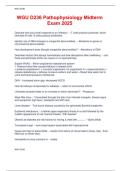
WGU D236 Pathophysiology Midterm Exam 2025

Document preview thumbnail
Preview 2 out of 11 pages

WGU D236 Pathophysiology Midterm Exam 2025 Describe how your body responds to an infection. - -T cells produce cytokines, which stimulate B cells. B cells produce antibodies. Identify role of DNA changes in congenital abnormalities. - -Mutations in genes or chromosomal abnormalities How development does disrupts congenital abnormalities? - -Alterations of DNA Describes factors that disrupt homeostasis and how disruptions affect wellbeing. - -(ex) Fluid and electrolyte shifts can cause n/v or dysrhythmias. Explain RAAS - -Renin-angiotensin-aldosterone system 1. Reduce blood flow causes kidneys to release renin produce angiotensin I converts angiotensin I to angiotensin II vasoconstriction release aldosterone kidneys conserve sodium and water Result less water lost in urine and blood pressure maintained. DKA - -increased anion gap, decreased HCO3 How do kidneys compensate for alkalosis - -retain H and excrete HCO3 Untreated acidosis leads to an increase in which electrolyte? - -Potassium West Nile Virus - -Transmitted through the bite of an infected mosquito. Severe signs and symptoms; high fever, headache and stiff neck Lyme disease - -Tick-borne disease caused by the spirochete Borrelia burgdorferi. Erythema infectiosum - -a febrile upper respiratory illness in a child followed by the sudden appearance of red, flushed cheeks, "fifth disease" Obesity ad diabetes are risk factors for having a child with _____. - -Spina bifida Trousseau's sign - -arm/carpal spasm associated with hypocalcemia Cause and sign of spina bifida - -results from failure of neural tube to close. sign - fluid filled sac on lower back. hemophilia is more common in - -males WGU D236 WGU D236 Prenatal exposure to alcohol includes - -ND-PAE, decreased brain function, FAS Connective vs muscle tissue disorders - -Connective- RA, Scleroderma, Lupus Muscle - MS, Muscular dystrophy, Myasthenia Gravia Describe Lupus - -Inflammatory disorder characterized by joint pain and butterfly rash Describe Myasthenia Gravis - -It is an autoimmune disorder where antibodies attack own Ach receptors. This causes weakness of skeletal muscles over the course of the day, along with ptosis, double vision, and difficulty swallowing. Dermatitis - -inflammation of the skin Eczema - -noninfectious, inflammatory skin disease characterized by redness, blisters, scabs, and itching Decubitus ulcer - -sore caused by lying down for long periods of time Fungal infections - -superficial, localized skin conditions or deep tissue infections caused by exposure to spores May or may not be transmitted Benign neoplasm - -noncancerous growths, stationary, distinct borders Malignant neoplasm - -uncontrolled new tissue growth, irregular borders, spreads Osteoporosis - -The loss of bone mass often due to age, causing the bones to become porous, brittle, and easily fractured. osteomalacia - -disease marked by softening of the bone caused by calcium and vitamin D deficiency Myoglobin - -red pigment that stores oxygen in muscle cells Bursa - -fluid-filled sac that allows for easy movement of one part of a joint over another Rickets - -a vitamin D deficiency in children, resulting in soft bones Degenerative disk disease - -A condition in which an intervertebral disk loses its normal structural integrity as a result of wear and tear, acute or repeated injuries or aging Paget disease - -Chronic inflammation of bones, resulting in thickening and softening of bones, that can occur in any bone but most commonly affects the long bones of the legs, the lower spine, the pelvis, and the skull WGU D236 WGU D236 Comminuted fracture - -splintered into many pieces Three types of skin cancer - -1. Basal cell carcinoma 2. Squamous cell carcinoma 3. Melanoma Basal cell carcinoma - -Most common and least severe type of skin cancer; often characterized by light or pearly nodules. Rarely metastasize, most common on face due to sun exposure Squamous cell carcinoma - -Type of skin cancer more serious than basal cell carcinoma; often characterized by scaly red crusted papules or firm nodules. Melanoma - -The most serious form of skin cancer, caucasian males at highest risk, usually black or brown lesion consequences when integumentary system is disrupted - -impaired immunity types of burns - -Superficial (1st degree) - red/painful Partial-thickness (2nd degree) -wet/pink/painful Full-thickness (3rd degree) -white/swollen/no pain Viltigo - -localized loss of skin pigmentation characterized by milk-white patches Ischemic CVA vs hemorrhagic CVA - -ischemic - clot vs hemorrhagic - blood Subdural hematoma - -collection of blood under the dura mater Alzheimer's disease vs parkinson's disease - -Alz - affects language and memory Park - affects all executive functioning Huntington's disease - -Genetic disorder that causes progressive deterioration of brain cells. caused by a dominant allele. symptoms do not appear until about the age of 30. involves involuntary muscle movement Sclerosis - -abnormal condition of hardening Disorders that cause vision loss - -glaucoma - loss of pheripheral vision, cataracts - cloudy vision, retinal detachment - floaters, flashes, curtain vision Kyphosis - -excessive outward curvature of the spine, causing hunching of the back. Disorders that cause hearing loss - -Meniere's disease - changes in fluid in tube of inner ear (imbalance and vertigo), Otitis media - middle ear infection WGU D236 WGU D236 Predisposing factors of ischemic stroke - -a fib, carotid stenosis, cerebral arteriosclerosis Rheumatoid arthritis - -A chronic systemic disease characterized by inflammation of the joints, stiffness, pain, and swelling that results in crippling deformities. Causes elevated WBC counts. Cerebral contusion - -the bruising of brain tissue as the result of a head injury that causes the brain to bounce against the rigid bone of the skull; symptoms: ringing in ears, severe headache, n/v. TIA vs CVA - -TIA = -result when a cerebral artery is temp blocked and decreases blood flow to brain Stroke= artery completely blocked leading to death of brain and permanent loss of certain functions Multiple sclerosis - -A chronic, irreversible disease of the central nervous system marked by damage to the myelin sheath. Plaques occur in the brain and spinal cord causing tremor, weakness, incoordination, paresthesia, and disturbances in vision and speech aneurysm - -ballooning of a weakened portion of an arterial wall thrombus vs embolus - -Thrombus = clot in arteries embolus = dislodged traveling clot in arteries, blocks blood flow Artherosclerosis - -Hardening and narrowing of the arteries due to buildup of cholesterol plaques helial injury cell formation streak formation Angina pectoris - -chest pain, which may radiate to the left arm and jaw, that occurs when there is an insufficient supply of blood to the heart muscle Myocardial infarction - -the occlusion of one or more coronary arteries caused by plaque buildup (heart attack) Endocarditis - -inflammation of the inner lining of the heart Pericarditis - -inflammation of the pericardium (sack surrounding heart) Benign vs malignant hypertension - -benign - "essential hypertension", chronic vascular damage due to sodium retention. WGU D236 WGU D236 Malignant - acute vascular damage due to renin release communicable disease - -A disease that can be spread from one person or species to another. infectious disease - -A disease that is caused by a pathogen and that can be spread from one individual to another. myocardial infarction causes damage to - -arteries of : brain, retina, heart, kidneys. what is expected in right sided heart falure - -JVD what characterizes hypertensive crisis - -systolic BP 180 types of anemia - -- Aplastic (decreased or missing RBC production) - Iron Deficiency - Folic Acid Deficiency - Vitamin B12 Deficiency/Pernicious - Hemolytic (breakdown of RBCs faster than produced) - Sickle Cell (RBCs die too early, shortage of RBCs) Where does cancer originate from in leukemia? - -bone marrow CD4 cells - -Helper T cells that mature in thymus that active B cells to create immunity Hodgkin's lymphoma - -distinguished from other lymphomas by the presence of large, cancerous lymphocytes known as Reed-Sternberg cells Lymphocytosis - -abnormal increase in lymphocytes, asymptomatic Stable angina - -predictable and consistent pain that occurs on exertion and is relieved by rest and/or nitroglycerin Upper respiratory tract infection - -common cold, laryngitis, croup, pharyngitis, rhinitis, sinusitis, and tonsillitis Lower respiratory tract infection - -pneumonia, bronchitis, tuberculosis Conditions that lead to COPD - -smoking, asthma, dust, chemicals, genetics Pneumonia - -an inflammation in the lung caused by infection from bacteria, viruses, fungi, or parasites, or resulting from aspiration of chemicals. Hear crackles and rhonchi. Asthma - -treatment resistant bronchospasm, same category of COPD Pneumothorax - -air in the pleural cavity caused by a puncture of th

Content preview

WGU D236


WGU D236 Pathophysiology Midterm
Exam 2025
Describe how your body responds to an infection. - -T cells produce cytokines, which
stimulate B cells. B cells produce antibodies.

Identify role of DNA changes in congenital abnormalities. - -Mutations in genes or
chromosomal abnormalities

How development does disrupts congenital abnormalities? - -Alterations of DNA

Describes factors that disrupt homeostasis and how disruptions affect wellbeing. - -(ex)
Fluid and electrolyte shifts can cause n/v or dysrhythmias.

Explain RAAS - -Renin-angiotensin-aldosterone system
1. Reduce blood flow causes kidneys to release renin
> produce angiotensin I > converts angiotensin I to angiotensin II > vasoconstriction >
release aldosterone > kidneys conserve sodium and water > Result less water lost in
urine and blood pressure maintained.

DKA - -increased anion gap, decreased HCO3

How do kidneys compensate for alkalosis - -retain H and excrete HCO3

Untreated acidosis leads to an increase in which electrolyte? - -Potassium

West Nile Virus - -Transmitted through the bite of an infected mosquito. Severe signs
and symptoms; high fever, headache and stiff neck

Lyme disease - -Tick-borne disease caused by the spirochete Borrelia burgdorferi.

Erythema infectiosum - -a febrile upper respiratory illness in a child followed by the
sudden appearance of red, flushed cheeks, "fifth disease"

Obesity ad diabetes are risk factors for having a child with _____. - -Spina bifida

Trousseau's sign - -arm/carpal spasm associated with hypocalcemia

Cause and sign of spina bifida - -results from failure of neural tube to close. sign - fluid
filled sac on lower back.

hemophilia is more common in - -males


WGU D236

, WGU D236


Prenatal exposure to alcohol includes - -ND-PAE, decreased brain function, FAS

Connective vs muscle tissue disorders - -Connective- RA, Scleroderma, Lupus
Muscle - MS, Muscular dystrophy, Myasthenia Gravia

Describe Lupus - -Inflammatory disorder characterized by joint pain and butterfly rash

Describe Myasthenia Gravis - -It is an autoimmune disorder where antibodies attack
own Ach receptors. This causes weakness of skeletal muscles over the course of the
day, along with ptosis, double vision, and difficulty swallowing.

Dermatitis - -inflammation of the skin

Eczema - -noninfectious, inflammatory skin disease characterized by redness, blisters,
scabs, and itching

Decubitus ulcer - -sore caused by lying down for long periods of time

Fungal infections - -superficial, localized skin conditions or deep tissue infections
caused by exposure to spores

May or may not be transmitted

Benign neoplasm - -noncancerous growths, stationary, distinct borders

Malignant neoplasm - -uncontrolled new tissue growth, irregular borders, spreads

Osteoporosis - -The loss of bone mass often due to age, causing the bones to become
porous, brittle, and easily fractured.

osteomalacia - -disease marked by softening of the bone caused by calcium and
vitamin D deficiency

Myoglobin - -red pigment that stores oxygen in muscle cells

Bursa - -fluid-filled sac that allows for easy movement of one part of a joint over another

Rickets - -a vitamin D deficiency in children, resulting in soft bones

Degenerative disk disease - -A condition in which an intervertebral disk loses its normal
structural integrity as a result of wear and tear, acute or repeated injuries or aging

Paget disease - -Chronic inflammation of bones, resulting in thickening and softening of
bones, that can occur in any bone but most commonly affects the long bones of the
legs, the lower spine, the pelvis, and the skull


WGU D236

Document information

Uploaded on
September 10, 2025
Number of pages
11
Written in
2025/2026
Type
Exam (elaborations)
Contains
Questions & answers
$15.49

Wrong document? Swap it for free Within 14 days of purchase and before downloading, you can choose a different document. You can simply spend the amount again.
Written by students who passed
Immediately available after payment
Read online or as PDF

Seller avatar
Reputation scores are based on the amount of documents a seller has sold for a fee and the reviews they have received for those documents. There are three levels: Bronze, Silver and Gold. The better the reputation, the more your can rely on the quality of the sellers work.
AlexScorer
2.5
(2)
Sold
11
Followers
0
Items
1800
Last sold
2 weeks ago


Why students choose Stuvia

Created by fellow students, verified by reviews

Quality you can trust: written by students who passed their tests and reviewed by others who've used these notes.

Didn't get what you expected? Choose another document

No worries! You can instantly pick a different document that better fits what you're looking for.

Pay as you like, start learning right away

No subscription, no commitments. Pay the way you're used to via credit card and download your PDF document instantly.

Student with book image

“Bought, downloaded, and aced it. It really can be that simple.”

Alisha Student

Working on your references?

Create accurate citations in APA, MLA and Harvard with our free citation generator.

Working on your references?

Frequently asked questions
