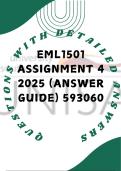
EML1501 ASSIGNMENT 4 2025 (Answer Guide) 593060
EML1501 ASSIGNMENT 4 2025 (Answer Guide) 593060 Question 1 — Overview Role of parents in the promotion of emergent literacy Parents are children’s first and most consistent literacy partners: they model language, provide scaffolding, and establish routines that make print meaningful (Vygotsky, 1978). Practical parental strategies include shared book reading with dialogic prompts (asking the child to predict, label, or retell), daily storytelling, singing rhymes to build phonological awareness, and labelling objects around the home to connect spoken words with print (Whitehurst & Lonigan, 1998; Sénéchal & LeFevre, 2002). These activities expand vocabulary, strengthen narrative skills and teach conventions of print (book handling, left-to-right direction), which together form the foundation of emergent literacy (Neuman & Dickinson, 2011). How you can identify a child who is emergent literate An emergent literate child shows observable behaviours rather than formal decoding: interest in books, pretending to read, scribbling and emergent writing, retelling simple stories, noticing environmental print (logos, signs), letter recognition of some familiar letters, and playful experimentation with sounds (phonological play). They also demonstrate increasing attention spans during joint reading and begin mapping sounds to symbols (Clay, 1991; National Early Literacy Panel, 2008). Use brief, authentic observations (e.g., child’s story retell after a picture book) to document these milestones. How a child’s family background affects literacy Family background shapes the quantity and quality of language input and access to literacy resources. Socioeconomic status, parental education, home language practices and cultural storytelling traditions influence vocabulary exposure, frequency of book interactions and attitudes toward formal schooling (Hart & Risley, 1995; Heath, 1983). Resource constraints may limit books and responsive tal
Document information
- Uploaded on
- September 9, 2025
- Number of pages
- 17
- Written in
- 2025/2026
- Type
- Exam (elaborations)
- Contains
- Questions & answers