

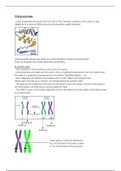
Chromosomes
= long, thread-like structures that form part of the chromatin network in the nuclei of cells.
(Made up of a strand of DNA wound around proteins called histones)
Chromosomes absorb dye easily and where therefore named coloured bodies.
They are however only visible when they are dividing.
In somatic cells:
- The number of chromosomes in each cell is the same
- Chromosomes are made up of two sets, one is a maternal chromosome from the mother and
the other is a paternal chromosome from the father (Therefore Diploid – 2n)
- Each paternal and maternal chromosome form a pair called a homologous pair
(these pairs only pair up in meiosis, not mitosis hence the somatic cells)
- The paternal and maternal chromosomes are equal in size and shape, have the same gene in
the same place, but may have a varying alleles for each
- The DNA of each chromosome replicates to form two identical threats called chromatids joined
by a centromere
During interphase
Maternal
Paternal Maternal
Paternal
Same gene on same chromosome
e.g. for red blood cell shape is gene
21 on chromosome 9 for everyone
, Gene location
= logus adress
Format: Chromosome no. Gene no.
Sequence of nucleotides that codes for
one specific characteristic
Crossing over
(leads to genetic diversity)
When homologous pairs are formed, the chromosomes can touch.
A gene segment from the maternal and paternal chromosome then breaks off and is exchanged
with the other.
Bivalent
the breaking point
Dominance and recession
Physical trait = phenotype
e.g. eye colour
B = brown
b = blue
B B B b b b
B B = homozygous dominant
B b = homozygous recessive Genotype
b b = heterozygous
= long, thread-like structures that form part of the chromatin network in the nuclei of cells.
(Made up of a strand of DNA wound around proteins called histones)
Chromosomes absorb dye easily and where therefore named coloured bodies.
They are however only visible when they are dividing.
In somatic cells:
- The number of chromosomes in each cell is the same
- Chromosomes are made up of two sets, one is a maternal chromosome from the mother and
the other is a paternal chromosome from the father (Therefore Diploid – 2n)
- Each paternal and maternal chromosome form a pair called a homologous pair
(these pairs only pair up in meiosis, not mitosis hence the somatic cells)
- The paternal and maternal chromosomes are equal in size and shape, have the same gene in
the same place, but may have a varying alleles for each
- The DNA of each chromosome replicates to form two identical threats called chromatids joined
by a centromere
During interphase
Maternal
Paternal Maternal
Paternal
Same gene on same chromosome
e.g. for red blood cell shape is gene
21 on chromosome 9 for everyone
, Gene location
= logus adress
Format: Chromosome no. Gene no.
Sequence of nucleotides that codes for
one specific characteristic
Crossing over
(leads to genetic diversity)
When homologous pairs are formed, the chromosomes can touch.
A gene segment from the maternal and paternal chromosome then breaks off and is exchanged
with the other.
Bivalent
the breaking point
Dominance and recession
Physical trait = phenotype
e.g. eye colour
B = brown
b = blue
B B B b b b
B B = homozygous dominant
B b = homozygous recessive Genotype
b b = heterozygous




