

23 Area
By studying this lesson you will be able to;
² find the area of a parallelogram,
² find the area of a trapezium,
² find the area of a circle.
Area
Area can be considered as a quantity that defines the spread of a surface. In grades
7 and 8 you learnt how to find the area of a square lamina, a rectangular lamina and
a triangular lamina. Let us recall what was learnt.
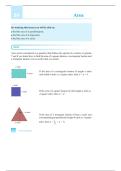
a units
If the area of a rectangular lamina of length a units
b units and width b units is A square units, then A = a × b.
a units
a units If the area of a square lamina of side length a units is
A square units, then A = a2.
h units
If the area of a triangular lamina of base a units and
corresponding perpendicular height h units is A square
a units units, then A = 1 × a × h'
2
28
For free distribution.
, Do the following review exercise in order to establish these facts further.
Review Exercise
1. Find the area of each plain figure shown below.
i ii iii
4 cm 5 cm
5 cm 6 cm 10 cm
iv v vi
3 cm
6 cm
9 cm
3 cm 4 cm
8 cm 7 cm 10 cm
2. In the triangle shown in the figure, the perpendicular
height corresponding to the base of length 12 cm is 5 cm
10 cm
5 cm, and the perpendicular height corresponding to
the base of length 10 cm is h cm. h
12 cm
i. Find the area of the triangle.
ii. Find the value of h.
3. (a) What is the perimeter of an equilateral triangular lamina of side length
12 cm?
(b) Consider a square lamina with the same perimeter as that of the above
triangular lamina.
i. Find the side length of the square lamina.
ii. Find the area of the square lamina.
29
For free distribution.
By studying this lesson you will be able to;
² find the area of a parallelogram,
² find the area of a trapezium,
² find the area of a circle.
Area
Area can be considered as a quantity that defines the spread of a surface. In grades
7 and 8 you learnt how to find the area of a square lamina, a rectangular lamina and
a triangular lamina. Let us recall what was learnt.
a units
If the area of a rectangular lamina of length a units
b units and width b units is A square units, then A = a × b.
a units
a units If the area of a square lamina of side length a units is
A square units, then A = a2.
h units
If the area of a triangular lamina of base a units and
corresponding perpendicular height h units is A square
a units units, then A = 1 × a × h'
2
28
For free distribution.
, Do the following review exercise in order to establish these facts further.
Review Exercise
1. Find the area of each plain figure shown below.
i ii iii
4 cm 5 cm
5 cm 6 cm 10 cm
iv v vi
3 cm
6 cm
9 cm
3 cm 4 cm
8 cm 7 cm 10 cm
2. In the triangle shown in the figure, the perpendicular
height corresponding to the base of length 12 cm is 5 cm
10 cm
5 cm, and the perpendicular height corresponding to
the base of length 10 cm is h cm. h
12 cm
i. Find the area of the triangle.
ii. Find the value of h.
3. (a) What is the perimeter of an equilateral triangular lamina of side length
12 cm?
(b) Consider a square lamina with the same perimeter as that of the above
triangular lamina.
i. Find the side length of the square lamina.
ii. Find the area of the square lamina.
29
For free distribution.


