

Angles related to straight lines and
8
parallel lines
By studying this lesson, you will be able to;
• identify and verify the theorems related to the adjacent angles/vertically opposite
angles formed by one straight line meeting or intersecting another straight line,
and use them to solve problems,
• identify the angles formed when a transversal intersects two straight lines,
• identify and verify the theorems related to the angles formed when a transversal
intersects two straight lines, and use them to solve problems.
Introduction
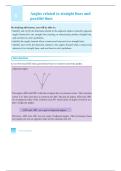
Let us first recall the basic geometrical facts we learnt in previous grades.
Adjacent angles
A D C
B
>
>
The angles ABD and DBC in the above figure have a common vertex. This common
>
>
vertex is B. They also have a common arm BD. The pair of angles ABD and DBC
lie on opposite sides of the common arm BD. Such a pair of angles is known as a
pair of adjacent angles.
>
>
ABD and DBC are a pair of adjacent angles.
>
>
However, ABD and ABC are not a pair of adjacent angles. This is because, these
two angles are not on opposite sides of the common arm AB.
94
For free distribution
,Complementary angles
A
P
R
C R
o
40 o
50 30
o
B Q P o
60
Q S
Figure I > Figure II
>
In figure I, since ABC + PQR = 40o + 50o = 90o, ABC and PQR are a pair of
>
>
complementary angles.
>
>
In figure II, PQR and RQS are a pair of adjacent angles. Furthermore, since
PQR + RQS = 90 , they are a pair of complementary angles too. Therefore,
>
>
o
>
>
PQR and RQS are a pair of complementary adjacent angles.
Supplementary angles
K
M D
P
o
40 140
o
o
120 60o
Q R A C B
L
Figure I Figure II
>
>
>
>
In figure I, since KLM + PQR = 180o, KLM and PQR are a pair of supplementary
>
>
angles. In figure II, ACD and BCD are a pair of adjacent angles. Furthermore,
>
>
since ACD + BCD = 180o, they are a pair of supplementary angles too. Therefore,
>
>
ACD and BCD are a pair of supplementary adjacent angles.
95
For free distribution
, Vertically opposite angles
P R
T
S Q
>
>
The pair of angles PTR and STQ , formed by the intersection of the straight lines
PQ and RS at the point T, are vertically opposite angles.
>
>
Similarly, PTS and RTQ are another pair of vertically opposite angles.
Vertically opposite angles are equal in magnitude.
>
>
>
>
Therefore, PTR = STQ and PTS = RTQ.
Parallel lines
B
Two straight lines in a plane which do not intersect D
each other are called parallel straight lines. The gap
between two parallel straight lines is a constant. A
As shown in the figure, parallel lines are indicated C
using arrow. We use the notation AB//CD to indicate
that AB and CD are Parallel.
Do the following exercise, to strengthen your understanding of the above facts.
Review Exercise
1' From the angles given below, select and write the pairs which are complemen-
tary.
E I J
A G K
o o
70 80
o
B 35 o
C 55
D F
H
L
o M T
20 o
O 40
o
P 10
M
N
R S
U
96
For free distribution
8
parallel lines
By studying this lesson, you will be able to;
• identify and verify the theorems related to the adjacent angles/vertically opposite
angles formed by one straight line meeting or intersecting another straight line,
and use them to solve problems,
• identify the angles formed when a transversal intersects two straight lines,
• identify and verify the theorems related to the angles formed when a transversal
intersects two straight lines, and use them to solve problems.
Introduction
Let us first recall the basic geometrical facts we learnt in previous grades.
Adjacent angles
A D C
B
>
>
The angles ABD and DBC in the above figure have a common vertex. This common
>
>
vertex is B. They also have a common arm BD. The pair of angles ABD and DBC
lie on opposite sides of the common arm BD. Such a pair of angles is known as a
pair of adjacent angles.
>
>
ABD and DBC are a pair of adjacent angles.
>
>
However, ABD and ABC are not a pair of adjacent angles. This is because, these
two angles are not on opposite sides of the common arm AB.
94
For free distribution
,Complementary angles
A
P
R
C R
o
40 o
50 30
o
B Q P o
60
Q S
Figure I > Figure II
>
In figure I, since ABC + PQR = 40o + 50o = 90o, ABC and PQR are a pair of
>
>
complementary angles.
>
>
In figure II, PQR and RQS are a pair of adjacent angles. Furthermore, since
PQR + RQS = 90 , they are a pair of complementary angles too. Therefore,
>
>
o
>
>
PQR and RQS are a pair of complementary adjacent angles.
Supplementary angles
K
M D
P
o
40 140
o
o
120 60o
Q R A C B
L
Figure I Figure II
>
>
>
>
In figure I, since KLM + PQR = 180o, KLM and PQR are a pair of supplementary
>
>
angles. In figure II, ACD and BCD are a pair of adjacent angles. Furthermore,
>
>
since ACD + BCD = 180o, they are a pair of supplementary angles too. Therefore,
>
>
ACD and BCD are a pair of supplementary adjacent angles.
95
For free distribution
, Vertically opposite angles
P R
T
S Q
>
>
The pair of angles PTR and STQ , formed by the intersection of the straight lines
PQ and RS at the point T, are vertically opposite angles.
>
>
Similarly, PTS and RTQ are another pair of vertically opposite angles.
Vertically opposite angles are equal in magnitude.
>
>
>
>
Therefore, PTR = STQ and PTS = RTQ.
Parallel lines
B
Two straight lines in a plane which do not intersect D
each other are called parallel straight lines. The gap
between two parallel straight lines is a constant. A
As shown in the figure, parallel lines are indicated C
using arrow. We use the notation AB//CD to indicate
that AB and CD are Parallel.
Do the following exercise, to strengthen your understanding of the above facts.
Review Exercise
1' From the angles given below, select and write the pairs which are complemen-
tary.
E I J
A G K
o o
70 80
o
B 35 o
C 55
D F
H
L
o M T
20 o
O 40
o
P 10
M
N
R S
U
96
For free distribution


