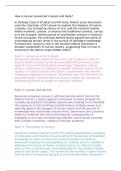
How is lanyon presented in Jekyll and Hyde?
In Strange Case of Dr Jekyll and Mr Hyde, Robert Louis Stevenson
uses the character of Dr Lanyon to explore the dangers of human
curiosity, the corrupting nature of vice, and the inherent duality
within mankind. Lanyon, a rational and traditional scientist, serves
as a foil to Jekyll, whose pursuit of unorthodox science is linked to
moral corruption. His eventual demise warns against the perils of
overstepping human limits in the pursuit of forbidden knowledge.
Furthermore, Lanyon’s role in the novella reflects Stevenson’s
broader exploration of human duality, suggesting that no man is
immune to the darker urges hidden within.
Point 1: Lanyon as a Foil to Jekyll
Stevenson employs lanyon to serve as a foil to Jekyll in order to
expose Jekyll’s studies as being associated with evil and to warn
against the pursuit of forbidden knowledge. Stevenson utilises
lanyon’s adherence to traditional scientific methods and his moral
rigidity to sharply contrast with Jekyll’s experiments and morally
ambiguous approach to science. Stevenson uses this dichotomy to
associate Jekyll’s science with evil and to critique the dangers of
abandoning ethical principles for personal ambition.
Point 2: Lanyon and the Fall
Stevenson employs Lanyon’s ultimate demise which mirrors the
biblical Fall as a caution against unchecked curiosity through his
curiosity abut Jekyll’s forbidden experiments leading to his downfall.
His exposure to the horrifying transformation of Hyde serves as a
warning against the dangers of human hubris and the pursuit of
knowledge that transcends natural limits. Stevenson uses Lanyon’s
death to underline the moral and physical consequences of
indulging in vice and overreaching ambition which would resonate
with a highly moralistic, religious Victorian audience.
Point 3: The Duality of Lanyon
Stevenson utilises Lanyon’s shift from being presented as a paragon
of rationality and morality to succumbing to the pursuit of forbidden
knowledge in order to reveal the inherent duality of mankind.
Stevenson employs his susceptibility to curiosity and his inability to
withstand the horror of Hyde’s transformation, to reflect Freudian
ideas of the id and the ego, illustrating that all men harbour hidden
desires and darker urges. This reinforces the novella’s central theme
that no one is immune to the pull of vice and evil which Stevenson
In Strange Case of Dr Jekyll and Mr Hyde, Robert Louis Stevenson
uses the character of Dr Lanyon to explore the dangers of human
curiosity, the corrupting nature of vice, and the inherent duality
within mankind. Lanyon, a rational and traditional scientist, serves
as a foil to Jekyll, whose pursuit of unorthodox science is linked to
moral corruption. His eventual demise warns against the perils of
overstepping human limits in the pursuit of forbidden knowledge.
Furthermore, Lanyon’s role in the novella reflects Stevenson’s
broader exploration of human duality, suggesting that no man is
immune to the darker urges hidden within.
Point 1: Lanyon as a Foil to Jekyll
Stevenson employs lanyon to serve as a foil to Jekyll in order to
expose Jekyll’s studies as being associated with evil and to warn
against the pursuit of forbidden knowledge. Stevenson utilises
lanyon’s adherence to traditional scientific methods and his moral
rigidity to sharply contrast with Jekyll’s experiments and morally
ambiguous approach to science. Stevenson uses this dichotomy to
associate Jekyll’s science with evil and to critique the dangers of
abandoning ethical principles for personal ambition.
Point 2: Lanyon and the Fall
Stevenson employs Lanyon’s ultimate demise which mirrors the
biblical Fall as a caution against unchecked curiosity through his
curiosity abut Jekyll’s forbidden experiments leading to his downfall.
His exposure to the horrifying transformation of Hyde serves as a
warning against the dangers of human hubris and the pursuit of
knowledge that transcends natural limits. Stevenson uses Lanyon’s
death to underline the moral and physical consequences of
indulging in vice and overreaching ambition which would resonate
with a highly moralistic, religious Victorian audience.
Point 3: The Duality of Lanyon
Stevenson utilises Lanyon’s shift from being presented as a paragon
of rationality and morality to succumbing to the pursuit of forbidden
knowledge in order to reveal the inherent duality of mankind.
Stevenson employs his susceptibility to curiosity and his inability to
withstand the horror of Hyde’s transformation, to reflect Freudian
ideas of the id and the ego, illustrating that all men harbour hidden
desires and darker urges. This reinforces the novella’s central theme
that no one is immune to the pull of vice and evil which Stevenson