
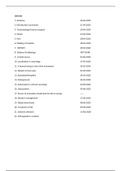
Lectures
1. Anatomy 20-04-2020
2. Introduction Locomotor 21-04-2020
3. Traumatology (trauma surgery) 20-04-2020
4. Stroke 23-04-2020
5. Pain 28-04-2020
6. Walking is freedom 28-04-2020
7. HAP(GP) 28-04-2020
8. Balance/Vestibulogy NOT DONE
9. Cranial nerves 02-06-2020
10. Localisation in neurology 19-05-2020
11. A human being is more than movement 26-05-2020
12. Explain chronic pain 02-06-2020
13. Spondylarthropathy 26-05-2020
14. Osteoporosis 26-05-2020
15. Systematics in clinical neurology 03-06-2020
16. Osteoartritis 09-06-2020
17. Access to innovative treatments for RA in europe -----
18. Disaster management 15-06-2020
19. Elbow/wrist/hand 08-06-2020
20. Treatment of RA 09-06-2020
21. Systemic diseases 15/06/2020
22. Orthopaedics/ scoliosis
,1. Anatomy
DEDUCT YOUR ANATOMY
Lower extremity
Frontal plane, sagittal plane, transversal plane. Pelvic bones and ligaments. Lig. Sacro-tuberal and
sacro-spinal, ilio-lumbar. Also the inguinal ligament, obturator ligament (“stopping something in
latin”) Obturator hiatus with artery nerve and muscle attachment. Then we have membranes:
obturator with the canal and the ischiadic foramina majus and minus then lacuna vasorum and
musculorum. Red of the muscle is origin and blue is insertion. Insertions are at protrusions of bones
(trochanters). The iliopsoas contracts and exorotates. Capsular patterns: specific decreases in ROM in
a specific disease. Then start learning the nerves and the vessels (n. femoralis L2-4, n. ischiadicus L4-
3, n. obturatorius L2-4). Every ventral muscle in the upper leg is innervated with the femoral nerve.
The femoral nerve does not traverse the knee except for the cutaneous branch which goes via V.
saphena accompanied by cutaneous saphenous nerve. The obturator nerve goes medial and does
not traverse the knee. The sciatic nerve goes on the back and does traverse the knee, divides in two
the tibial and the fibular (peroneal). Write down on the exam that the innervation of the hamstring is
sciatic nerve (we take it as a group). IF we continue to the foot from the n. tibialis we go to the
plantar nerves: medial and lateral plantar nerve. The abductor digiti minimi flexes the toe, so it must
be underneath the foot and on the lateral side and thus it must be innervated by the lateral plantar
nerve. The fibular nerve goes around the fibula to anterior with a deep and superficial part. The deep
part is in the anterior compartment and the superficial compartment has the superficial part. Next
are the arteries. The femoral artery again does the ventral part of the legs however not to ventral
part of the knee, it goes back to the poplital fossa where it is more safe, it traverses the adductors
(adductor channel) and through the adduc tor hiatus in the adductor magnus muscle. Then the name
changes to the popliteal artery which continues to the a. tibialis posterior and a. peronea (fibularis).
The anterior nerves in the legs are called fibular and the tibial nerves are always posterior, however
with the arteries this is not the case. In the vessels it is the other way around. We have a posterior
and anterior tibial artery which stay at the tibia and continues to be the a. dorsalis penis. The
posterior tibial become the plantar vessels. Veins go along the arteries v. saphena magna is
superficial. Then there is v. saphena parva coming from not the v. femoralis but from the v. poplitea.
Superficial epigastric veins are in the abdomen. But they have to get to the deep system by per vv.
Perforantes. Then we start with the compartments and functional groups:
- Ventral innervated by the deep fibular nerve
o Tibialis anterior
o Extensor hallucis longus
o Extensor digitorum longus
- Lateral superficial fibular nerve
o Fibular/peroneal muscles
- Deep dorsal innervated by tibial nerve
o Posterior tibial muscle
- Superficial dorsal tibial nerve
o Kuitspieren
Posterior muscles are innervated by the tibial nerve, the anterior muscles are innervated by the
fibular nerve. The more distal in the body you go the less clinically relevant are the insertions. Distal
insertions can have more relevance than the proximal ones. (ex. Avulsion fracture, 5 th metatarsal
attachment fibular muscle yes but origin no). Next are the topographic anatomy pictures to see how
everything is in relation to eachother.
Upper extremity
18 muscles that attach to the scapula:
, - Supraspinatus - Latissimus dorsi - Coracoid tendon of
- Infraspinatus - Teres major coracohumerals and
- Rhomboid minor - Teres minor biceps
- Rhomboid major - Triceps brachii - Pectoralis minor
- Levator scapulae - Trapezius - Subscapularis
- Deltoid - Omohyoid - Serratus anterior
The nerves and the vessels: brachial plexus. Clinically it is not necessary to know the exact
composition. Several nerves are composed of multiple segments (which is safe). The plexus has
difficult nerves and simple nerves coming out of it.
- First order (simple) almost purely motoric or sensory. Do not pay too much attention to them.
Muscular
o Subscapular o Long thoraci
o Suprascapular o Dorsal scapular
o Lateral and Medial pectoral o Phrenic
o Thoracodorsal o Nerve to subclavius
Sensory
o Medial cutaneous nerve of arm
o Medial cutaneous nerve of forearm
- Second order mixed nerves! There are five and we need to know them
o Axillary nerve (innervates deltoid and around humerus to innervate upper lateral
aspect of the arm) upper
lateral cutaneous nerve of
arm
o Musculocutaneous nerve
(ventral in upper arm so
innervating the biceps,
brachial, coracobrachial
muscle) lateral cutaneous
nerve of forearm (the medial
are simple)
Radial nerve (also
dorsal muscles of
upper and lower arm
innervation) posterior
cutaneous nerve of
arm
Ulnar nerve Will not be discussed today
o Median nerve
Know this for the exam! Know from which nerves these nerves originate.
Where the vessels are is the inside of the arm. Epifascial veins are cephalis and baslic. Then brachial
artery with veins and biceps muscle, brachial muscle and on the back triceps muscle. Then we see the
musculocutaneous nerve (ventral), radial nerve (posterior) and two simple cutaneous nerve (medial
of the arm and medial of forearm) and then two nerves left: median and ulnar nerve.
Rotator cuff muscles: subscapular, supraspinatus, infraspinatus and teres minor. We see a lateral
view of the right shoulder and the socket. Then the muscle which we see are: subscapular muscle,
supraspinatus, infraspinatus and teres minor. We can also see the labrum. We can also see the long
head of the biceps tendon. Supraspinatus, long tendon of biceps and subacromial bursa can lead to
subacromial pain syndrome. The radial nerve goes from ventral to dorsal. The axillary nerve goes to
, the deltoid from the inside and then becoming this lateral cutaneous. The axillary nerve can be
damaged quite easily upon dislocated shoulder or the radial nerve upon humerus fractures. The
ulnar nerve can become entrapped if we hit the ulna bone (telefoonbotje?). A sign of radial nerve
damage could be triceps dysfunction and extensors of the lower arm as well as the skin on the
posterior of the arm including the thumb. How can we test the axillary nerve function? Soft touch on
the upper lateral cutaneous nerve of the arm (branch of the axillary nerve).
2. Introduction locomotor
EPC’s are replaced by virtual meetings (schedule will follow).
AssessmentL
- 1x practical assessment
- 2x SOEPEL
- 2x PB in EPASS
- Written exam
o Practice test on student portal
o Prepare for questions like what is your dd?
o Also MCQ
As for anatomy, you need to repeat:
The foot & ankle region was covered in block 1.2, the shoulder girdle in block 2.3, the spine in
block 2,4 and hip & knee in block 2.5.
Presentations in tutorial 10 min and reserve 5 min for discussion.
1. Anatomy 20-04-2020
2. Introduction Locomotor 21-04-2020
3. Traumatology (trauma surgery) 20-04-2020
4. Stroke 23-04-2020
5. Pain 28-04-2020
6. Walking is freedom 28-04-2020
7. HAP(GP) 28-04-2020
8. Balance/Vestibulogy NOT DONE
9. Cranial nerves 02-06-2020
10. Localisation in neurology 19-05-2020
11. A human being is more than movement 26-05-2020
12. Explain chronic pain 02-06-2020
13. Spondylarthropathy 26-05-2020
14. Osteoporosis 26-05-2020
15. Systematics in clinical neurology 03-06-2020
16. Osteoartritis 09-06-2020
17. Access to innovative treatments for RA in europe -----
18. Disaster management 15-06-2020
19. Elbow/wrist/hand 08-06-2020
20. Treatment of RA 09-06-2020
21. Systemic diseases 15/06/2020
22. Orthopaedics/ scoliosis
,1. Anatomy
DEDUCT YOUR ANATOMY
Lower extremity
Frontal plane, sagittal plane, transversal plane. Pelvic bones and ligaments. Lig. Sacro-tuberal and
sacro-spinal, ilio-lumbar. Also the inguinal ligament, obturator ligament (“stopping something in
latin”) Obturator hiatus with artery nerve and muscle attachment. Then we have membranes:
obturator with the canal and the ischiadic foramina majus and minus then lacuna vasorum and
musculorum. Red of the muscle is origin and blue is insertion. Insertions are at protrusions of bones
(trochanters). The iliopsoas contracts and exorotates. Capsular patterns: specific decreases in ROM in
a specific disease. Then start learning the nerves and the vessels (n. femoralis L2-4, n. ischiadicus L4-
3, n. obturatorius L2-4). Every ventral muscle in the upper leg is innervated with the femoral nerve.
The femoral nerve does not traverse the knee except for the cutaneous branch which goes via V.
saphena accompanied by cutaneous saphenous nerve. The obturator nerve goes medial and does
not traverse the knee. The sciatic nerve goes on the back and does traverse the knee, divides in two
the tibial and the fibular (peroneal). Write down on the exam that the innervation of the hamstring is
sciatic nerve (we take it as a group). IF we continue to the foot from the n. tibialis we go to the
plantar nerves: medial and lateral plantar nerve. The abductor digiti minimi flexes the toe, so it must
be underneath the foot and on the lateral side and thus it must be innervated by the lateral plantar
nerve. The fibular nerve goes around the fibula to anterior with a deep and superficial part. The deep
part is in the anterior compartment and the superficial compartment has the superficial part. Next
are the arteries. The femoral artery again does the ventral part of the legs however not to ventral
part of the knee, it goes back to the poplital fossa where it is more safe, it traverses the adductors
(adductor channel) and through the adduc tor hiatus in the adductor magnus muscle. Then the name
changes to the popliteal artery which continues to the a. tibialis posterior and a. peronea (fibularis).
The anterior nerves in the legs are called fibular and the tibial nerves are always posterior, however
with the arteries this is not the case. In the vessels it is the other way around. We have a posterior
and anterior tibial artery which stay at the tibia and continues to be the a. dorsalis penis. The
posterior tibial become the plantar vessels. Veins go along the arteries v. saphena magna is
superficial. Then there is v. saphena parva coming from not the v. femoralis but from the v. poplitea.
Superficial epigastric veins are in the abdomen. But they have to get to the deep system by per vv.
Perforantes. Then we start with the compartments and functional groups:
- Ventral innervated by the deep fibular nerve
o Tibialis anterior
o Extensor hallucis longus
o Extensor digitorum longus
- Lateral superficial fibular nerve
o Fibular/peroneal muscles
- Deep dorsal innervated by tibial nerve
o Posterior tibial muscle
- Superficial dorsal tibial nerve
o Kuitspieren
Posterior muscles are innervated by the tibial nerve, the anterior muscles are innervated by the
fibular nerve. The more distal in the body you go the less clinically relevant are the insertions. Distal
insertions can have more relevance than the proximal ones. (ex. Avulsion fracture, 5 th metatarsal
attachment fibular muscle yes but origin no). Next are the topographic anatomy pictures to see how
everything is in relation to eachother.
Upper extremity
18 muscles that attach to the scapula:
, - Supraspinatus - Latissimus dorsi - Coracoid tendon of
- Infraspinatus - Teres major coracohumerals and
- Rhomboid minor - Teres minor biceps
- Rhomboid major - Triceps brachii - Pectoralis minor
- Levator scapulae - Trapezius - Subscapularis
- Deltoid - Omohyoid - Serratus anterior
The nerves and the vessels: brachial plexus. Clinically it is not necessary to know the exact
composition. Several nerves are composed of multiple segments (which is safe). The plexus has
difficult nerves and simple nerves coming out of it.
- First order (simple) almost purely motoric or sensory. Do not pay too much attention to them.
Muscular
o Subscapular o Long thoraci
o Suprascapular o Dorsal scapular
o Lateral and Medial pectoral o Phrenic
o Thoracodorsal o Nerve to subclavius
Sensory
o Medial cutaneous nerve of arm
o Medial cutaneous nerve of forearm
- Second order mixed nerves! There are five and we need to know them
o Axillary nerve (innervates deltoid and around humerus to innervate upper lateral
aspect of the arm) upper
lateral cutaneous nerve of
arm
o Musculocutaneous nerve
(ventral in upper arm so
innervating the biceps,
brachial, coracobrachial
muscle) lateral cutaneous
nerve of forearm (the medial
are simple)
Radial nerve (also
dorsal muscles of
upper and lower arm
innervation) posterior
cutaneous nerve of
arm
Ulnar nerve Will not be discussed today
o Median nerve
Know this for the exam! Know from which nerves these nerves originate.
Where the vessels are is the inside of the arm. Epifascial veins are cephalis and baslic. Then brachial
artery with veins and biceps muscle, brachial muscle and on the back triceps muscle. Then we see the
musculocutaneous nerve (ventral), radial nerve (posterior) and two simple cutaneous nerve (medial
of the arm and medial of forearm) and then two nerves left: median and ulnar nerve.
Rotator cuff muscles: subscapular, supraspinatus, infraspinatus and teres minor. We see a lateral
view of the right shoulder and the socket. Then the muscle which we see are: subscapular muscle,
supraspinatus, infraspinatus and teres minor. We can also see the labrum. We can also see the long
head of the biceps tendon. Supraspinatus, long tendon of biceps and subacromial bursa can lead to
subacromial pain syndrome. The radial nerve goes from ventral to dorsal. The axillary nerve goes to
, the deltoid from the inside and then becoming this lateral cutaneous. The axillary nerve can be
damaged quite easily upon dislocated shoulder or the radial nerve upon humerus fractures. The
ulnar nerve can become entrapped if we hit the ulna bone (telefoonbotje?). A sign of radial nerve
damage could be triceps dysfunction and extensors of the lower arm as well as the skin on the
posterior of the arm including the thumb. How can we test the axillary nerve function? Soft touch on
the upper lateral cutaneous nerve of the arm (branch of the axillary nerve).
2. Introduction locomotor
EPC’s are replaced by virtual meetings (schedule will follow).
AssessmentL
- 1x practical assessment
- 2x SOEPEL
- 2x PB in EPASS
- Written exam
o Practice test on student portal
o Prepare for questions like what is your dd?
o Also MCQ
As for anatomy, you need to repeat:
The foot & ankle region was covered in block 1.2, the shoulder girdle in block 2.3, the spine in
block 2,4 and hip & knee in block 2.5.
Presentations in tutorial 10 min and reserve 5 min for discussion.


