

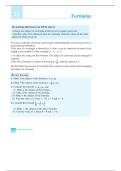
23 Formulae
By studying this lesson you will be able to
• change the subject of a formula which involves squares and roots.
• find the value of an unknown term in a formula when the values of the other
unknown terms are given.
You may recall that a formula expresses the relationship that exists between two or
more physical quantities.
If the area of a rectangle is denoted by A, then A can be expressed in terms of the
length a and breadth b of the rectangle as A = a « b.
A is called the subject of this formula. The subject of a formula can be changed if
required.
If the above formula is written in the form , then the subject is b.
Do the following exercise to recall the facts you have learnt earlier about changing
the subject of a formula.
Review Exercise
1. Make u the subject of the formula .
2. Make F the subject of the formula ( )'
9
3. Consider the formula .
^i& Make a the subject of the formula.
^ii& Make d the subject of the formula.
^iii& Make n the subject of the formula.
^iv& Find the value of d when l = 24" a = 3 and n = 8.
4. Consider the formula '
^i& Make r1 the subject of the above formula.
^ii& Find the value of r1 when R = 4 and r2= 6.
56 For free distribution
, 23.1 Changing the subject of formulae containing squares and
square roots
Given below is the formula for the area of a circle. Here A denotes the area and r
denotes the radius of the circle.
Let us consider how r is made the subject of this formula.
Let us first make r2 the subject of the formula.
That is, .
Now, to make r the subject of the formula, let us take the square root of both sides.
This can be expressed as '
Since denotes the positive square root value, remember that the signs + and
– should be written in front of the symbol to denote the square root. In this
example, since r represents the radius of the circle, it is positive. Therefore, we can
ignore the negative value. However, when the meanings of the unknowns are not
known (or have not been given), the correct form is to have both signs.
Now let us consider how the subject of a formula which contains a square root is
changed. For this, let us consider the formula '
Let us see how l is made the subject of this formula.
Let us first keep the term with the square root sign on one side of the equality
symbol, and move all the other terms to the other side.
Let us now square both sides.
Then
Now l can easily be made the subject of the formula.
That is,
For free distribution 57
By studying this lesson you will be able to
• change the subject of a formula which involves squares and roots.
• find the value of an unknown term in a formula when the values of the other
unknown terms are given.
You may recall that a formula expresses the relationship that exists between two or
more physical quantities.
If the area of a rectangle is denoted by A, then A can be expressed in terms of the
length a and breadth b of the rectangle as A = a « b.
A is called the subject of this formula. The subject of a formula can be changed if
required.
If the above formula is written in the form , then the subject is b.
Do the following exercise to recall the facts you have learnt earlier about changing
the subject of a formula.
Review Exercise
1. Make u the subject of the formula .
2. Make F the subject of the formula ( )'
9
3. Consider the formula .
^i& Make a the subject of the formula.
^ii& Make d the subject of the formula.
^iii& Make n the subject of the formula.
^iv& Find the value of d when l = 24" a = 3 and n = 8.
4. Consider the formula '
^i& Make r1 the subject of the above formula.
^ii& Find the value of r1 when R = 4 and r2= 6.
56 For free distribution
, 23.1 Changing the subject of formulae containing squares and
square roots
Given below is the formula for the area of a circle. Here A denotes the area and r
denotes the radius of the circle.
Let us consider how r is made the subject of this formula.
Let us first make r2 the subject of the formula.
That is, .
Now, to make r the subject of the formula, let us take the square root of both sides.
This can be expressed as '
Since denotes the positive square root value, remember that the signs + and
– should be written in front of the symbol to denote the square root. In this
example, since r represents the radius of the circle, it is positive. Therefore, we can
ignore the negative value. However, when the meanings of the unknowns are not
known (or have not been given), the correct form is to have both signs.
Now let us consider how the subject of a formula which contains a square root is
changed. For this, let us consider the formula '
Let us see how l is made the subject of this formula.
Let us first keep the term with the square root sign on one side of the equality
symbol, and move all the other terms to the other side.
Let us now square both sides.
Then
Now l can easily be made the subject of the formula.
That is,
For free distribution 57


