
HEENT: PRACTICE QUESTIONS
310+ (2025-2026 Updated) Solved Exams + 100% Verified Solutions | Complete
Q&A
Question 1 pts
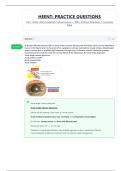
A 40-year-old man presents with an acute onset of severe left eye pain and blurry vision. He was watching a
Correct!
movie in the theater prior to the onset of his symptoms. Left eye examination reveals redness, dilated pupil,
steamy cornea, and no pupillary light response. His right eye is otherwise normal. Intraocular pressure
measurement in his left eye reads 50 mm Hg. Which of the following is the most likely diagnosis?
Acute angle-closure glaucoma
Acute anterior uveitis
Acute conjunctivitis
Acute keratitis
Acute angle-closure glaucoma
Acute Angle-Closure Glaucoma
Patient will be entering a dark room or movie theater
Acute unilateral painful vision loss, vomiting, and seeing halos around lights
PE will show cloudy cornea and fixed mid-dilated pupil
Testing will show IOP ( > 21 mm Hg)
Treatment is topical beta-blockers, topical alpha-agonists, carbonic anhydrase inhibitors,
mioticsIridotomy is definitive treatment, but not used for initial management
, Question 2 pts
A 54-year-old woman comes to the emergency department because of vertigo for the past 20 minutes. She
Correct!
has a one-year history of attacks of vertigo, left ear fullness, left ear hearing loss, and tinnitus. One month
ago, she was treated with oral steroids by another physician and her symptoms improved. She has
subsequently had three more vertigo attacks with similar symptoms in her left ear. Physical examination
shows Rinne and Weber tests are consistent with sensorineural hearing loss in the left ear. No nystagmus is
present. Which of the following is the most likely diagnosis?
A. Benign paroxysmal positional vertigo
B. Labyrinthitis
C. Meniere disease
D. Otitis Media
E. Vestibular Neuronitis
C. Meniere disease
Think of Meniere disease when a patient presents with recurrent episodes of rotatory vertigo
associated with hearing loss,
aural fullness, and
tinnitus.
Meniere disease, also known as endolymphatic
hydrops, is an idiopathic disorder of the inner ear associated with increased endolymphatic pressure.
Question 3 pts
___________ ___________ is visualized on
Correct!
fundoscopic crinkling of retinal tissue and changes in vessel direction.
Retinal detachment
, Question 4 pts
____________ is the separation of neurosensory layer of retina from outermost pigmented epithelium leading
Correct!
to vision loss.
Retinal detachment
Question 5 pts
Retinal detachment usually presents with defects in the (central/peripheral) visual field.
Correct!
Peripheral
Question 6 pts
Most of the cases of retinal detachment are (rhegmatogenous/non-rhegmatogenous).
Correct!
Rhegmatogenous
, Question 7 pts
(Myopia/Hypermetropia) is a risk factor for the development of retinal detachment.
Correct!
Myopia
Question 8 pts
The most common manifestation of posterior vitreous detachment is the presence of _________ in the visual
Correct!
field.
floaters
Question 9 pts
Retinal detachment is usually (unilateral/bilateral).
Correct!
unilateral.
310+ (2025-2026 Updated) Solved Exams + 100% Verified Solutions | Complete
Q&A
Question 1 pts
A 40-year-old man presents with an acute onset of severe left eye pain and blurry vision. He was watching a
Correct!
movie in the theater prior to the onset of his symptoms. Left eye examination reveals redness, dilated pupil,
steamy cornea, and no pupillary light response. His right eye is otherwise normal. Intraocular pressure
measurement in his left eye reads 50 mm Hg. Which of the following is the most likely diagnosis?
Acute angle-closure glaucoma
Acute anterior uveitis
Acute conjunctivitis
Acute keratitis
Acute angle-closure glaucoma
Acute Angle-Closure Glaucoma
Patient will be entering a dark room or movie theater
Acute unilateral painful vision loss, vomiting, and seeing halos around lights
PE will show cloudy cornea and fixed mid-dilated pupil
Testing will show IOP ( > 21 mm Hg)
Treatment is topical beta-blockers, topical alpha-agonists, carbonic anhydrase inhibitors,
mioticsIridotomy is definitive treatment, but not used for initial management
, Question 2 pts
A 54-year-old woman comes to the emergency department because of vertigo for the past 20 minutes. She
Correct!
has a one-year history of attacks of vertigo, left ear fullness, left ear hearing loss, and tinnitus. One month
ago, she was treated with oral steroids by another physician and her symptoms improved. She has
subsequently had three more vertigo attacks with similar symptoms in her left ear. Physical examination
shows Rinne and Weber tests are consistent with sensorineural hearing loss in the left ear. No nystagmus is
present. Which of the following is the most likely diagnosis?
A. Benign paroxysmal positional vertigo
B. Labyrinthitis
C. Meniere disease
D. Otitis Media
E. Vestibular Neuronitis
C. Meniere disease
Think of Meniere disease when a patient presents with recurrent episodes of rotatory vertigo
associated with hearing loss,
aural fullness, and
tinnitus.
Meniere disease, also known as endolymphatic
hydrops, is an idiopathic disorder of the inner ear associated with increased endolymphatic pressure.
Question 3 pts
___________ ___________ is visualized on
Correct!
fundoscopic crinkling of retinal tissue and changes in vessel direction.
Retinal detachment
, Question 4 pts
____________ is the separation of neurosensory layer of retina from outermost pigmented epithelium leading
Correct!
to vision loss.
Retinal detachment
Question 5 pts
Retinal detachment usually presents with defects in the (central/peripheral) visual field.
Correct!
Peripheral
Question 6 pts
Most of the cases of retinal detachment are (rhegmatogenous/non-rhegmatogenous).
Correct!
Rhegmatogenous
, Question 7 pts
(Myopia/Hypermetropia) is a risk factor for the development of retinal detachment.
Correct!
Myopia
Question 8 pts
The most common manifestation of posterior vitreous detachment is the presence of _________ in the visual
Correct!
field.
floaters
Question 9 pts
Retinal detachment is usually (unilateral/bilateral).
Correct!
unilateral.



