
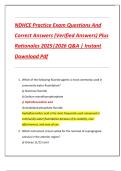
NDHCE Practice Exam Questions And
Correct Answers (Verified Answers) Plus
Rationales 2025|2026 Q&A | Instant
Download Pdf
1. Which of the following fluoride agents is most commonly used in
community water fluoridation?
a) Stannous fluoride
b) Sodium monofluorophosphate
c) Hydrofluorosilicic acid
d) Acidulated phosphate fluoride
Hydrofluorosilicic acid is the most frequently used compound in
community water fluoridation because of its stability, cost-
effectiveness, and ease of use.
2. Which instrument is best suited for the removal of supragingival
calculus in the anterior region?
a) Gracey 11/12 curet
, b) Universal curet
c) Sickle scaler
d) Hoe scaler
Sickle scalers have a pointed tip and are designed for supragingival
calculus removal, especially in anterior teeth and proximal areas.
3. Which radiographic error results in a cone-cut appearance?
a) Improper positioning of the PID
b) Insufficient vertical angulation
c) Film placed backwards
d) Patient movement
A cone-cut occurs when the x-ray beam does not cover the entire
receptor because of misaligned positioning of the PID.
4. Which bacteria is primarily responsible for dental caries?
a) Actinomyces viscosus
b) Streptococcus mutans
c) Porphyromonas gingivalis
d) Treponema denticola
Streptococcus mutans is the main pathogen associated with the
initiation of dental caries.
5. What is the first step in the dental hygiene process of care?
a) Planning
b) Implementation
c) Assessment
, d) Evaluation
Assessment is the foundation step that involves collecting data on the
patient’s health, dental history, and risk factors.
6. Which drug is most likely to cause gingival hyperplasia?
a) Tetracycline
b) Metronidazole
c) Phenytoin
d) Aspirin
Phenytoin, an anticonvulsant, is well known for causing gingival
hyperplasia.
7. The primary goal of dental sealants is to:
a) Remineralize enamel
b) Prevent pit and fissure caries
c) Whiten stained fissures
d) Replace lost enamel
Sealants act as a physical barrier to protect susceptible pits and
fissures from bacterial accumulation and acid attack.
8. What does informed consent require?
a) Patient signs a written contract
b) Patient is fully informed of risks, benefits, and alternatives
c) Patient agrees verbally only
d) Provider documents only treatment
Informed consent means the patient is given full disclosure about
Correct Answers (Verified Answers) Plus
Rationales 2025|2026 Q&A | Instant
Download Pdf
1. Which of the following fluoride agents is most commonly used in
community water fluoridation?
a) Stannous fluoride
b) Sodium monofluorophosphate
c) Hydrofluorosilicic acid
d) Acidulated phosphate fluoride
Hydrofluorosilicic acid is the most frequently used compound in
community water fluoridation because of its stability, cost-
effectiveness, and ease of use.
2. Which instrument is best suited for the removal of supragingival
calculus in the anterior region?
a) Gracey 11/12 curet
, b) Universal curet
c) Sickle scaler
d) Hoe scaler
Sickle scalers have a pointed tip and are designed for supragingival
calculus removal, especially in anterior teeth and proximal areas.
3. Which radiographic error results in a cone-cut appearance?
a) Improper positioning of the PID
b) Insufficient vertical angulation
c) Film placed backwards
d) Patient movement
A cone-cut occurs when the x-ray beam does not cover the entire
receptor because of misaligned positioning of the PID.
4. Which bacteria is primarily responsible for dental caries?
a) Actinomyces viscosus
b) Streptococcus mutans
c) Porphyromonas gingivalis
d) Treponema denticola
Streptococcus mutans is the main pathogen associated with the
initiation of dental caries.
5. What is the first step in the dental hygiene process of care?
a) Planning
b) Implementation
c) Assessment
, d) Evaluation
Assessment is the foundation step that involves collecting data on the
patient’s health, dental history, and risk factors.
6. Which drug is most likely to cause gingival hyperplasia?
a) Tetracycline
b) Metronidazole
c) Phenytoin
d) Aspirin
Phenytoin, an anticonvulsant, is well known for causing gingival
hyperplasia.
7. The primary goal of dental sealants is to:
a) Remineralize enamel
b) Prevent pit and fissure caries
c) Whiten stained fissures
d) Replace lost enamel
Sealants act as a physical barrier to protect susceptible pits and
fissures from bacterial accumulation and acid attack.
8. What does informed consent require?
a) Patient signs a written contract
b) Patient is fully informed of risks, benefits, and alternatives
c) Patient agrees verbally only
d) Provider documents only treatment
Informed consent means the patient is given full disclosure about


