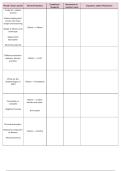
Conditions/ Mechanism &
Recall- theory points General Reaction: Equations and/or Mechanism
Reagents reaction name
Crude oil-> alkane
process
Alkane boiling point
trends with chain
length and branching
Alkane -> Alkene
Shape of alkanes and
bond type
Sigma bond
description
Reactivity, polarity,
Difference between
aliphatic, alicyclic Alkane -> cyclic
aromatic.
What are the
disadvantages of Alkane -> Haloalkane
FRS?
Alkane -> carbon
Incomplete vs
dioxide and water
complete
Algebraic formula
(two types)
Pi bond description
Reactivity comparison
Alkene -> Alcohol
to alkanes
Stereoisomerism
, Conditions/ Mechanism &
Recall- theory points General Reaction: Equations and/or Mechanism
Reagents reaction name
What isomers have
you used?
Which product is
major, which is minor
+ why?
Alkene -> Haloalkane
Carbocations and
stability
Reactivity, trends in
haloalkanes: polarity,
enthalpy, rate of
hydrolysis
Alkene-> Alkane
Glucose -> alcohol
Rate of hydrolysis and
how is it measured
Primary vs secondary Haloalkane - alcohol
vs tertiary haloalkanes
rate of hydrolysis
trend
Halide ->Silver salt
Bond angle:
Boiling and melting
points:
Alcohol -> Alkene
Gen formula:
Combustion:
Polarity:
Recall- theory points General Reaction: Equations and/or Mechanism
Reagents reaction name
Crude oil-> alkane
process
Alkane boiling point
trends with chain
length and branching
Alkane -> Alkene
Shape of alkanes and
bond type
Sigma bond
description
Reactivity, polarity,
Difference between
aliphatic, alicyclic Alkane -> cyclic
aromatic.
What are the
disadvantages of Alkane -> Haloalkane
FRS?
Alkane -> carbon
Incomplete vs
dioxide and water
complete
Algebraic formula
(two types)
Pi bond description
Reactivity comparison
Alkene -> Alcohol
to alkanes
Stereoisomerism
, Conditions/ Mechanism &
Recall- theory points General Reaction: Equations and/or Mechanism
Reagents reaction name
What isomers have
you used?
Which product is
major, which is minor
+ why?
Alkene -> Haloalkane
Carbocations and
stability
Reactivity, trends in
haloalkanes: polarity,
enthalpy, rate of
hydrolysis
Alkene-> Alkane
Glucose -> alcohol
Rate of hydrolysis and
how is it measured
Primary vs secondary Haloalkane - alcohol
vs tertiary haloalkanes
rate of hydrolysis
trend
Halide ->Silver salt
Bond angle:
Boiling and melting
points:
Alcohol -> Alkene
Gen formula:
Combustion:
Polarity: