
FNP Certification Exam Review Practice Test.
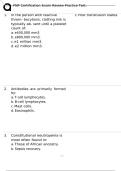
1. In the person with reactive c. Post transfusion states.
throm- bocytosis, clotting risk is
typically ab- sent until a platelet
count of:
a. e400,000 mm3
b. e800,000 mm3.
c. e1 million mm3.
d. e2 million mm3.
2. Antibodies are primarily formed
by:
a. T-cell lymphocytes.
b. B-cell lymphocytes.
c. Mast cells.
d. Eosinophils.
3. Constitutional neutropenia is
most often found in:
a. Those of African ancestry.
b. Sepsis recovery.
, FNP Certification Exam Review Practice Test.
C. 1emillion mm3.
Reactive thrombocytosis is an increase in platelet
count in response to a stimulus. There are several
causes of reactive thrombocytosis, including acute
bleeding and blood loss, allergic reactions, cancer,
infections, some types of anemia, major surgery,
splenectomy, and some types of medications. Treat-
ment of reactive thrombocytosis is directed at the
underlying cause and platelet counts usually return to
normal once the underlying condition is brought
under control. An increased risk of blood clots can
occur once the platelet count is 1emillion mm3 (NL
= 150,000-450,000 mm3). Topic: Assessment and
Intervention in Select Hematologic Disorders
B. B-cell lymphocytes.
B cells are involved in antibody formation. Delaying the
hypersensitivity response is a primary function of T-
cell lymphocytes. Granulocytes and monocytes are
involved in the phagocytosis of circulating de- bris
and pathogens, such as bacteria or fungi. Topic:
Assessment and Intervention in Select Hematologic
Disorders
A. Those of African ancestry.
Constitutional neutropenia (also called benign eth- nic
neutropenia or benign familial neutropenia) is a
condition more often observed in people with African
and Middle Eastern ancestry. The condition
, FNP Certification Exam Review Practice Test.
d. Patients who have is potentially caused by a defect in the
undergone splenectomy. release of mature WBCs from the bone
marrow to peripheral circulation. Despite a
consistently lower than nor- mal ANC in
people with constitutional neutropenia, many
do not show increased susceptibility to infec-
tion or any other adverse ettect. Topic:
Assessment and Intervention in Select
4. Agranulocytosis is
Hematologic Disorders
characterized by:
a. Total WBC d8000 mm3. D. ANC < 500 mm3.
b. Total WBC d5000 mm3.
c. ANC < 2000 mm3 Neutropenia is characterized by an absolute
d. ANC < 500 mm3 neu- trophil count (ANC) of <2000 mm3.
Several fac- tors can result in the
development of neutrope- nia, including a
drug-induced reaction, nutritional
deficiencies (e.g., vitamin B12, folate, or
copper), and hormone disorders (e.g.,
thyrotoxicosis, Addi- son disease, and
acromegaly). Severe neutropenia, or
agranulocytosis, is defined as an ANC <500
mm3 and places the patient at increased
5. Eosinophilia is often seen in susceptibility to serious bacterial infections.
infec- tions caused by: Topic: Assessment and Intervention in Select
a. Viruses. Hematologic Disorders.
b. Encapsulated bacteria.
c. Mycobacterium. D. Protozoans.
d. Protozoans.
Eosinophils exhibit weak phagocytic action
in the presence of foreign substances and
can ingest antigen-antibody complexes. These
cells are active against parasitic infections, such
, FNP Certification Exam Review Practice Test.
as protozoans, and if the parasite is too large for
ingestion, the cells can release substances directly
onto the parasite's sur- face. Neutrophils are active
against bacteria while lymphocytes are active against
viral infections. Topic:


