

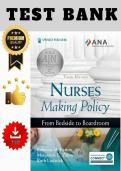
Nurses Making Policy, 3rd
Edition
From Bedside to Boardroom — Test Bank
Corrected Edition — Answer Choices Randomized to Remove Answer-Key Bias
Each chapter contains 25 numbered questions (1–25).
,CHAPTER LIST
Unit I: Making the Case — Valuing Policy
Chapter 1: Marching to Lead in Policy
Chapter 2: Advocating for Nursing and for Health
Chapter 3: Navigating the Political System
Unit II: Analyzing Policy
Chapter 4: Identifying a Problem and Analyzing a Policy Issue
Chapter 5: Harnessing Evidence in the Policy Process
Chapter 6: Setting the Agenda
Unit III: Strategizing and Creating Change
Chapter 7: Building Capital: Intellectual, Social, Political, and Financial
Chapter 8: Transforming Policy With Innovation
Chapter 9: Implementing the Plan
Chapter 10: Influencing Public Opinion and Health Policy Through Media Advocacy
Chapter 11: Applying a Nursing Lens to Shape Policy
Unit IV: Judging Worth and Advancing the Cause
Chapter 12: Evaluating Policy: Structures, Processes, and Outcomes
Chapter 13: Eliminating Health Inequities Through National and Global Policy
Chapter 14: Valuing Global Realities for Health Policy
Chapter 15: Taking Action, Shaping the Future
,Chapter 1: Marching to Lead in Policy
Select-All-That-Apply (SATA)
1. A nurse manager is preparing a workshop on policy engagement for frontline staff. Which
factors should the manager highlight as historical and systemic barriers that have limited
nurses' active involvement in health policy development? Select all that apply.
A. Low self-efficacy and confidence regarding political processes
B. Socialization of nurses toward clinical execution rather than systemic governance
C. Time constraints associated with demanding clinical shift schedules
D. Absence of professional nursing organizations advocating for health policy
E. Lack of formal policy education in traditional nursing curricula
F. Legal prohibitions against nurses contacting legislative representatives
Answer: A, B, C, E
Rationale: Historical barriers to nursing policy involvement include a lack of formal policy
preparation in education, traditional gender and professional socialization focusing strictly on
bedside care, time scarcity due to intensive shift work, and low political self-efficacy.
Professional organizations do exist and actively advocate, and there are no legal prohibitions
against nurses contacting representatives.
Topic: Barriers to Nursing Policy Involvement | Cognitive Level: Recall
2. A public health nurse is designing a presentation comparing public policy, organizational
policy, and professional policy. Which examples correctly illustrate public policy initiatives?
Select all that apply.
A. A municipal ordinance banning tobacco smoking in public parks
B. A state legislative act mandating workplace violence prevention programs in all hospitals
C. Federal regulations promulgated by the Centers for Medicare & Medicaid Services (CMS)
regarding reimbursement
D. A national nursing association's position statement on nurse-to-patient staffing ratios
E. A county health department mandate requiring municipal water fluoridation
F. A hospital system's internal clinical guideline for inpatient bed-turnaround times
Answer: A, B, C, E
Rationale: Public policy consists of authoritative actions, laws, regulations, and ordinances
enacted by governmental bodies at local, state, or federal levels. Internal hospital guidelines
represent organizational policy, while professional association position statements represent
professional policy.
Topic: Types of Policy (Public vs. Organizational vs. Professional) | Cognitive Level: Application
,3. A nurse executive is aligning an academic health center's nursing leadership goals with
national policy frameworks. Which recommendations from the Future of Nursing 2020--2030:
Charting a Path to Achieve Health Equity report directly frame the expanded policy leadership
role for nurses? Select all that apply.
A. Fostering interprofessional collaboration to eliminate practice barriers
B. Restricting APRN scope of practice to institutional boundary limits
C. Supporting nurse participation on boards, commissions, and governance bodies
D. Systematically preparing nurses to address social determinants of health and health
equity
E. Transitioning all direct-care nursing positions to mandatory administrative roles
Answer: A, C, D
Rationale: The Future of Nursing 2020--2030 report emphasizes preparing nurses to advance
health equity and address social determinants of health, promoting nurse leadership on
decision-making boards and commissions, and dismantling practice barriers through
interprofessional collaboration. Restricting scope of practice and eliminating direct-care roles
contradict the report's goals.
Topic: National Landmark Reports & Policy Frameworks | Cognitive Level: Recall
4. A clinical nurse leader is developing a educational session on professional identity and policy
leadership. Which core leadership competencies are necessary for a bedside nurse to transition
toward boardroom influence? Select all that apply.
A. Understanding of health system finance and policy processes
B. Unilateral decision-making without stakeholder consultation
C. Negotiation and consensus-building skills
D. Self-efficacy and professional advocacy orientation
E. Strategic communication and message framing
Answer: A, C, D, E
Rationale: Moving from bedside to boardroom requires competency in strategic
communication, policy process comprehension, negotiation, consensus-building, and high self-
efficacy. Policy leadership relies heavily on coalition building and stakeholder engagement,
making unilateral decision-making ineffective and counterproductive.
Topic: Policy Leadership Competencies | Cognitive Level: Analysis
5. An advanced practice nurse mentor is explaining the role of professional associations in
shaping health policy. Which mechanisms demonstrate how professional nursing associations
build political self-efficacy and professional identity? Select all that apply.
A. Directly funding individual partisan political campaigns using general member dues
B. Publishing policy briefs and position statements on emerging health issues
C. Providing mentorship networks pairing experienced nurse advocates with novices
D. Offering structured policy fellowships and legislative day events
E. Enforcing state licensure penalties for non-member nurses
,Answer: B, C, D
Rationale: Professional nursing associations build self-efficacy and identity by offering policy
fellowships, legislative learning events, formal mentorship, and published policy analyses.
Membership is voluntary and separate from state licensing boards; direct partisan campaign
funding from general membership dues is legally restricted.
Topic: Professional Identity, Self-Efficacy, and Mentorship | Cognitive Level: Application
Sequencing / Ordered-Response
6. A nurse advocate is planning a progressive career path to move from bedside clinical
observations to formal political influence at the state level. Place the following operational
milestones in the correct sequential order from early bedside engagement to boardroom
influence.
A. Serving on a state governor's health policy advisory board or commission
B. Applying bedside clinical observations to identify a recurrent policy-level system failure
C. Participating in a state nursing association's annual legislative advocacy day
D. Joining a hospital unit-based council to address local clinical workflows
E. Testifying as a subject matter expert before a legislative health committee
Answer: B, D, C, E, A
Rationale: The journey from bedside to boardroom begins with identifying clinical issues (B),
advancing to organizational engagement via unit councils (D), participating in broader
professional advocacy events (C), acting as an expert witness in legislative hearings (E), and
ultimately securing an appointment to a governmental advisory board or decision-making body
(A).
Topic: Career Continuum of Policy Leadership | Cognitive Level: Analysis
7. A group of nurse leaders is launching a advocacy campaign to address workplace safety
legislation. Place the core stages of the policy development process in the correct chronological
order.
A. Formulating specific policy alternatives and legislative language
B. Evaluating the enacted policy's real-world outcomes and impact
C. Translating passed legislation into operational agency regulations
D. Identifying and defining the health safety problem through clinical evidence
E. Mobilizing political support to pass the bill through legislative committees
Answer: D, A, E, C, B
Rationale: The policy process begins with problem identification (D), followed by policy
formulation and drafting (A), political mobilization and enactment (E), regulatory
implementation by state or federal agencies (C), and final policy evaluation (B).
Topic: Policy Process Stages | Cognitive Level: Application
, 8. A nurse manager wants to cultivate political self-efficacy among staff nurses on a medical-
surgical unit. Place the developmental steps of mentorship and self-efficacy building in the
correct logical sequence.
A. Assigning the nurse to analyze a specific institutional policy impact on unit outcomes
B. Encouraging the nurse to independently draft a policy brief for local leadership
C. Pairing the novice nurse with an experienced nurse advocate for observation
D. Assessing the novice nurse's baseline awareness of healthcare policy issues
E. Inviting the nurse to co-present a policy issue at a professional association **chapter**
meeting
Answer: D, C, A, E, B
Rationale: Building self-efficacy begins with baseline assessment (D), followed by role modeling
and observation (C), applied analytical practice within a familiar environment (A), shared public
voice and presentation (E), and independent policy synthesis (B).
Topic: Professional Identity and Mentorship Progression | Cognitive Level: Application
Matching Sets
9. Match each policy type with its corresponding real-world application.
1. Public Policy
2. Organizational Policy
3. Professional Policy
A. Clinical agency procedure mandating dual-signoff for high-risk medications
B. Municipal health code regulating sanitation standards in public dining venues
C. Code of Ethics establishing moral standards for professional practice
Answer: 1-B, 2-A, 3-C
Rationale: Public policy is enacted by governmental entities like municipal boards (B).
Organizational policy governs practice within specific institutions (A). Professional policy
represents standards set by professional bodies to govern practice and ethics (C).
Topic: Distinguishing Policy Domains | Cognitive Level: Recall
10. Match each key report or framework with its core policy imperative for nursing.
1. Future of Nursing 2020--2030 Report
2. AACN Essentials
3. ANA Code of Ethics (Provision 9)
A. Asserting that the profession must collectively articulate nursing values and shape social
policy
B. Centering nursing leadership on achieving health equity and addressing social
determinants
Edition
From Bedside to Boardroom — Test Bank
Corrected Edition — Answer Choices Randomized to Remove Answer-Key Bias
Each chapter contains 25 numbered questions (1–25).
,CHAPTER LIST
Unit I: Making the Case — Valuing Policy
Chapter 1: Marching to Lead in Policy
Chapter 2: Advocating for Nursing and for Health
Chapter 3: Navigating the Political System
Unit II: Analyzing Policy
Chapter 4: Identifying a Problem and Analyzing a Policy Issue
Chapter 5: Harnessing Evidence in the Policy Process
Chapter 6: Setting the Agenda
Unit III: Strategizing and Creating Change
Chapter 7: Building Capital: Intellectual, Social, Political, and Financial
Chapter 8: Transforming Policy With Innovation
Chapter 9: Implementing the Plan
Chapter 10: Influencing Public Opinion and Health Policy Through Media Advocacy
Chapter 11: Applying a Nursing Lens to Shape Policy
Unit IV: Judging Worth and Advancing the Cause
Chapter 12: Evaluating Policy: Structures, Processes, and Outcomes
Chapter 13: Eliminating Health Inequities Through National and Global Policy
Chapter 14: Valuing Global Realities for Health Policy
Chapter 15: Taking Action, Shaping the Future
,Chapter 1: Marching to Lead in Policy
Select-All-That-Apply (SATA)
1. A nurse manager is preparing a workshop on policy engagement for frontline staff. Which
factors should the manager highlight as historical and systemic barriers that have limited
nurses' active involvement in health policy development? Select all that apply.
A. Low self-efficacy and confidence regarding political processes
B. Socialization of nurses toward clinical execution rather than systemic governance
C. Time constraints associated with demanding clinical shift schedules
D. Absence of professional nursing organizations advocating for health policy
E. Lack of formal policy education in traditional nursing curricula
F. Legal prohibitions against nurses contacting legislative representatives
Answer: A, B, C, E
Rationale: Historical barriers to nursing policy involvement include a lack of formal policy
preparation in education, traditional gender and professional socialization focusing strictly on
bedside care, time scarcity due to intensive shift work, and low political self-efficacy.
Professional organizations do exist and actively advocate, and there are no legal prohibitions
against nurses contacting representatives.
Topic: Barriers to Nursing Policy Involvement | Cognitive Level: Recall
2. A public health nurse is designing a presentation comparing public policy, organizational
policy, and professional policy. Which examples correctly illustrate public policy initiatives?
Select all that apply.
A. A municipal ordinance banning tobacco smoking in public parks
B. A state legislative act mandating workplace violence prevention programs in all hospitals
C. Federal regulations promulgated by the Centers for Medicare & Medicaid Services (CMS)
regarding reimbursement
D. A national nursing association's position statement on nurse-to-patient staffing ratios
E. A county health department mandate requiring municipal water fluoridation
F. A hospital system's internal clinical guideline for inpatient bed-turnaround times
Answer: A, B, C, E
Rationale: Public policy consists of authoritative actions, laws, regulations, and ordinances
enacted by governmental bodies at local, state, or federal levels. Internal hospital guidelines
represent organizational policy, while professional association position statements represent
professional policy.
Topic: Types of Policy (Public vs. Organizational vs. Professional) | Cognitive Level: Application
,3. A nurse executive is aligning an academic health center's nursing leadership goals with
national policy frameworks. Which recommendations from the Future of Nursing 2020--2030:
Charting a Path to Achieve Health Equity report directly frame the expanded policy leadership
role for nurses? Select all that apply.
A. Fostering interprofessional collaboration to eliminate practice barriers
B. Restricting APRN scope of practice to institutional boundary limits
C. Supporting nurse participation on boards, commissions, and governance bodies
D. Systematically preparing nurses to address social determinants of health and health
equity
E. Transitioning all direct-care nursing positions to mandatory administrative roles
Answer: A, C, D
Rationale: The Future of Nursing 2020--2030 report emphasizes preparing nurses to advance
health equity and address social determinants of health, promoting nurse leadership on
decision-making boards and commissions, and dismantling practice barriers through
interprofessional collaboration. Restricting scope of practice and eliminating direct-care roles
contradict the report's goals.
Topic: National Landmark Reports & Policy Frameworks | Cognitive Level: Recall
4. A clinical nurse leader is developing a educational session on professional identity and policy
leadership. Which core leadership competencies are necessary for a bedside nurse to transition
toward boardroom influence? Select all that apply.
A. Understanding of health system finance and policy processes
B. Unilateral decision-making without stakeholder consultation
C. Negotiation and consensus-building skills
D. Self-efficacy and professional advocacy orientation
E. Strategic communication and message framing
Answer: A, C, D, E
Rationale: Moving from bedside to boardroom requires competency in strategic
communication, policy process comprehension, negotiation, consensus-building, and high self-
efficacy. Policy leadership relies heavily on coalition building and stakeholder engagement,
making unilateral decision-making ineffective and counterproductive.
Topic: Policy Leadership Competencies | Cognitive Level: Analysis
5. An advanced practice nurse mentor is explaining the role of professional associations in
shaping health policy. Which mechanisms demonstrate how professional nursing associations
build political self-efficacy and professional identity? Select all that apply.
A. Directly funding individual partisan political campaigns using general member dues
B. Publishing policy briefs and position statements on emerging health issues
C. Providing mentorship networks pairing experienced nurse advocates with novices
D. Offering structured policy fellowships and legislative day events
E. Enforcing state licensure penalties for non-member nurses
,Answer: B, C, D
Rationale: Professional nursing associations build self-efficacy and identity by offering policy
fellowships, legislative learning events, formal mentorship, and published policy analyses.
Membership is voluntary and separate from state licensing boards; direct partisan campaign
funding from general membership dues is legally restricted.
Topic: Professional Identity, Self-Efficacy, and Mentorship | Cognitive Level: Application
Sequencing / Ordered-Response
6. A nurse advocate is planning a progressive career path to move from bedside clinical
observations to formal political influence at the state level. Place the following operational
milestones in the correct sequential order from early bedside engagement to boardroom
influence.
A. Serving on a state governor's health policy advisory board or commission
B. Applying bedside clinical observations to identify a recurrent policy-level system failure
C. Participating in a state nursing association's annual legislative advocacy day
D. Joining a hospital unit-based council to address local clinical workflows
E. Testifying as a subject matter expert before a legislative health committee
Answer: B, D, C, E, A
Rationale: The journey from bedside to boardroom begins with identifying clinical issues (B),
advancing to organizational engagement via unit councils (D), participating in broader
professional advocacy events (C), acting as an expert witness in legislative hearings (E), and
ultimately securing an appointment to a governmental advisory board or decision-making body
(A).
Topic: Career Continuum of Policy Leadership | Cognitive Level: Analysis
7. A group of nurse leaders is launching a advocacy campaign to address workplace safety
legislation. Place the core stages of the policy development process in the correct chronological
order.
A. Formulating specific policy alternatives and legislative language
B. Evaluating the enacted policy's real-world outcomes and impact
C. Translating passed legislation into operational agency regulations
D. Identifying and defining the health safety problem through clinical evidence
E. Mobilizing political support to pass the bill through legislative committees
Answer: D, A, E, C, B
Rationale: The policy process begins with problem identification (D), followed by policy
formulation and drafting (A), political mobilization and enactment (E), regulatory
implementation by state or federal agencies (C), and final policy evaluation (B).
Topic: Policy Process Stages | Cognitive Level: Application
, 8. A nurse manager wants to cultivate political self-efficacy among staff nurses on a medical-
surgical unit. Place the developmental steps of mentorship and self-efficacy building in the
correct logical sequence.
A. Assigning the nurse to analyze a specific institutional policy impact on unit outcomes
B. Encouraging the nurse to independently draft a policy brief for local leadership
C. Pairing the novice nurse with an experienced nurse advocate for observation
D. Assessing the novice nurse's baseline awareness of healthcare policy issues
E. Inviting the nurse to co-present a policy issue at a professional association **chapter**
meeting
Answer: D, C, A, E, B
Rationale: Building self-efficacy begins with baseline assessment (D), followed by role modeling
and observation (C), applied analytical practice within a familiar environment (A), shared public
voice and presentation (E), and independent policy synthesis (B).
Topic: Professional Identity and Mentorship Progression | Cognitive Level: Application
Matching Sets
9. Match each policy type with its corresponding real-world application.
1. Public Policy
2. Organizational Policy
3. Professional Policy
A. Clinical agency procedure mandating dual-signoff for high-risk medications
B. Municipal health code regulating sanitation standards in public dining venues
C. Code of Ethics establishing moral standards for professional practice
Answer: 1-B, 2-A, 3-C
Rationale: Public policy is enacted by governmental entities like municipal boards (B).
Organizational policy governs practice within specific institutions (A). Professional policy
represents standards set by professional bodies to govern practice and ethics (C).
Topic: Distinguishing Policy Domains | Cognitive Level: Recall
10. Match each key report or framework with its core policy imperative for nursing.
1. Future of Nursing 2020--2030 Report
2. AACN Essentials
3. ANA Code of Ethics (Provision 9)
A. Asserting that the profession must collectively articulate nursing values and shape social
policy
B. Centering nursing leadership on achieving health equity and addressing social
determinants



