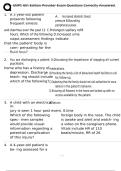
ENPC 6th Edition Provider Exam Questions Correctly Answered.
1. A 3 year-old patient
Increased diastolic blood
A.
presents following
pressure B.Bounding
frequent emesis
peripheral pulses
and diarrhea over the past 12 C.Prolonged capillary refill
hours. Which of the following D.Increased urine
output assessment findings indicate
that the patient' body is
com- pensating for the
fluid loss?
2. You are discharging a patient A.Discussing the importance of stopping all current
psychiatric
home who has a history of medications.
depression. Discharge B.Providing the family a list of behavioral health facilities to call
teach- ing should include for follow-up.
which of the following? C.Explaining that the family should not call authorities for esca-
lations in the patient's behavior.
D.Ensuring all firearms in the home are locked up with no
access available by the patient.
3. A child with an electrical
A.Serum
in-
jury is seen 1 hour post event. B.Urine
Which of the following foreign body in the nose. The child
spec- imen samples is awake and alert and watch- ing
would provide visual a video on the caregivers phone.
information regarding a Vitals include HR of 110
potential complication beats/minute, RR of 26
of this injury?
4. A 4-year-old patient is
be- ing assessed for a
, ENPC 6th Edition Provider Exam Questions Correctly Answered.
C
.
S
t
o
o
l
D
.S
p
u
t
u
m
A.Check the size of the blood pressure cutt
B.Recheck the temperature rectally
C.Recheck the blood pressure on the other
arm
D.Place the patient on cardiac and
respiratory monitors
, ENPC 6th Edition Provider Exam Questions Correctly Answered.
breaths per minute, BP of this patient?
138/90 mm Hg, and T of
37.3oC (99.3oF) orally. 7. A caregiver reports their
Which of the following
interventions should the
nurse perform next?
5. A 10-year-old playing
base- ball is hit in the
chest with a ball. He
immediately demon-
strates loss of
consciousness with no
pulses. Which of the
following is the priority
inter- vention?
6. The triage nurse is
assess- ing a 14 year
old male who was
brought in by ambu-
lance. The patient reports
he was playing his video
games at home when he
had a sud- den onset of
groin pain that was so
severe he became
nauseated and vomited.
Fur- ther assessment
reveals a swollen
scrotum. What is the
priority intervention for
, ENPC 6th Edition Provider Exam Questions Correctly Answered.
A.Obtaining a sterile urine
sample B.Initiating intravenous
access C.Preparing the patient for
ultrasound D.Scanning the
patient's bladder
A. Utilize AED/defibrillator
B. Prepare for
needle
decompression
C.Administer
intravenous
epinephrine
D.Intubate with
endotracheal tube
Integumentary
A.
one-month-old has had a yel- B.Renal
lowish color to their eyes and
1. A 3 year-old patient
Increased diastolic blood
A.
presents following
pressure B.Bounding
frequent emesis
peripheral pulses
and diarrhea over the past 12 C.Prolonged capillary refill
hours. Which of the following D.Increased urine
output assessment findings indicate
that the patient' body is
com- pensating for the
fluid loss?
2. You are discharging a patient A.Discussing the importance of stopping all current
psychiatric
home who has a history of medications.
depression. Discharge B.Providing the family a list of behavioral health facilities to call
teach- ing should include for follow-up.
which of the following? C.Explaining that the family should not call authorities for esca-
lations in the patient's behavior.
D.Ensuring all firearms in the home are locked up with no
access available by the patient.
3. A child with an electrical
A.Serum
in-
jury is seen 1 hour post event. B.Urine
Which of the following foreign body in the nose. The child
spec- imen samples is awake and alert and watch- ing
would provide visual a video on the caregivers phone.
information regarding a Vitals include HR of 110
potential complication beats/minute, RR of 26
of this injury?
4. A 4-year-old patient is
be- ing assessed for a
, ENPC 6th Edition Provider Exam Questions Correctly Answered.
C
.
S
t
o
o
l
D
.S
p
u
t
u
m
A.Check the size of the blood pressure cutt
B.Recheck the temperature rectally
C.Recheck the blood pressure on the other
arm
D.Place the patient on cardiac and
respiratory monitors
, ENPC 6th Edition Provider Exam Questions Correctly Answered.
breaths per minute, BP of this patient?
138/90 mm Hg, and T of
37.3oC (99.3oF) orally. 7. A caregiver reports their
Which of the following
interventions should the
nurse perform next?
5. A 10-year-old playing
base- ball is hit in the
chest with a ball. He
immediately demon-
strates loss of
consciousness with no
pulses. Which of the
following is the priority
inter- vention?
6. The triage nurse is
assess- ing a 14 year
old male who was
brought in by ambu-
lance. The patient reports
he was playing his video
games at home when he
had a sud- den onset of
groin pain that was so
severe he became
nauseated and vomited.
Fur- ther assessment
reveals a swollen
scrotum. What is the
priority intervention for
, ENPC 6th Edition Provider Exam Questions Correctly Answered.
A.Obtaining a sterile urine
sample B.Initiating intravenous
access C.Preparing the patient for
ultrasound D.Scanning the
patient's bladder
A. Utilize AED/defibrillator
B. Prepare for
needle
decompression
C.Administer
intravenous
epinephrine
D.Intubate with
endotracheal tube
Integumentary
A.
one-month-old has had a yel- B.Renal
lowish color to their eyes and