
BUL 4310 EXAM 1 PPT QUESTIONS & ANSWERS
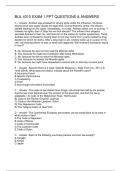
C - Answer -Andrew was arrested for driving while under the influence. His blood
alcohol level was nearly double the legal limit. During Andrew's arrest, the officers
started reading him his rights. Immediately, in a rage, Andrew yelled, sort of slurring, "I
knowse my rights, darn it! Stop this ver-bull aboose!" The officers then stopped,
escorted Andrew to their car, and took him to the station for further questioning. There,
Andrew soon confessed to having been on his way home from a party hosted by drug
dealers for whom he works. After a long night in jail, Andrew woke up in a panic in his
cell, not knowing where he was or what had happened. Will Andrew's confession stand
in court?
A. No, because he was not fully read his Miranda rights
B. Yes, because he made the confession after being Mirandized
C. No, because he did not waive his Miranda rights
D. Yes, because he waived his Miranda rights
E. No, because he might have requested to consult with an attorney at some point
E - Answer -Assume there is a case: Galactic Bargains v. State Farm Ins., 251 U.S.
1442 (2018). What does the citation indicate about the Plaintiff's claim?
A.Insurance Fraud
B.Specific Performance
C.Trespassing
D.Theft
E.Not enough information is provided
C - Answer -This code of law stated three things: rule should be held by the people,
that the law must depend upon the consent of the governed, and that the law is
adaptable.• A) Code of the Babylonian Ruler, Hammurabi
B) Code of the Roman Emperor Justinian
C) Code of the Athenian Lawgiver, Solon
D) The Napoleonic Code
E) The "Magna Carta" of New York
D - Answer -The Continental European law system can be traced back to its roots in
what source of law?
A.The Code of Napoleon
B.Code of Morse
C.Code of Hammurabi
D.The Justinian Code
E.Code of Solon
C - Answer -Each of the following countries practice common law except?
A.Canada
B.Kenya
C.Japan
, D.New Zealand
E.India
A - Answer -Judge JojoJones, a trial court judge, is presiding over a case and has
reached the point where she must make a decision. Previous cases very similar to this
one, in the same district, ruled in the plaintiff's favor, but Judge Jones wants to rule in
the defendant's favor. A common law system requires her to rule in the plaintiff's favor?
a. True, because of the doctrine of Stare Decisis
b. False, because ordinarily the law cannot bind her to older decisions
c. True, because under an adversarial approach the judge must follow precedent
d. False, inasmuch as an inquisitorial approach applies.
e. True, because she must avoid "legal games" (as that concept has been interpreted in
legal commentary)LSB 16
E - Answer -Josh turned sixteen. As a reward for his good behavior and grades, his
parents bought Josh a brand-new car. Josh is excited and goes driving. While driving,
he picks up his friend, Tori. After some time, Josh decides to go above the speed limit.
Suddenly, a deer jumps into the road and causes Josh to crash his car. He was
uninjured, but Tori ended up breaking her shoulder. Tori sues Josh in order to recover
medical expenses. Is Tori's case considered private or public law?
a.It is private because Tori's claim is covered by criminal law
b.It is public because the injury occurred on a public road.
c.It is private if they left the scene before police could file a statement.
d.It is public because the issue was not resolved outside of the courtroom.
e.It is private because Tori is the Plaintiff.
C - Answer -Peter is researching an article for his newspaper and stumbles across a
case titled Stark v. Rogers, 100 U.S. 623 (2016). Pick the most accurate description of
the case:
A. The case starts on page 100 of the United States Reports. The case was decided in
2016.
B. Stark was likely the appellee, Rogers was likely the appellant, and the opinion is in
the United States Reporter and starts on page 623.
C. Stark was likely the plaintiff, or the appellant, or both, and it was a case decided by
the U.S. Supreme Court
D. Rogers filed the case in New York, and the New York Supreme Court wrote the
opinion.
E. Stark was likely the plaintiff, Rogers was likely the defendant, and the case was
concluded in the 1st Judicial Circuit
D - Answer -The philosophical view of law is notdemonstrated in which of the following
situations?
A. Law is deciding to go to college at 18, become partner by 34, and retire by 65, all in
line with rules, enforcement, societal principles for behavior, and simple norms or
customs.
B. Law is adjusting your free will and desires to match with the universal rules.
C - Answer -Andrew was arrested for driving while under the influence. His blood
alcohol level was nearly double the legal limit. During Andrew's arrest, the officers
started reading him his rights. Immediately, in a rage, Andrew yelled, sort of slurring, "I
knowse my rights, darn it! Stop this ver-bull aboose!" The officers then stopped,
escorted Andrew to their car, and took him to the station for further questioning. There,
Andrew soon confessed to having been on his way home from a party hosted by drug
dealers for whom he works. After a long night in jail, Andrew woke up in a panic in his
cell, not knowing where he was or what had happened. Will Andrew's confession stand
in court?
A. No, because he was not fully read his Miranda rights
B. Yes, because he made the confession after being Mirandized
C. No, because he did not waive his Miranda rights
D. Yes, because he waived his Miranda rights
E. No, because he might have requested to consult with an attorney at some point
E - Answer -Assume there is a case: Galactic Bargains v. State Farm Ins., 251 U.S.
1442 (2018). What does the citation indicate about the Plaintiff's claim?
A.Insurance Fraud
B.Specific Performance
C.Trespassing
D.Theft
E.Not enough information is provided
C - Answer -This code of law stated three things: rule should be held by the people,
that the law must depend upon the consent of the governed, and that the law is
adaptable.• A) Code of the Babylonian Ruler, Hammurabi
B) Code of the Roman Emperor Justinian
C) Code of the Athenian Lawgiver, Solon
D) The Napoleonic Code
E) The "Magna Carta" of New York
D - Answer -The Continental European law system can be traced back to its roots in
what source of law?
A.The Code of Napoleon
B.Code of Morse
C.Code of Hammurabi
D.The Justinian Code
E.Code of Solon
C - Answer -Each of the following countries practice common law except?
A.Canada
B.Kenya
C.Japan
, D.New Zealand
E.India
A - Answer -Judge JojoJones, a trial court judge, is presiding over a case and has
reached the point where she must make a decision. Previous cases very similar to this
one, in the same district, ruled in the plaintiff's favor, but Judge Jones wants to rule in
the defendant's favor. A common law system requires her to rule in the plaintiff's favor?
a. True, because of the doctrine of Stare Decisis
b. False, because ordinarily the law cannot bind her to older decisions
c. True, because under an adversarial approach the judge must follow precedent
d. False, inasmuch as an inquisitorial approach applies.
e. True, because she must avoid "legal games" (as that concept has been interpreted in
legal commentary)LSB 16
E - Answer -Josh turned sixteen. As a reward for his good behavior and grades, his
parents bought Josh a brand-new car. Josh is excited and goes driving. While driving,
he picks up his friend, Tori. After some time, Josh decides to go above the speed limit.
Suddenly, a deer jumps into the road and causes Josh to crash his car. He was
uninjured, but Tori ended up breaking her shoulder. Tori sues Josh in order to recover
medical expenses. Is Tori's case considered private or public law?
a.It is private because Tori's claim is covered by criminal law
b.It is public because the injury occurred on a public road.
c.It is private if they left the scene before police could file a statement.
d.It is public because the issue was not resolved outside of the courtroom.
e.It is private because Tori is the Plaintiff.
C - Answer -Peter is researching an article for his newspaper and stumbles across a
case titled Stark v. Rogers, 100 U.S. 623 (2016). Pick the most accurate description of
the case:
A. The case starts on page 100 of the United States Reports. The case was decided in
2016.
B. Stark was likely the appellee, Rogers was likely the appellant, and the opinion is in
the United States Reporter and starts on page 623.
C. Stark was likely the plaintiff, or the appellant, or both, and it was a case decided by
the U.S. Supreme Court
D. Rogers filed the case in New York, and the New York Supreme Court wrote the
opinion.
E. Stark was likely the plaintiff, Rogers was likely the defendant, and the case was
concluded in the 1st Judicial Circuit
D - Answer -The philosophical view of law is notdemonstrated in which of the following
situations?
A. Law is deciding to go to college at 18, become partner by 34, and retire by 65, all in
line with rules, enforcement, societal principles for behavior, and simple norms or
customs.
B. Law is adjusting your free will and desires to match with the universal rules.


