

PART 2
Type 1 and type 2 errors
Rejecting the null hypothesis when it is correct. → type 1 error, α: ‘false positive’
Not rejecting the null hypothesis when it actually is false→ type 2 error, β: ‘false negative’
PART 4
NHST of counts in categories
Χ2 test of independence
Χ2 goodness-of-fit test (in tackling data)
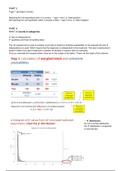
The chi squared test is used to analyse count data is based on bivariate probabilities.In the example the test of
independence is used. Which means that the diagnosis is independent to the treatment. This test is testing that it
doesn’t matter if you get a treatment or placebo to develop a reaction (sick for example).
First you calculate the marginal totals. (they are in the margin of the table) These are the totals of the columns.
← X2 distribution.
So not a normal distribution,
the X2 distribution is supposed
to look like this.
Type 1 and type 2 errors
Rejecting the null hypothesis when it is correct. → type 1 error, α: ‘false positive’
Not rejecting the null hypothesis when it actually is false→ type 2 error, β: ‘false negative’
PART 4
NHST of counts in categories
Χ2 test of independence
Χ2 goodness-of-fit test (in tackling data)
The chi squared test is used to analyse count data is based on bivariate probabilities.In the example the test of
independence is used. Which means that the diagnosis is independent to the treatment. This test is testing that it
doesn’t matter if you get a treatment or placebo to develop a reaction (sick for example).
First you calculate the marginal totals. (they are in the margin of the table) These are the totals of the columns.
← X2 distribution.
So not a normal distribution,
the X2 distribution is supposed
to look like this.


