
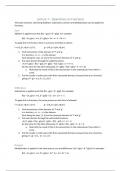
Lecture 7 – Operations on Functions
The basic functions, that being Addition, Subtraction, Division and Multiplication can be applied to
functions.
Sum
Addition is applied such that f(x) + g(x) = (f + g)(x). For example:
f(x) = 2x, g(x) = x+1, (f + g)(x) = 2x + x + 1 = 3x + 1
To apply this to functions, there is a process to follow as shown:
f = {<1,2>,<2,4>,<3,7>} g = {<0,2>,<1,4>,<2,6>}
1. Find intersection of the domains of ‘f’ and ‘g’.
In a function, <a, b> - a is the domain.
Such being the case, {1, 2} are the common domains of ‘f’ and ‘g’.
2. Put each domain through the added functions.
As (f + g)(x) = f(x) + g(x), (f + g)(1) = f(1) + g(1) = 2 + 4 = 6.
Do the same for the other domain(s), (f + g)(2) = f(2) + g(2) = 4 + 6 = 10
a. Note that the result of f(n) is the second item in the ordered pair from which n
came.
3. Put the results in order pairs with their associated domains, because they are a function,
giving: (f + g) = {<1, 6>, <2, 10>}
Difference
Subtraction is applied such that f(x) - g(x) = (f - g)(x). For example:
f(x) = 2x, g(x) = x+1, (f - g)(x) = 2x - (x + 1) = x - 1
To apply this to functions, the same process as with Sum is followed:
f = {<1,2>,<2,4>,<3,7>} g = {<0,2>,<1,4>,<2,6>}
1. Find intersection of the domains of ‘f’ and ‘g’.
In a function, <a, b> - a is the domain.
Such being the case, {1, 2} are the common domains of ‘f’ and ‘g’.
2. Put each domain through the subtracted functions.
As (f - g)(x) = f(x) - g(x), (f - g)(1) = f(1) - g(1) = 2 - 4 = -2.
Do the same for the other domain(s), (f - g)(2) = f(2) - g(2) = 4 - 6 = -2.
a. Note that the result of f(n) is the second item in the ordered pair from which n
came.
3. Put the results in order pairs with their associated domains, because they are a function,
giving: (f - g) = {<1, -2>, <2, -2>}
Product
Multiplication is applied in the same way as sum and difference. f(x) * g(x) = (f * g)(x). For example:
f(x) = 2x, g(x) = x+1, (f + g)(x) = 2x * (x + 1) = 2x2 + 2x


