Biology 102 Chapter 1 - The Nature of Science
Science!
from Latin scientia: “to know”
"The body of knowledge we have about the natural world
and
The process for acquiring that knowledge"
• Deals with the natural world, which can be detected, observed, and measured.
• Based on evidence that can be demonstrated through observations and/or experiments.
• Subject to independent validation and peer review.
• Open to challenge by anyone at any time based on evidence.
• A self-correcting enterprise.
BIOLOGY
The science of life
What is life?
All living things have the following characteristics:
1. Composed of cells
2. Can reproduce/use DNA
3. Use energy/have a metabolism
4. Interact with their environment
5. Maintain a constant internal environment (homeostasis)
6. Populations evolve
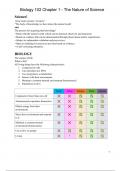
Rock Virus Fungus Plant Animal
Composed of more than one cell ❌ ❌ ✅ ✅ ✅
Autonomously reproduce themselves ❌ ❌ ✅ ✅ ✅
Obtain energy from their ❌ ❌ ✅ ✅ ✅
environment.
Since their environment and respond ❌ ❌ ✅ ✅ ✅
to it.
Maintain a constant internal ❌ ❌ ✅ ✅ ✅
environment (homeostasis)
Can evolve as groups ❌ ✅ ✅ ✅ ✅
Living ❌ ? ✅ ✅ ✅
1
, Biology 102 Chapter 1 - The Nature of Science
The Biological Hierarchy
1. The biological hierarchy begins with atoms, which are the building blocks of all matter.
2. Two or more atoms held together by strong chemical bonds become a molecule.
3. Molecules make up the cell, the basic unit of life, and some organisms, such as bacteria,
consist of only a single cell.
4. Multicellular organisms form tissues. A tissue is a group of cells that performs a unique
set of tasks in the body.
5. Plants and animals also have organs, which are body parts composed of different types
of tissues functioning in a coordinated manner.
6. In animals, groups of organs are networked into organ systems, which perform a wide
range of functions.
7. In an individual organism, all components work as a well-knit whole.
8. Each organism is a member of a population, a group of individuals of the same species
living and interacting in a shared environment.
9. Populations of different species that live and interact with one another in a particular
place are a biological community.
10.A particular physical environment and all its communities together make up an
ecosystem.
11.Biomes are large regions of the world defined by shared physical characteristics,
especially climate, and a distinctive community of organisms.
12.All biomes are part of one biosphere, all the world's living organisms and the places
where they live.
Back to science...
Our knowledge of the natural world continually progresses through
application of the scientific method.
1. Observation: After moving to a beach house, a couple notices that they don’t have to
mow their lawn as often as they did at their previous home.
2. Question: What is it that causes their grass to grow more slowly?
3. Hypothesis: Salt from the ocean inhibits the growth of grass.
4. Make the Prediction: Watering grass with salt water will cause it to grow more slowly.
5. Test the Prediction: This prediction can be tested in an experiment.
- Experimentation or repeated observation
6. Analysis of data
7. Draw conclusions
2
Science!
from Latin scientia: “to know”
"The body of knowledge we have about the natural world
and
The process for acquiring that knowledge"
• Deals with the natural world, which can be detected, observed, and measured.
• Based on evidence that can be demonstrated through observations and/or experiments.
• Subject to independent validation and peer review.
• Open to challenge by anyone at any time based on evidence.
• A self-correcting enterprise.
BIOLOGY
The science of life
What is life?
All living things have the following characteristics:
1. Composed of cells
2. Can reproduce/use DNA
3. Use energy/have a metabolism
4. Interact with their environment
5. Maintain a constant internal environment (homeostasis)
6. Populations evolve
Rock Virus Fungus Plant Animal
Composed of more than one cell ❌ ❌ ✅ ✅ ✅
Autonomously reproduce themselves ❌ ❌ ✅ ✅ ✅
Obtain energy from their ❌ ❌ ✅ ✅ ✅
environment.
Since their environment and respond ❌ ❌ ✅ ✅ ✅
to it.
Maintain a constant internal ❌ ❌ ✅ ✅ ✅
environment (homeostasis)
Can evolve as groups ❌ ✅ ✅ ✅ ✅
Living ❌ ? ✅ ✅ ✅
1
, Biology 102 Chapter 1 - The Nature of Science
The Biological Hierarchy
1. The biological hierarchy begins with atoms, which are the building blocks of all matter.
2. Two or more atoms held together by strong chemical bonds become a molecule.
3. Molecules make up the cell, the basic unit of life, and some organisms, such as bacteria,
consist of only a single cell.
4. Multicellular organisms form tissues. A tissue is a group of cells that performs a unique
set of tasks in the body.
5. Plants and animals also have organs, which are body parts composed of different types
of tissues functioning in a coordinated manner.
6. In animals, groups of organs are networked into organ systems, which perform a wide
range of functions.
7. In an individual organism, all components work as a well-knit whole.
8. Each organism is a member of a population, a group of individuals of the same species
living and interacting in a shared environment.
9. Populations of different species that live and interact with one another in a particular
place are a biological community.
10.A particular physical environment and all its communities together make up an
ecosystem.
11.Biomes are large regions of the world defined by shared physical characteristics,
especially climate, and a distinctive community of organisms.
12.All biomes are part of one biosphere, all the world's living organisms and the places
where they live.
Back to science...
Our knowledge of the natural world continually progresses through
application of the scientific method.
1. Observation: After moving to a beach house, a couple notices that they don’t have to
mow their lawn as often as they did at their previous home.
2. Question: What is it that causes their grass to grow more slowly?
3. Hypothesis: Salt from the ocean inhibits the growth of grass.
4. Make the Prediction: Watering grass with salt water will cause it to grow more slowly.
5. Test the Prediction: This prediction can be tested in an experiment.
- Experimentation or repeated observation
6. Analysis of data
7. Draw conclusions
2