
ABMDI Scientific Knowledge
Study online at https://quizlet.com/_hbbfi4
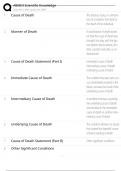
1. Cause of Death The disease, injury, or combina-
tion of conditions that leads to
the death of the individual
2. Manner of Death A classification of death based
on how the cause of death was
brought into play, with the typ-
ical options being natural, acci-
dent, suicide, homicide, or un-
determined
3. Cause of Death Statement (Part I) Immediate cause of death
Intermediary cause of death
Underlying cause of death
4. Immediate Cause of Death The condition that was last to oc-
cur, immediately resulted in the
death, and was the result of the
underlying cause of death
5. Intermediary Cause of Death A condition that was caused by
the underlying cause of death
and resulted in the immediate
cause of death or another inter-
mediary cause of death
6. Underlying Cause of Death The condition (disease or injury)
that started the downhill course
of events leading to death
7. Cause of Death Statement (Part II) Other significant conditions
8. Other Significant Conditions
, ABMDI Scientific Knowledge
Study online at https://quizlet.com/_hbbfi4
Usually consist of co-existing
co-morbid conditions or addi-
tional complications of the un-
derlying cause of death, which
were less important than those
listed in Part I
9. Terminal Events Final common pathways of death
and include such things as car-
diopulmonary arrest, asystole,
ventricular fibrillation, respirato-
ry arrest, and electromechani-
cal dissociation (typically, these
should not be listed on a death
certificate because they are so
common and non-specific)
10. Nonspecific Anatomic Processes (NAP's) Consist of anatomic findings and
include such things as pneumo-
nia and cirrhosis, each of which
has multiple underlying causes,
and which may be reported on
the death certificate using specif-
ic guidelines
11. Nonspecific Physiologic Derangements (NPD's) Nonanatomical findings and in-
clude such things as hyper-
kalemia and hypoglycemia, each
of which has multiple possible
underlying causes, and which
may be reported on the death
, ABMDI Scientific Knowledge
Study online at https://quizlet.com/_hbbfi4
certificate using specific guide-
lines
12. An individual had insulin dependent diabetes Part I:
mellitus. He recently obtained cerebral artery ar- a. Systemic sepsis
teriosclerosis which caused him to be in a bedrid- b. Due to: Infected decubitus ul-
den state from a previous stroke. Because he was cers
bedridden, he obtained infected decubitus ulcers c. Due to: Bedridden state from
that caused him to obtain systemic sepsis and previous stroke
died. How should the death certificate be written? d. Due to: Cerebral artery arte-
riosclerosis
Part II:
OSC: Insulin dependent diabetes
mellitus
13. An individual was a chronic alcoholic who ob- Part I:
tained cirrhosis of the liver. He then had rup- a. Ruptured esophageal varices
tured esophageal varices and died. How should b. Due to: Cirrhosis of the liver
the death certificate be written? c. Due to: Chronic alcoholism
d. Due to:
Part II:
OSC:
14. An individual obtained metastatic carcinoma of Part I:
the prostate and died. How should the death cer- a. Metastatic carcinoma of
tificate be written? prostate
b. Due to:
c. Due to:
d: Due to:
Part II:
OSC:
15.
Study online at https://quizlet.com/_hbbfi4
1. Cause of Death The disease, injury, or combina-
tion of conditions that leads to
the death of the individual
2. Manner of Death A classification of death based
on how the cause of death was
brought into play, with the typ-
ical options being natural, acci-
dent, suicide, homicide, or un-
determined
3. Cause of Death Statement (Part I) Immediate cause of death
Intermediary cause of death
Underlying cause of death
4. Immediate Cause of Death The condition that was last to oc-
cur, immediately resulted in the
death, and was the result of the
underlying cause of death
5. Intermediary Cause of Death A condition that was caused by
the underlying cause of death
and resulted in the immediate
cause of death or another inter-
mediary cause of death
6. Underlying Cause of Death The condition (disease or injury)
that started the downhill course
of events leading to death
7. Cause of Death Statement (Part II) Other significant conditions
8. Other Significant Conditions
, ABMDI Scientific Knowledge
Study online at https://quizlet.com/_hbbfi4
Usually consist of co-existing
co-morbid conditions or addi-
tional complications of the un-
derlying cause of death, which
were less important than those
listed in Part I
9. Terminal Events Final common pathways of death
and include such things as car-
diopulmonary arrest, asystole,
ventricular fibrillation, respirato-
ry arrest, and electromechani-
cal dissociation (typically, these
should not be listed on a death
certificate because they are so
common and non-specific)
10. Nonspecific Anatomic Processes (NAP's) Consist of anatomic findings and
include such things as pneumo-
nia and cirrhosis, each of which
has multiple underlying causes,
and which may be reported on
the death certificate using specif-
ic guidelines
11. Nonspecific Physiologic Derangements (NPD's) Nonanatomical findings and in-
clude such things as hyper-
kalemia and hypoglycemia, each
of which has multiple possible
underlying causes, and which
may be reported on the death
, ABMDI Scientific Knowledge
Study online at https://quizlet.com/_hbbfi4
certificate using specific guide-
lines
12. An individual had insulin dependent diabetes Part I:
mellitus. He recently obtained cerebral artery ar- a. Systemic sepsis
teriosclerosis which caused him to be in a bedrid- b. Due to: Infected decubitus ul-
den state from a previous stroke. Because he was cers
bedridden, he obtained infected decubitus ulcers c. Due to: Bedridden state from
that caused him to obtain systemic sepsis and previous stroke
died. How should the death certificate be written? d. Due to: Cerebral artery arte-
riosclerosis
Part II:
OSC: Insulin dependent diabetes
mellitus
13. An individual was a chronic alcoholic who ob- Part I:
tained cirrhosis of the liver. He then had rup- a. Ruptured esophageal varices
tured esophageal varices and died. How should b. Due to: Cirrhosis of the liver
the death certificate be written? c. Due to: Chronic alcoholism
d. Due to:
Part II:
OSC:
14. An individual obtained metastatic carcinoma of Part I:
the prostate and died. How should the death cer- a. Metastatic carcinoma of
tificate be written? prostate
b. Due to:
c. Due to:
d: Due to:
Part II:
OSC:
15.


