

NUR 214 Final Exam Review Topics and Key Concepts
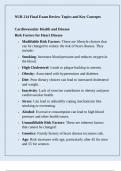
Cardiovascular Health and Disease
Risk Factors for Heart Disease
Modifiable Risk Factors: These are lifestyle choices that
can be changed to reduce the risk of heart disease. They
include:
Smoking: Increases blood pressure and reduces oxygen in
the blood.
High Cholesterol: Leads to plaque buildup in arteries.
Obesity: Associated with hypertension and diabetes.
Diet: Poor dietary choices can lead to increased cholesterol
and weight.
Inactivity: Lack of exercise contributes to obesity and poor
cardiovascular health.
Stress: Can lead to unhealthy coping mechanisms like
smoking or overeating.
Alcohol: Excessive consumption can lead to high blood
pressure and other health issues.
Unmodifiable Risk Factors: These are inherent factors
that cannot be changed:
Genetics: Family history of heart disease increases risk.
Age: Risk increases with age, particularly after 45 for men
and 55 for women.
, Gender: Men are at higher risk at a younger age compared
to women.
Race: Certain ethnic groups have higher risks of heart
disease.
Personal Health History: Previous heart issues increase
future risk.
DVT Prevention and Management
DVT Prevention Strategies Post-Op:
Elevation of the Foot of the Bed: Promotes venous return
by reducing pressure on veins.
Early Ambulation: Encourages blood flow; passive range
of motion (ROM) exercises if ambulation is not possible.
Compression Hose/SCDs: Help prevent blood pooling in
the legs.
Prophylactic Anticoagulation Therapy: Medications like
heparin to prevent clot formation.
Signs and Symptoms of DVT:
Calf or Groin Pain: Tenderness in the affected area.
Sudden Onset of Edema: Swelling in the extremity.
Warmth and Induration: Affected area may feel warm
and hard.
Changes in Circumference: Measuring calf and thigh can
indicate swelling.
Pulmonary Embolus (PE) Diagnostics and Treatment
, Diagnostic Testing for PE:
CT Pulmonary Angiogram (CTPA): Gold standard for
diagnosing PE.
VQ Scan: Assesses ventilation and perfusion in the lungs.
ECG and Cardiac Tests: Evaluate heart function.
Biomarkers: D-dimer, troponin, and BNP levels can
indicate heart strain or damage.
Medications for PE:
Low Molecular Weight Heparin (e.g., Lovenox): Used
for initial treatment.
tPa: Thrombolytic therapy at the site of the thrombus.
Warfarin: Long-term anticoagulation; Vitamin K is the
antidote.
Heparin Antidote: Protamine sulfate is used to reverse
heparin effects.
Hypertension Management
General Management of Hypertension
Lifestyle Modifications:
Maintain BMI <25: Weight reduction is crucial for
lowering blood pressure.
Limit Caffeine and Alcohol: Both can raise blood
pressure.
Stop Smoking: Reduces cardiovascular risk.
Cardiovascular Health and Disease
Risk Factors for Heart Disease
Modifiable Risk Factors: These are lifestyle choices that
can be changed to reduce the risk of heart disease. They
include:
Smoking: Increases blood pressure and reduces oxygen in
the blood.
High Cholesterol: Leads to plaque buildup in arteries.
Obesity: Associated with hypertension and diabetes.
Diet: Poor dietary choices can lead to increased cholesterol
and weight.
Inactivity: Lack of exercise contributes to obesity and poor
cardiovascular health.
Stress: Can lead to unhealthy coping mechanisms like
smoking or overeating.
Alcohol: Excessive consumption can lead to high blood
pressure and other health issues.
Unmodifiable Risk Factors: These are inherent factors
that cannot be changed:
Genetics: Family history of heart disease increases risk.
Age: Risk increases with age, particularly after 45 for men
and 55 for women.
, Gender: Men are at higher risk at a younger age compared
to women.
Race: Certain ethnic groups have higher risks of heart
disease.
Personal Health History: Previous heart issues increase
future risk.
DVT Prevention and Management
DVT Prevention Strategies Post-Op:
Elevation of the Foot of the Bed: Promotes venous return
by reducing pressure on veins.
Early Ambulation: Encourages blood flow; passive range
of motion (ROM) exercises if ambulation is not possible.
Compression Hose/SCDs: Help prevent blood pooling in
the legs.
Prophylactic Anticoagulation Therapy: Medications like
heparin to prevent clot formation.
Signs and Symptoms of DVT:
Calf or Groin Pain: Tenderness in the affected area.
Sudden Onset of Edema: Swelling in the extremity.
Warmth and Induration: Affected area may feel warm
and hard.
Changes in Circumference: Measuring calf and thigh can
indicate swelling.
Pulmonary Embolus (PE) Diagnostics and Treatment
, Diagnostic Testing for PE:
CT Pulmonary Angiogram (CTPA): Gold standard for
diagnosing PE.
VQ Scan: Assesses ventilation and perfusion in the lungs.
ECG and Cardiac Tests: Evaluate heart function.
Biomarkers: D-dimer, troponin, and BNP levels can
indicate heart strain or damage.
Medications for PE:
Low Molecular Weight Heparin (e.g., Lovenox): Used
for initial treatment.
tPa: Thrombolytic therapy at the site of the thrombus.
Warfarin: Long-term anticoagulation; Vitamin K is the
antidote.
Heparin Antidote: Protamine sulfate is used to reverse
heparin effects.
Hypertension Management
General Management of Hypertension
Lifestyle Modifications:
Maintain BMI <25: Weight reduction is crucial for
lowering blood pressure.
Limit Caffeine and Alcohol: Both can raise blood
pressure.
Stop Smoking: Reduces cardiovascular risk.


