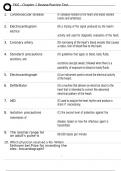
EKG - Chapter 1 Review Practice Test.
1. Cardiovascular disease (F) disease related to the heart and blood vessels
(veins and arteries).
2. Electrocardiogram (B) a tracing of the signal produced by the heart's
electrical
activity and used for diagnostic evaluation of the heart.
3. Coronary artery (D) narrowing of the heart's blood vessels that causes
a reduc- tion of blood flow to the heart.
4. Standard precautions (H) guidelines that apply to blood, body fluids,
secretions, and
excretions (except sweat); followed when there is a
possibility of exposure to blood or body fluids.
5. Electrocardiograph (A) an instrument used to record the electrical activity
of the heart.
6. Defibrillator (G) a machine that delivers an electrical shock to the
heart that is intended to correct the abnormal
electrical pattern of the heart.
7. AED (E) used to analyze the heart rhythm and produce a
shock if necessary.
8. Isolation precautions (C) the second level of protection against the
transmission of
disease; based on how the infectious agent is
transmitted.
9. The normal range for
an adult's pulse is 60-100 beats per minute
10. Which physician received a No- Willem
Einthoven bel Prize for inventing the
elec- trocardiograph?
1/
3
1. Cardiovascular disease (F) disease related to the heart and blood vessels
(veins and arteries).
2. Electrocardiogram (B) a tracing of the signal produced by the heart's
electrical
activity and used for diagnostic evaluation of the heart.
3. Coronary artery (D) narrowing of the heart's blood vessels that causes
a reduc- tion of blood flow to the heart.
4. Standard precautions (H) guidelines that apply to blood, body fluids,
secretions, and
excretions (except sweat); followed when there is a
possibility of exposure to blood or body fluids.
5. Electrocardiograph (A) an instrument used to record the electrical activity
of the heart.
6. Defibrillator (G) a machine that delivers an electrical shock to the
heart that is intended to correct the abnormal
electrical pattern of the heart.
7. AED (E) used to analyze the heart rhythm and produce a
shock if necessary.
8. Isolation precautions (C) the second level of protection against the
transmission of
disease; based on how the infectious agent is
transmitted.
9. The normal range for
an adult's pulse is 60-100 beats per minute
10. Which physician received a No- Willem
Einthoven bel Prize for inventing the
elec- trocardiograph?
1/
3