CEE 125 Final Exam Questions & Answers.
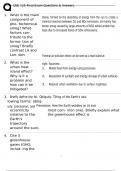
1. What is the main
Ozone, formed by the absorbing of energy from the sun to create a
component of
chemical reaction between O2 and NOx emissions. LA mainly has
pho- tochemical
brown smog caused by large amounts of NO2 while London has
smog? What
haze due to increased levels of SOx emissions.
factors con-
tribute to the
forma- tion of
smog? Briefly
contrast LA and
Lon- don. Thermal air pollution ettect can be seen as a heat island at
2. What is the night Sources:
urban heat 1. Waste heat from energy-using processes
island effect?
Why is it a 2. Absorption of sunlight and energy storage of urban surfaces
problem and
how can it be 3. Reduced urban ventilation due to surface roughness
mitigated?
3. Briefly define the fol- Obliquity: Tilting of the Earth's axis.
lowing terms: obliq-
uity, precession, and Precession: How the Earth wobbles on its axis
eccentricity most com- mon one). Briefly explain what
(relative to the the greenhouse effect is
Earth's
trajectory
around the sun).
4. Cite 3
greenhouse
gases (GHG;
includ- ing the
1/
19
, CEE 125 Final Exam Questions & Answers.
Eccentricity: How the Earth's orbit
(which is elliptical) around the sun
changes. Usually changing the
center of the ellipse.
Primary: CO2, water vapor, and
O3.
Allow incoming solar radiant
energy (short wavelengths) to
penetrate to the earth's surface
while re-absorbing infrared
radiation emanating from it.
2/
19
, CEE 125 Final Exam Questions & Answers.
in relation to the
cli- mate.
5. Define the Radiative forcing: net radiative energy available to the earth's
follow- ing:
radiative forc- atmosphere. Radiative Ettectiveness: Ability to absorb thermal energy
ing, radiative
effec- tiveness, relative to CO2.
and global
warming Global Warming Potential (GWP): depends upon the absorption
potential. spectrum of the gas and the emission spectrum of the earth.
Increases in global surface temperatures.
6. Cite four pieces
of evidence for Increases in average nighttime minimum temperatures.
global climate
change. Increase in ocean surface temperatures.
Sea level changes of 10 to 20 cm over the past century.
Global climate change can cause things such as draughts, which
would attect waterways and boat transportation. It can also cause
7. Briefly explain more frequent weather abnormalities which can hinder existing
how global transportation infrastructure.
climate change
can affect
transportation
sys- tems.
8. What are the criteria Criteria Air Pollutants: CO, Pb, NO2, O3, PM2.5 and PM10, SO2
air pollutants?
9. What are primary stan- dards in the Clean Air Act?
and secondary
3/
19
1. What is the main
Ozone, formed by the absorbing of energy from the sun to create a
component of
chemical reaction between O2 and NOx emissions. LA mainly has
pho- tochemical
brown smog caused by large amounts of NO2 while London has
smog? What
haze due to increased levels of SOx emissions.
factors con-
tribute to the
forma- tion of
smog? Briefly
contrast LA and
Lon- don. Thermal air pollution ettect can be seen as a heat island at
2. What is the night Sources:
urban heat 1. Waste heat from energy-using processes
island effect?
Why is it a 2. Absorption of sunlight and energy storage of urban surfaces
problem and
how can it be 3. Reduced urban ventilation due to surface roughness
mitigated?
3. Briefly define the fol- Obliquity: Tilting of the Earth's axis.
lowing terms: obliq-
uity, precession, and Precession: How the Earth wobbles on its axis
eccentricity most com- mon one). Briefly explain what
(relative to the the greenhouse effect is
Earth's
trajectory
around the sun).
4. Cite 3
greenhouse
gases (GHG;
includ- ing the
1/
19
, CEE 125 Final Exam Questions & Answers.
Eccentricity: How the Earth's orbit
(which is elliptical) around the sun
changes. Usually changing the
center of the ellipse.
Primary: CO2, water vapor, and
O3.
Allow incoming solar radiant
energy (short wavelengths) to
penetrate to the earth's surface
while re-absorbing infrared
radiation emanating from it.
2/
19
, CEE 125 Final Exam Questions & Answers.
in relation to the
cli- mate.
5. Define the Radiative forcing: net radiative energy available to the earth's
follow- ing:
radiative forc- atmosphere. Radiative Ettectiveness: Ability to absorb thermal energy
ing, radiative
effec- tiveness, relative to CO2.
and global
warming Global Warming Potential (GWP): depends upon the absorption
potential. spectrum of the gas and the emission spectrum of the earth.
Increases in global surface temperatures.
6. Cite four pieces
of evidence for Increases in average nighttime minimum temperatures.
global climate
change. Increase in ocean surface temperatures.
Sea level changes of 10 to 20 cm over the past century.
Global climate change can cause things such as draughts, which
would attect waterways and boat transportation. It can also cause
7. Briefly explain more frequent weather abnormalities which can hinder existing
how global transportation infrastructure.
climate change
can affect
transportation
sys- tems.
8. What are the criteria Criteria Air Pollutants: CO, Pb, NO2, O3, PM2.5 and PM10, SO2
air pollutants?
9. What are primary stan- dards in the Clean Air Act?
and secondary
3/
19