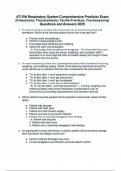
ATI RN Respiratory System Comprehensive Predictor Exam (Pneumonia, Thoracentesis, Tactile Fremitus, Tracheostomy) Questions and Answers 2025
ATI RN Respiratory System Comprehensive Predictor Exam (Pneumonia, Thoracentesis, Tactile Fremitus, Tracheostomy) Questions and Answers 2025 c. administer O2 as prescribed to maintain optimal O2 levels. d. teach the patient how to cough effectively and expectorate secretions - d. teach the patient how to cough effectively and expectorate secretions 5. While caring for a patient with respiratory disease, the nurse observes that the patient's SpO2 drops from 93% to 88% while the patient is ambulating in the hallway. What is the priority action of the nurse? a. Notify the health care provider. b. Document the response to exercise. c. Administer the PRN supplemental O2. d. Encourage the patient to pace activity. - c. Administer the PRN supplemental O2. 6. Following assessment of a patient with pneumonia, the nurse identifies a nursing diagnosis of ineffective airway clearance. Which assessment data best supports this diagnosis? a. Weak, nonproductive cough effort b. Large amounts of greenish sputum c. Respiratory rate of 28 breaths/minute d. Resting pulse oximetry (SpO2) of 85% - A. The weak, nonproductive cough indicates that the patient is unable to clear the airway effectively. The other data would be used to support diagnoses such as impaired gas exchange and ineffective breathing pattern. 7. The nurse assesses the chest of a patient with pneumococcal pneumonia. Which finding would the nurse expect? a. Increased tactile fremitus b. Dry, nonproductive cough c. Hyperresonance to percussion d. A grating sound on auscultation - A. Increased tactile fremitus over the area of pulmonary consolidation is expected with bacterial pneumonias. Dullness to percussion would be expected. Pneumococcal pneumonia typically presents with a loose, productive cough. Adventitious breath sounds such as crackles and wheezes are typical. A grating sound is more representative of a pleural friction rub rather than pneumonia. 8. A patient with bacterial pneumonia has rhonchi and thick sputum. What is the nurses most appropriate action to promote airway clearance? a. Assist the patient to splint the chest when coughing. b. Teach the patient about the need for fluid restrictions. c. Encourage the patient to wear the nasal oxygen cannula. d. Instruct the patient on the pursed lip breathing technique. - A. Coughing is less painful and more likely to be effective when the patient splints the chest during coughing. Fluids should be encouraged to help liquefy secretions. Nasal oxygen will improve gas exchange, but will not improve airway clearance. Pursed lip breathing is used to improve gas exchange in patients with COPD, but will not improve airway clearance. 9. The nurse provides discharge instructions to a patient who was hospitalized for pneumonia. Which statement, if made by the patient, indicates a good understanding of the instructions? a. I will call the doctor if I still feel tired after a week. b. I will continue to do the deep breathing and coughing exercises at home. c. I will schedule two appointments for the pneumonia and influenza vaccines. d. Ill cancel my chest x-ray appointment if I'm feeling better in a couple weeks. - B. Patients should continue to cough and deep breathe after discharge. Fatigue is expected for several weeks. The Pneumovax and influenza vaccines can be given at the same time in different arms. Explain that a follow-up chest x-ray needs to be done in 6 to 8 weeks to evaluate resolution of pneumonia. 10. A patient has just been admitted with probable bacterial pneumonia and sepsis. Which order should the nurse implement first? a. Chest x-ray via stretcher b. Blood cultures from two sites c. Ciprofloxacin (Cipro) 400 mg IV d. Acetaminophen (Tylenol) rectal suppository - B. Initiating antibiotic therapy rapidly is essential, but it is important that the cultures be obtained before antibiotic administration. The chest x-ray and acetaminophen administration can be done last.
Document information
- Uploaded on
- August 11, 2025
- Number of pages
- 21
- Written in
- 2025/2026
- Type
- Exam (elaborations)
- Contains
- Questions & answers