

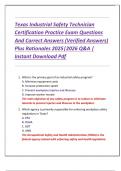
Texas Industrial Safety Technician
Certification Practice Exam Questions
And Correct Answers (Verified Answers)
Plus Rationales 2025|2026 Q&A |
Instant Download Pdf
1. What is the primary goal of an industrial safety program?
A. Minimize equipment costs
B. Increase production speed
C. Prevent workplace injuries and illnesses
D. Improve worker morale
The main objective of any safety program is to reduce or eliminate
hazards to prevent injuries and illnesses in the workplace.
2. Which agency is primarily responsible for enforcing workplace safety
regulations in Texas?
A. EPA
B. OSHA
C. DOT
D. ANSI
The Occupational Safety and Health Administration (OSHA) is the
federal agency tasked with enforcing safety and health legislation.
,3. A job safety analysis (JSA) should be conducted:
A. Only after an accident
B. Before starting a new job or task
C. Every five years
D. When the supervisor requests it
A JSA helps identify hazards before work begins, allowing for
appropriate controls to be implemented.
4. What is the first step in hazard control according to the hierarchy of
controls?
A. PPE
B. Substitution
C. Elimination
D. Administrative controls
Eliminating the hazard entirely is the most effective method of
control in the hierarchy.
5. Lockout/Tagout procedures are used to:
A. Reduce noise levels
B. Secure confidential documents
C. Prevent accidental energization of machinery
D. Ensure fire safety
LOTO procedures isolate energy sources to prevent machines from
being unintentionally started or energized during maintenance.
6. A confined space is considered permit-required when it has:
A. Poor lighting
B. A known hazard such as toxic atmosphere or engulfment risk
C. Multiple exits
D. Less than 1 meter of headspace
Permit-required confined spaces contain or have the potential to
contain a serious hazard such as toxic air or engulfment.
, 7. Which of the following is an example of an engineering control?
A. Installing machine guards
B. Posting warning signs
C. Rotating workers
D. Providing safety training
Engineering controls physically change the workplace to reduce or
eliminate exposure to hazards.
8. What color is typically used for caution signs according to OSHA?
A. Red
B. Yellow
C. Green
D. Blue
Yellow indicates caution and is used to alert workers to potential
physical hazards.
9. Personal protective equipment (PPE) should be used:
A. As a replacement for other controls
B. When workers prefer it
C. At all times
D. As a last line of defense
PPE is the least effective control method and should only be used
when other controls are not feasible or effective.
10. The flash point of a substance is:
A. The lowest temperature at which it can ignite in air
B. The temperature at which it freezes
C. The point it becomes nonflammable
D. Its boiling point
Flash point indicates how easily a chemical can ignite; it is crucial for
assessing fire risk.
Certification Practice Exam Questions
And Correct Answers (Verified Answers)
Plus Rationales 2025|2026 Q&A |
Instant Download Pdf
1. What is the primary goal of an industrial safety program?
A. Minimize equipment costs
B. Increase production speed
C. Prevent workplace injuries and illnesses
D. Improve worker morale
The main objective of any safety program is to reduce or eliminate
hazards to prevent injuries and illnesses in the workplace.
2. Which agency is primarily responsible for enforcing workplace safety
regulations in Texas?
A. EPA
B. OSHA
C. DOT
D. ANSI
The Occupational Safety and Health Administration (OSHA) is the
federal agency tasked with enforcing safety and health legislation.
,3. A job safety analysis (JSA) should be conducted:
A. Only after an accident
B. Before starting a new job or task
C. Every five years
D. When the supervisor requests it
A JSA helps identify hazards before work begins, allowing for
appropriate controls to be implemented.
4. What is the first step in hazard control according to the hierarchy of
controls?
A. PPE
B. Substitution
C. Elimination
D. Administrative controls
Eliminating the hazard entirely is the most effective method of
control in the hierarchy.
5. Lockout/Tagout procedures are used to:
A. Reduce noise levels
B. Secure confidential documents
C. Prevent accidental energization of machinery
D. Ensure fire safety
LOTO procedures isolate energy sources to prevent machines from
being unintentionally started or energized during maintenance.
6. A confined space is considered permit-required when it has:
A. Poor lighting
B. A known hazard such as toxic atmosphere or engulfment risk
C. Multiple exits
D. Less than 1 meter of headspace
Permit-required confined spaces contain or have the potential to
contain a serious hazard such as toxic air or engulfment.
, 7. Which of the following is an example of an engineering control?
A. Installing machine guards
B. Posting warning signs
C. Rotating workers
D. Providing safety training
Engineering controls physically change the workplace to reduce or
eliminate exposure to hazards.
8. What color is typically used for caution signs according to OSHA?
A. Red
B. Yellow
C. Green
D. Blue
Yellow indicates caution and is used to alert workers to potential
physical hazards.
9. Personal protective equipment (PPE) should be used:
A. As a replacement for other controls
B. When workers prefer it
C. At all times
D. As a last line of defense
PPE is the least effective control method and should only be used
when other controls are not feasible or effective.
10. The flash point of a substance is:
A. The lowest temperature at which it can ignite in air
B. The temperature at which it freezes
C. The point it becomes nonflammable
D. Its boiling point
Flash point indicates how easily a chemical can ignite; it is crucial for
assessing fire risk.


