
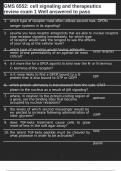
GMS 6552: cell signaling and therapeutics
review exam 1 Well answered to pass
1. which type of receptor most often utilizes second mes- GPCRs
senger systems in its signaling?
2. assume you have receptor antagonists that are able to nuclear receptors
stop receptor signaling immediately. for which type
of receptor would take the longest to see the effects
of your drug at the cellular level?
3. which type of receptor would having adequate
mem- brane permeability of an agonist be most nuclear receptors
critical?
4. is it more like for a GPCR agonist to bind near the N- or N terminus
C- terminus of the receptor?
5. is it more likely to find a GPCR bound to a G-
protein that is also bound to GTP or GDP? GDP
6. which protein ultimately is translocated from the cyto- STAT
plasm to the nucleus as a result of JAK signaling?
7. where, in relation to the protein-coding region of
a gene, are the binding sites that become upstream
occupied by nuclear receptors?
8. the levels of which second messenger would be
ex- pected to increase following administration of
nitro- glycerin? cGMP
9. does TGF-beta treatment cause cells to grow
more of less in the soft agar assay?
10. the latent TGF-beta peptide must be cleaved by more
what protease in order to be activated?
plasmin
1/
7
, GMS 6552: cell signaling and therapeutics
review exam 1 Well answered to pass
11. in the TGF-beta pathway, which protein becomes TGFBR2
acti- vated first upon binding of a ligand?
12. how many DNA binding domains do SMADs have? 1
13. different SMAD complexes bind different genes, which R-Smads
group of SMADs is responsible for this specifically?
14. would it likely be most beneficial (for the tumor)
for an early tumor to up or down regulate the down regulate
TGF-beta pathway?
15. would it likely be most beneficial (for the tumor)
for a large and well developed tumor to up or down
regulate the TGF-beta pathway? up-regulate
16. where are the g-proteins located in relation to
the cellular membrane?
17. which families of GPCRs contain disulfide bonds intracellularly
be- tween the first and second extracellular
loops? select all that apply.
Family
A
Family
B
Family
C
18. what protein leads to the hydrolysis of GTP and subse- Gap
quent inactivation of the Ga subunit?
19. which of the following may directly result from a spon- constitutive action
taneous conformation change in a GPCR?
20. where do GPCR agonists bind in relation to the cellular extracellularly
2/
7
review exam 1 Well answered to pass
1. which type of receptor most often utilizes second mes- GPCRs
senger systems in its signaling?
2. assume you have receptor antagonists that are able to nuclear receptors
stop receptor signaling immediately. for which type
of receptor would take the longest to see the effects
of your drug at the cellular level?
3. which type of receptor would having adequate
mem- brane permeability of an agonist be most nuclear receptors
critical?
4. is it more like for a GPCR agonist to bind near the N- or N terminus
C- terminus of the receptor?
5. is it more likely to find a GPCR bound to a G-
protein that is also bound to GTP or GDP? GDP
6. which protein ultimately is translocated from the cyto- STAT
plasm to the nucleus as a result of JAK signaling?
7. where, in relation to the protein-coding region of
a gene, are the binding sites that become upstream
occupied by nuclear receptors?
8. the levels of which second messenger would be
ex- pected to increase following administration of
nitro- glycerin? cGMP
9. does TGF-beta treatment cause cells to grow
more of less in the soft agar assay?
10. the latent TGF-beta peptide must be cleaved by more
what protease in order to be activated?
plasmin
1/
7
, GMS 6552: cell signaling and therapeutics
review exam 1 Well answered to pass
11. in the TGF-beta pathway, which protein becomes TGFBR2
acti- vated first upon binding of a ligand?
12. how many DNA binding domains do SMADs have? 1
13. different SMAD complexes bind different genes, which R-Smads
group of SMADs is responsible for this specifically?
14. would it likely be most beneficial (for the tumor)
for an early tumor to up or down regulate the down regulate
TGF-beta pathway?
15. would it likely be most beneficial (for the tumor)
for a large and well developed tumor to up or down
regulate the TGF-beta pathway? up-regulate
16. where are the g-proteins located in relation to
the cellular membrane?
17. which families of GPCRs contain disulfide bonds intracellularly
be- tween the first and second extracellular
loops? select all that apply.
Family
A
Family
B
Family
C
18. what protein leads to the hydrolysis of GTP and subse- Gap
quent inactivation of the Ga subunit?
19. which of the following may directly result from a spon- constitutive action
taneous conformation change in a GPCR?
20. where do GPCR agonists bind in relation to the cellular extracellularly
2/
7


