
National 5 Cell Biology Summary Notes
Cell Structure
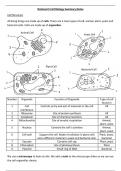
All living things are made up of cells. There are 4 main types of cell: animal, plant, yeast and
bacterial cells. Cells are made up of organelles.
Animal Cell
Yeast Cell
Plant Cell
Bacterial Cell
Number Organelle Function of Organelle Type of cell
found in
1 Cell Controls entry and exit of materials in the cell All
membrane
2 Ribosome Site of protein synthesis All
3 Cytoplasm Site of chemical reactions All
4 Mitochondria Site of aerobic respiration Animal,
plant, yeast
5 Nucleus Controls the cell’s activities Animal,
plant, yeast
6 Cell wall Support the cell. Made of cellulose in plant cells Plant, yeast,
and a different material in yeast and bacterial cells. bacterial
7 Vacuole Contains cell sap Plant, yeast
8 Chloroplast Site of photosynthesis Plant
9 Plasmid Small ring of DNA Bacterial
We use a microscope to look at cells. We add a stain to the microscope slides so we can see
the cell organelles clearly.
, phospholipid protein
Transport Across Cell Membranes
The cell membrane is made up of proteins and phospholipids.
Transport across the cell membrane can be passive. This is
where molecules move down a concentration gradient and no energy is required.
There are two types:
1) Diffusion - the movement of molecules down a concentration gradient from a higher to
a lower concentration. No energy is needed. It is important to allow cells to gain glucose
and oxygen for respiration and remove carbon dioxide into the blood.
2) Osmosis -the movement of water molecules from a higher water concentration to a
lower water concentration through a selectively permeable membrane. No energy is
needed.
Type of cell Type of solution Effect of solution on the cell
Animal High water/dilute Cell bursts
Low water/concentrated Cell shrinks
Plant High water/dilute Cell becomes turgid – cell swells and contents
push against the cell wall
Low water/concentrated Cell becomes plasmolysed – cell contents
shrink and pull away from the cell wall
Transport can also be active. Active transport requires energy for membrane proteins to
move molecules and ions against the concentration gradient.
DNA and the Production of Proteins
DNA carries the genetic information for making proteins and therefore determines your
characteristics eg. hair and eye colour. DNA is made up of genes. A gene codes for a
particular protein.
DNA is made up of 2 strands. The strands are twisted into a double helix shape. There are
four bases in DNA – adenine, thymine, guanine and cytosine.
The following are the base pairs of DNA:
• Adenine – thymine
• Guanine – cytosine
Proteins are made of amino acids. There are different types of amino acids. Different amino
acids will join together in different orders and make different proteins.


