
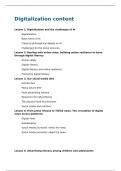
Digitalization content
Lesson 1: Digitalization and the challenges of AI
Digitalization
Basic forms of AI
Classical philosophical debate on AI
Challenges for the social sciences
Lesson 2: Dealing with online risks: building online resilience to harm
through digital literacy
Online safety
Digital literacy
Digital literacy and online resilience
Promoting digital literacy
Lesson 3: Our social media diet
Introduction
Policy advice SHV
Food advertising volume
Research into kidsvertising
The physical food environment
Social media and nutrition
Lesson 4: From press release to TikTok news: The circulation of digital
news across platforms
Digital news
Gatekeeping
Social media journalist: select the news
Social media journalist: adapt the news
Lesson 5: Advertising literacy among children and adolescents
, Children and advertising
Advertising literacy
Development of advertising literacy
Lesson 6: Photography in Crisis: Post-digital technological
developments in the field of visual culture
Recent developments in photography
Beginning of photography
Photography and human suffering
Digital camera’s & AI
Lesson 7: Social media literacy: Insights and implications for
adolescents mental health
Social media and adolescents’ well-being
Social media literacy
Empowerment
Development
Audience Heterogeneity
Lesson 8: From Audience to Partner: Design Lessons in Co-Creation and
Participation
Design
Design thinking
Co-creation
Example from practice: VRT innovation
Co-creation methods
Lesson 9: Digital Games & Gambling
Introduction
Games research
Games and gambling
Conclusion
,Lesson 1: Digitalization and the
challenges of AI
Stef Aupers
Digitalisation
Traditional media (tv, radio) ↔ digital media
Digitalization = spread of digital media and the effects on individuals
and society
Three waves of digitalization
1. Personal computer (1950s)
60s / 70s hackers, hippies (=ppl with knowledge, having fun using
computers) in Silicon Valley bringing computer power to the
people (democratic, liberty)
75: first pc (Apple)
75 – 85: development, mass production, commercialization
2. Internet and social media
web 1.0 (90s): interconnected PC’s (existed before: army,
libraries), websites
web 2.0 (00s): social media platforms (Facebook), User Generated
Content (UGC) democratic promise of internet (better than
politics)
time magazine (08) person of the year: “you”
Zuckerberg (CEO Facebook): “making the world more open and
connected”
from democratization to surveillance capitalism?
3. AI
John McCarthy (mathematician / scientist) & Marvin Minsky
Darthmouth Conference (55): making a machine similar to humans
AI
Basic forms of AI
Weak AI: imitates human cognitive functions, only one function
(playing chess)
↔ Strong AI: more functions (language, information, art, play chess)
Top Down AI: programmed instructions, no self-learning
↔ Bottem Up AI: self-learning, immerging, reflecting / incorporating
information: evolutionary
, Classical philosophical debate on AI
What is difference between human intelligence and computer intelligence?
When has a computer the same intelligence as humans? When is a
computer really intelligent?
Alan Turing: The Turing Test: Intelligence of AI: how can AI be
considered intelligent? how decided?
Person having conversation with human / machine?
after 8 minutes no idea which one is machine
machine = intelligent (able to talk, act like a humen)
↔ John Searle: Chinese Room Experiment: machines
are never intelligent: machines works because of the
instructions humans gives, it gives answers without knowing the meaning
in words
Following instructions to put Chinese characters in an order to give
an answer, don’t understand the characters impossible to be like
a human
Kevin Warwick: 3th position
Beyond human centric philosophical comparative analysis: not only
humans are intelligent, more than human intelligence = relativistic
perspective on intelligence
Challenges for the social sciences
Will it take over human functions in everyday life?
Outsourcing human labour to AI
Communicating with chatbots
Communication science:
Traditional view: humans communicate with humans through a
medium
AI challenge: humans communicate with the medium
Peter & Kühne:


